Book Scan
Men’s Full Body Ultrasound-Scan: Private Health Screening London | Sonoworld
Men’s Health Screening · Marylebone, London

Men’s Full Body Ultrasound-Scan

A single 60-minute appointment covering six organ systems — thyroid, carotid arteries, abdomen, urinary tract, abdominal aorta, and testes. Immediate verbal feedback and a same-day written report.

CQC Registered Good No GP Referral Needed Same-Day Report 6 Organ Systems Assessed

No referral needed. Fast preparation. Results the same day.

What Is the Scan

Men’s Full Body Ultrasound-Scan: A Complete Health Picture

The men’s full body ultrasound-scan at Sonoworld combines six individual ultrasound-scans into a single, structured 60-minute appointment. Rather than attending multiple clinics or waiting months for separate NHS referrals, you receive a comprehensive assessment of your major organ systems in one visit at our Marylebone clinic.

Ultrasound uses high-frequency sound waves to produce real-time images of soft tissue, organs, and blood vessels. The technique is radiation-free, non-invasive, and widely regarded as the first-line imaging modality for abdominal, vascular, and urological assessment. At Sonoworld, every scan is performed by a consultant sonographer with 15+ years of NHS and private practice experience.

The examination covers the thyroid gland and neck, carotid arteries, abdominal organs (liver, gallbladder, pancreas, spleen), urinary tract (kidneys, bladder, prostate), abdominal aorta, and testes. Each area is assessed systematically, with measurements documented and compared against established clinical reference ranges.

Six scans. One appointment. One report.

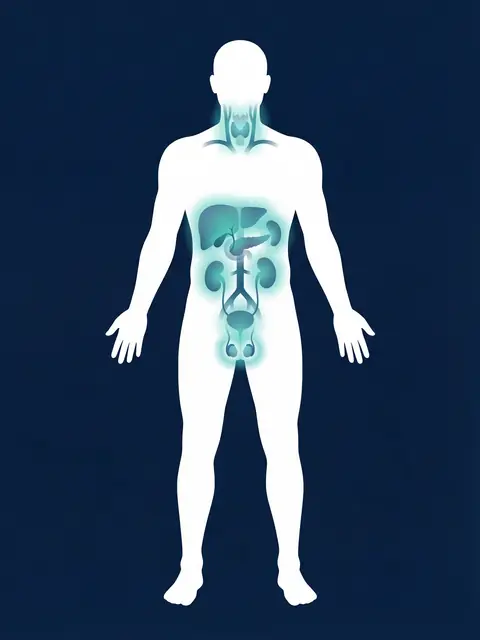
  • Thyroid & Neck
  • Carotid Duplex (carotid arteries & blood flow)
  • Abdomen (liver, gallbladder, pancreas, spleen)
  • Urinary Tract (kidneys, bladder, prostate)
  • Abdominal Aorta (aneurysm screening)
  • Testes
Male body diagram showing the six organ areas assessed in a full body ultrasound-scan

Six organ systems assessed in a single 60-minute appointment

Scan Components

What Each Scan Area Assesses

Each component of the full body screening follows the same clinical protocol used in NHS diagnostic imaging departments. The table below outlines what is assessed in each area and the conditions the sonographer is looking for.

Scan Area Structures Assessed Conditions Detected
Thyroid & Neck Thyroid lobes, isthmus, lymph nodes, parathyroid region Thyroid nodules, goitre, thyroiditis, lymphadenopathy, cysts
Carotid Duplex Common carotid arteries, internal and external carotid branches, vertebral arteries, intima-media thickness Atherosclerotic plaque, carotid stenosis, increased IMT (stroke risk marker)
Liver Liver parenchyma, lobes, hepatic veins, portal vein, bile ducts Fatty liver disease (NAFLD), cirrhosis, hepatic cysts, haemangiomas, focal lesions
Gallbladder & Bile Ducts Gallbladder wall, lumen, common bile duct diameter Gallstones, polyps, cholecystitis, biliary dilatation
Pancreas Pancreatic head, body, tail, pancreatic duct Pancreatic cysts, duct dilatation, focal lesions, pancreatitis changes
Spleen Splenic parenchyma, size, vascularity Splenomegaly, splenic cysts, accessory spleen
Kidneys Renal cortex, medulla, collecting system, renal vascularity Renal cysts, hydronephrosis, renal calculi, cortical thinning
Bladder Bladder wall, lumen, post-void residual volume Bladder wall thickening, diverticula, stones, incomplete emptying
Prostate Prostate volume (transabdominal), zonal anatomy Benign prostatic hyperplasia (BPH), prostate enlargement, calcifications
Abdominal Aorta Aortic diameter at multiple levels, iliac arteries Abdominal aortic aneurysm (AAA), aortic dilatation
Testes Testicular parenchyma, epididymis, vascularity (Doppler) Testicular cysts, varicocele, epididymo-orchitis, microlithiasis, focal lesions

Prostate note

The prostate is assessed transabdominally (through the lower abdomen) as part of this screening package. This provides a reliable measurement of prostate volume and identifies significant enlargement. A dedicated transrectal ultrasound-scan (TRUS) is available separately for more detailed prostate assessment when clinically indicated.

Clinical Rationale

Why Men Benefit from Full Body Ultrasound Screening

Many of the conditions detected by this scan produce no symptoms in their early stages. Abdominal aortic aneurysm, for example, is typically asymptomatic until rupture — yet ultrasound identifies it with near-100% sensitivity when the aorta is adequately visualised. Similarly, non-alcoholic fatty liver disease (NAFLD) affects approximately 25% of the UK adult population and is frequently identified incidentally on ultrasound before liver function tests become abnormal.

The NHS AAA screening programme offers a single abdominal aorta ultrasound-scan to men aged 65. This screening extends that principle across multiple organ systems and is available to men of any age who want a proactive health baseline or who have risk factors such as hypertension, hyperlipidaemia, a family history of cardiovascular disease, or symptoms that have not yet been investigated.

Carotid intima-media thickness (CIMT) measurement, included in the carotid duplex component, provides a validated marker of subclinical atherosclerosis. A CIMT above the 75th percentile for age is associated with a significantly elevated 10-year cardiovascular risk, independent of traditional risk factors.

Early Detection

Identify organ changes before symptoms appear, when management options are widest.

Health Baseline

Establish documented measurements for comparison at future annual screenings.

No Waiting List

Same-week appointments available. No GP referral or NHS waiting time required.

Actionable Report

Written report with images sent the same day, formatted for your GP or specialist.

Who Should Consider This Scan

  • Men aged 40+ seeking a proactive health baseline
  • Family history of cardiovascular disease, AAA, or cancer
  • Hypertension, hyperlipidaemia, or type 2 diabetes
  • Unexplained abdominal discomfort or urinary symptoms
  • Elevated PSA or abnormal blood tests awaiting investigation
  • Smokers or ex-smokers aged 50+ (elevated AAA risk)
  • Men who want annual health monitoring without NHS waiting times

Related scans

If a specific area requires more detailed assessment, individual scans are available separately:

The Procedure

How the Full Body Ultrasound-Scan Works

The appointment follows a structured sequence, moving systematically through each organ area. The sonographer documents findings in real time and provides verbal feedback throughout.

History & preparation

Your sonographer takes a brief medical history, reviews any previous results you have brought, and confirms you have fasted and have a full bladder. The procedure is explained and consent obtained.

Neck & vascular assessment

The thyroid and neck lymph nodes are scanned first, followed by the carotid duplex. Carotid intima-media thickness is measured and blood flow velocities are recorded using colour Doppler.

Abdominal organs

With you lying on your back, the liver, gallbladder, pancreas, and spleen are assessed systematically. The abdominal aorta is measured at multiple levels from the diaphragm to the bifurcation.

Urinary tract & prostate

Both kidneys are assessed in full. The bladder is examined with a full bladder and again after voiding to calculate post-void residual volume. Prostate volume is measured transabdominally.

Testes & report

The testes and epididymides are examined with greyscale and colour Doppler. Immediate verbal feedback is given. A comprehensive written report with images is sent digitally the same day.

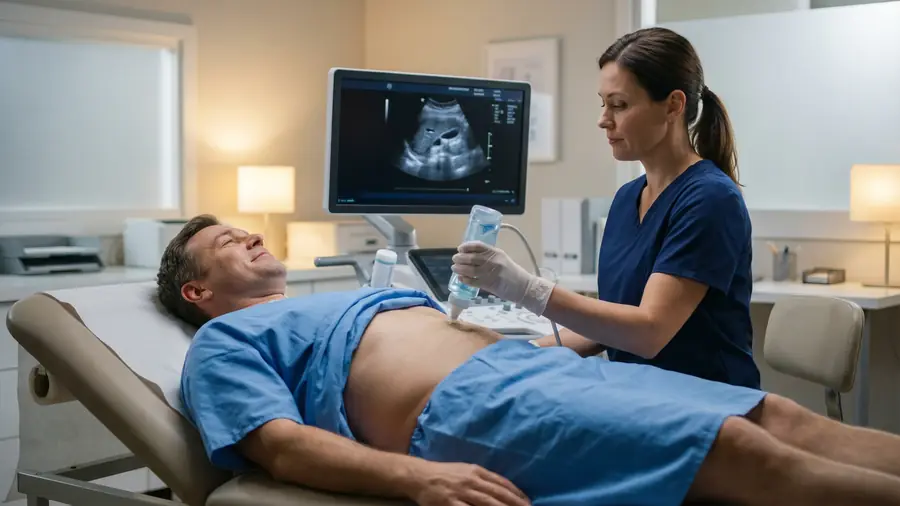
Sonographer performing an abdominal ultrasound-scan on a male patient at Sonoworld
Before Your Appointment

How to Prepare

Correct preparation is important for image quality, particularly for the abdominal and urinary tract components. Please follow these instructions carefully.

What to do

  • Fast for 4 hours before your appointment. Water is permitted and encouraged.
  • Drink 1 litre (2 pints) of water in the hour before your appointment to achieve a full bladder.
  • Wear loose, comfortable clothing that allows easy access to the abdomen, neck, and groin.
  • Bring any previous scan reports, blood test results, or GP letters for context.
  • Arrive 5 minutes early to complete a brief patient history form.

Important preparation notes

  • Do not eat solid food for 4 hours before the scan. This reduces bowel gas that obscures abdominal organs.
  • Do not empty your bladder in the hour before the appointment. A full bladder is required for the bladder and prostate assessment.
  • Avoid fizzy drinks on the morning of the scan as carbonated beverages increase bowel gas.
  • If you are unable to fast, please call us on 020 3633 4902 to discuss rescheduling.
Price

Transparent, All-Inclusive Pricing

The price below covers the complete six-area examination, verbal feedback, and a same-day written report with images. There are no additional charges for the report or follow-up questions.

Men’s Full Body Ultrasound-Scan
£785
All-inclusive · No hidden fees · ~60 minutes

  • Thyroid & neck ultrasound-scan
  • Carotid duplex with CIMT measurement
  • Full abdominal ultrasound-scan
  • Urinary tract & prostate ultrasound-scan
  • Abdominal aorta (AAA) screening
  • Testicular ultrasound-scan with Doppler
  • Immediate verbal feedback
  • Same-day written report with images

Private Medical Insurance

Sonoworld accepts AXA, Healix, WPA, and most major private medical insurers. Please call us before booking online so we can process your authorisation code correctly.

Call 020 3633 4902 to discuss insurance

Value comparison

Booking each component as an individual private scan would typically cost:

Thyroid & neck£195
Carotid duplex£295
Abdominal£235
Urinary tract & prostate£235
Abdominal aorta£195
Testes£195
Individual total£1,350
Full body package£785

Frequently Asked Questions

What does the full body ultrasound-scan include?
The scan covers six areas: thyroid and neck, carotid duplex (carotid arteries and blood flow), abdomen (liver, gallbladder, pancreas, spleen), urinary tract (kidneys, bladder, prostate), abdominal aorta, and testes. Each area is assessed by a consultant sonographer using high-resolution ultrasound equipment. The appointment takes approximately 60 minutes and includes immediate verbal feedback and a same-day written report with images.
Do I need to fast before the scan?
Yes. Please fast for 4 hours before your appointment. Fasting reduces bowel gas, which can obscure abdominal organs and reduce image quality. Water is permitted and encouraged throughout the fasting period. You should also drink 1 litre (2 pints) of water in the hour before your appointment to achieve a full bladder for the urinary tract and prostate assessment.
Do I need a GP referral?
No referral is required. You can self-refer and book directly online or by calling 020 3633 4902. The written report is formatted for sharing with your GP or specialist if follow-up is needed.
Can the scan detect cancer?
Ultrasound can identify focal lesions, masses, and structural abnormalities in the organs assessed. When a suspicious lesion is identified, the report will recommend further investigation — typically MRI, CT, or biopsy — through your GP or a specialist. Ultrasound is not a standalone cancer diagnosis tool, but it is a highly effective first-line modality for identifying lesions that warrant further assessment.
How is the prostate assessed in this scan?
The prostate is assessed transabdominally (through the lower abdomen with a full bladder) as part of this package. This provides a reliable measurement of prostate volume and identifies significant enlargement consistent with benign prostatic hyperplasia (BPH). A dedicated transrectal ultrasound-scan (TRUS) provides more detailed internal prostate assessment and is available separately when clinically indicated.
When will I receive my report?
Your written report with images is sent digitally the same day. Immediate verbal feedback is provided at the end of the appointment. The report is formatted for sharing with your GP or specialist and includes measurements, findings, and recommendations for each area assessed.
Can I use private medical insurance?
Yes. We accept AXA, Healix, WPA, and most major private medical insurers. Please call us before booking online so we can process your authorisation code correctly. Self-pay patients are always welcome and no referral is needed.
Our Clinic

29 Weymouth Street, Marylebone

Sonoworld Diagnostic Services is located just off Harley Street in central London. The clinic is easily accessible from Regent’s Park, Great Portland Street, and Oxford Circus Underground stations.

CQC Registered & Rated Good
BMUS Member
HCPC Registered
ICO Registered
View on Google Maps

Opening Hours & Contact

Monday – Friday08:00 – 18:00
Saturday09:00 – 14:00
SundayClosed

29 Weymouth Street
Marylebone, London W1G 7DB
Nearest stations: Regent’s Park · Great Portland Street · Oxford Circus

crossmenu
Not sure which scan you need?
Sono AISonoworld Scan Advisor
Tap to Call