
- Home
- Scans for Women
- Scans for Men
- Msk
- Pregnancy
- Cardiovascular
- About
- Book a Scan
- Blog
A bilateral duplex Doppler ultrasound-scan that assesses valve function and blood flow direction in the leg veins. Identifies venous insufficiency, maps reflux patterns, and supports treatment planning for varicose veins and venous skin changes. Written report within 24 hours. No GP referral required.
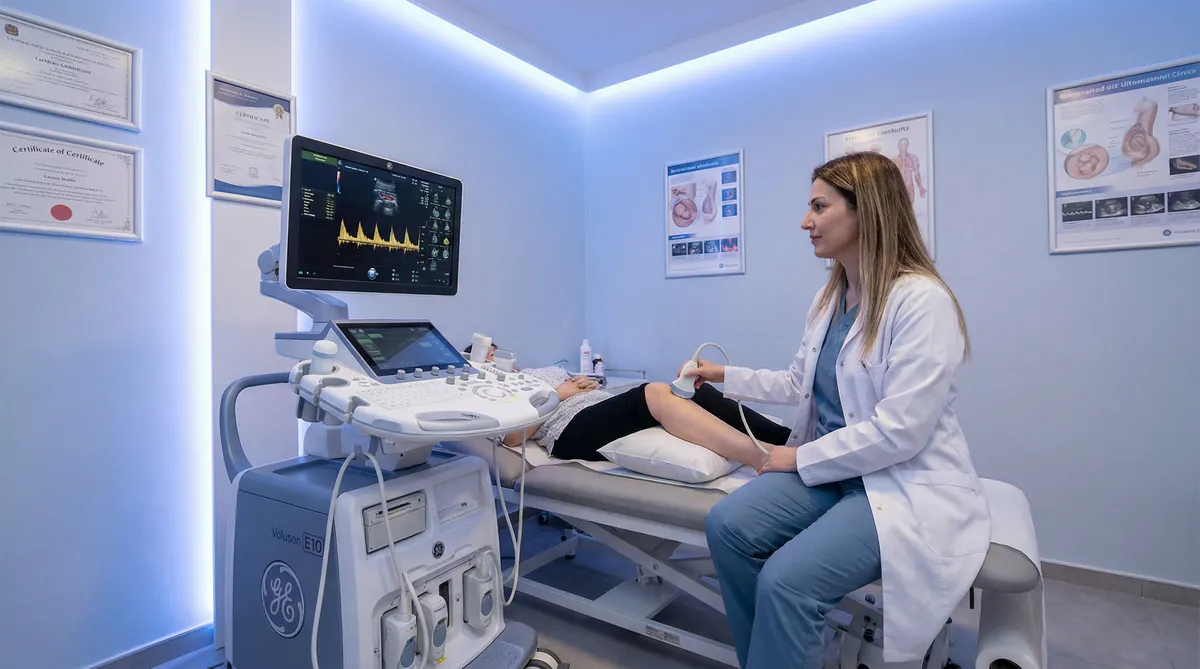
Healthy leg veins rely on a series of one-way valves to push blood back towards the heart against gravity. When those valves weaken or fail, blood pools in the vein and flows backwards — a process called venous reflux, or venous insufficiency. Over time, this raised venous pressure causes the familiar symptoms: aching, heaviness, ankle swelling, and, in more advanced cases, skin discolouration, eczema-like changes, and venous ulcers.
A venous reflux ultrasound-scan is a duplex Doppler examination that combines greyscale B-mode imaging with colour flow Doppler to map vein anatomy and detect valve incompetence. The sonographer uses gentle calf compression and release manoeuvres to provoke reflux and measure its duration and extent. Because venous disease is rarely confined to one limb, the assessment is always performed bilaterally — both legs are examined to give a complete clinical picture.
At Sonoworld, the examination is performed by an HCPC-registered vascular sonographer using a GE Voluson system. A written report is issued within 24 hours and is designed to be shared directly with your GP, vascular surgeon, or phlebologist.
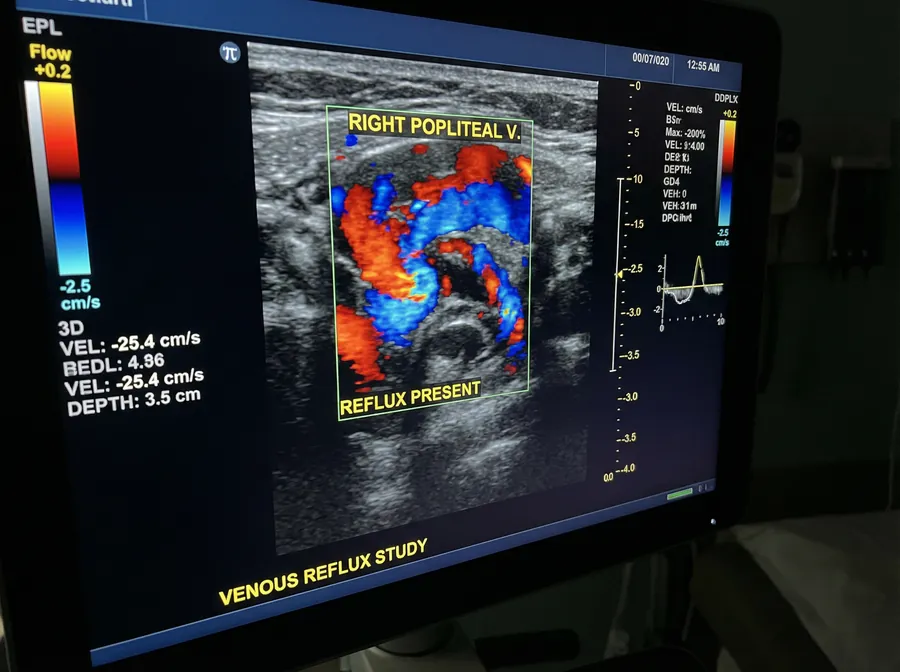
Reflux is defined by the duration of retrograde flow following a standardised compression manoeuvre. The accepted clinical thresholds are:
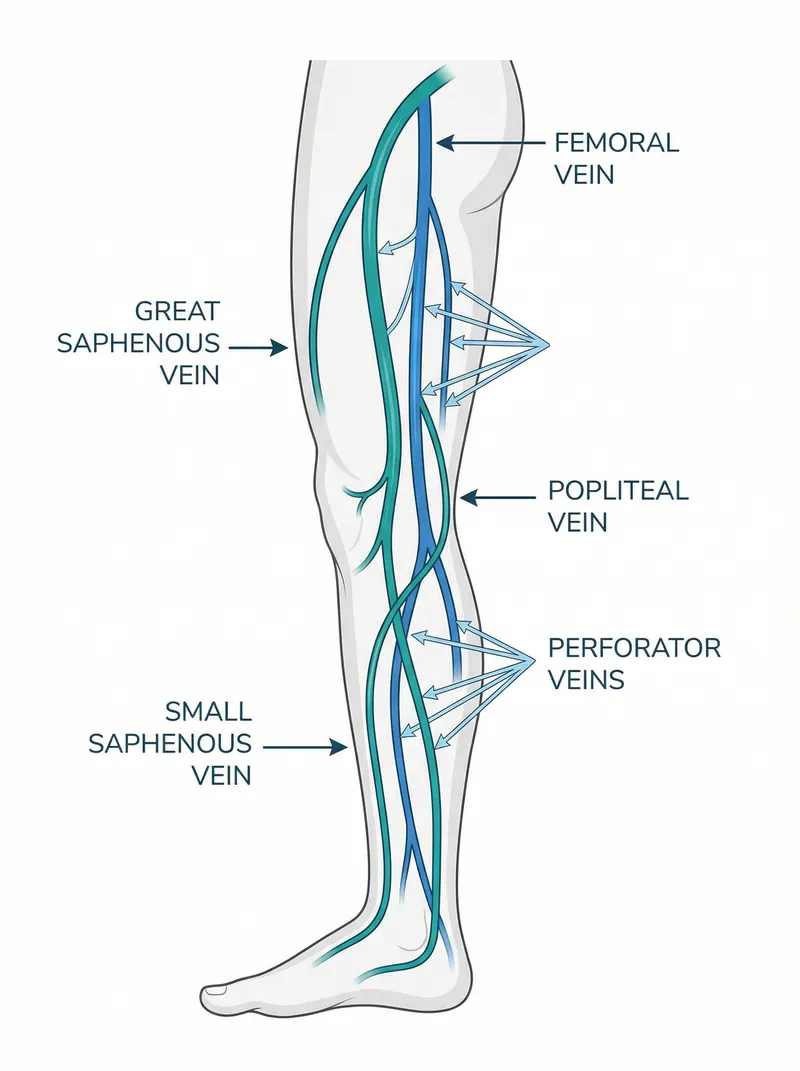
The examination uses greyscale imaging and colour Doppler to assess vein anatomy, valve competence, and flow direction throughout the superficial and deep venous systems of both legs. The table below summarises the structures assessed and the conditions identified.
| Structure | Assessment Method | Conditions Identified |
|---|---|---|
| Great saphenous vein (GSV) | Greyscale diameter; Doppler reflux duration at SFJ and along the thigh and calf | GSV reflux, saphenous incompetence, varicose vein source mapping |
| Small saphenous vein (SSV) | Greyscale; Doppler reflux at sapheno-popliteal junction (SPJ) | SSV reflux, posterior calf varicosities, SPJ incompetence |
| Sapheno-femoral junction (SFJ) | Colour Doppler; valve closure assessment | SFJ incompetence — primary driver of great saphenous reflux |
| Deep veins (femoral, popliteal) | Compressibility; Doppler waveform; reflux duration | Deep venous insufficiency, post-thrombotic syndrome, deep vein patency |
| Perforator veins | Colour Doppler; outward flow direction and duration | Incompetent perforators contributing to skin changes or ulceration |
| Varicose tributaries | Greyscale mapping; Doppler source identification | Tributary varicosities, recurrent varicose veins, reflux source |
Venous disease is classified using the internationally recognised CEAP system. A reflux ultrasound-scan provides the objective evidence needed to assign the correct clinical class and plan appropriate management.
Venous insufficiency is frequently bilateral even when symptoms appear unilateral. Assessing only the symptomatic leg misses clinically significant disease in the other limb and produces an incomplete picture for treatment planning. All venous reflux studies at Sonoworld are performed on both legs as standard.
People book this scan because their legs feel different, look different, or because they are planning treatment and need an objective map of what is happening. The scan answers one core question: are the vein valves working properly, and if not, where is the reflux originating?
Not the right scan for sudden swelling or suspected DVT
Sudden one-sided leg swelling, calf pain, redness, or warmth — particularly with shortness of breath — requires urgent medical assessment and a DVT ultrasound-scan pathway, not a reflux study. If in doubt, seek urgent care first.
Preparation for a venous reflux ultrasound-scan is straightforward. There is no fasting, no special diet, and no need to adjust medications. A few simple steps ensure the scan can be performed efficiently and comfortably.
Wear or bring loose clothing that allows easy access above the knee. Shorts or loose trousers are ideal. Compression stockings should be removed before the scan — you can bring them with you and put them back on afterwards.
Avoid applying lotions, creams, or oils to your legs on the day of the scan. These can interfere with ultrasound gel contact and reduce image quality. Clean, dry skin gives the best results.
Drink water normally before the appointment — good hydration supports venous filling and improves image quality. No fasting is required. Continue eating and drinking as usual.
Continue all medications as prescribed. If you take anticoagulants (e.g., warfarin, apixaban, rivaroxaban), there is no need to stop them for this scan. Bring a list of your current medications to the appointment.
The scan is non-invasive. You will feel only cool gel and gentle probe pressure on your legs. For part of the examination you may be asked to stand or adopt a semi-standing position — this is normal and helps to demonstrate reflux under gravitational load.
If any area of your leg is tender or has an open wound, tell the sonographer before the scan begins. The technique can be adjusted accordingly.
The appointment is structured to be calm and unhurried. Both legs are assessed in sequence, with the sonographer explaining findings as the scan progresses. Here is what to expect at each stage.
The sonographer confirms your symptoms, duration, any prior vein history or treatment, and your primary goal — whether that is reassurance, diagnosis, or pre-treatment mapping. You sign a consent form before the scan begins.
Both legs are exposed and ultrasound gel is applied. The sonographer maps the superficial and deep vein anatomy in greyscale, assessing vein calibre, wall morphology, and compressibility from groin to ankle.
Colour Doppler is applied at each key junction (SFJ, SPJ, perforators). Gentle calf compression and release manoeuvres provoke reflux. Duration and extent of retrograde flow are measured and recorded.
Where clinically indicated, you will be asked to stand or adopt a semi-standing position. Gravity increases venous pressure and makes reflux easier to demonstrate and measure accurately.
The sonographer explains findings in plain English at the end of the scan — which veins reflux, where, and what that means for your next steps. A written report is issued within 24 hours and can be shared with your GP or vascular specialist.
Choose your preferred date and time below. Booking is confirmed immediately. No GP referral is required. Both legs are always assessed as part of the bilateral study.
Price includes bilateral assessment, verbal feedback, and written report within 24 hours. Insurance patients: please bring your authorisation code.
One fixed price. Venous insufficiency is always assessed bilaterally — both legs are examined as standard to ensure a complete clinical picture. No hidden fees. No GP referral required.
Insurance patients are welcome. Please bring your authorisation code. Sonoworld is recognised by most major insurers including Bupa, AXA Health, Aviva, and Vitality.
No. A DVT scan looks for acute blood clots (thrombus) in the deep veins and is the appropriate test for sudden, painful, one-sided leg swelling. A venous reflux scan assesses valve function and chronic venous insufficiency — it is the correct test for varicose veins, aching legs, ankle swelling, and skin changes that have developed gradually. If you have sudden swelling with pain or redness, please seek urgent care and consider a DVT scan instead.
No. You can book a venous reflux ultrasound-scan at Sonoworld directly, without a GP referral. The scan is available to anyone who wishes to assess their venous health, whether for reassurance, diagnosis, or pre-treatment planning. If you have a referral letter, bring it along — it provides useful clinical context.
Venous insufficiency is frequently bilateral even when symptoms appear to affect only one leg. Assessing only the symptomatic limb misses clinically significant disease in the other and produces an incomplete picture for treatment planning. Vascular surgeons and phlebologists require bilateral data before planning interventions such as EVLA, RFA, or foam sclerotherapy. For this reason, all venous reflux studies at Sonoworld are bilateral as standard.
Yes. Ultrasound-scan uses sound waves, not radiation. It is safe for all patients, including those who are pregnant or taking anticoagulant medication. The examination is non-invasive — there are no needles, no injections, and no internal examination. You will feel only cool gel and gentle probe pressure on your legs.
A bilateral venous reflux study typically takes 30–45 minutes, depending on clinical complexity. Both legs are assessed in sequence. Your booking confirmation will include the allocated appointment time. The appointment is designed to be unhurried — the sonographer will take time to explain findings clearly before you leave.
Yes. The sonographer provides verbal feedback at the end of the scan, explaining what was found and what it means. The written report, issued within 24 hours, includes a structured clinical summary and next-step guidance designed to be shared with your GP or specialist. If reflux is present, the report documents which veins are affected and the severity — the information a vascular clinician needs to plan conservative or interventional management.
Yes. Appointments can be cancelled or rescheduled up to 24 hours before the appointment time without charge. Cancellations made within 24 hours may be subject to a cancellation fee. Please call 020 3633 4902 or email info@sonoworld.co.uk to make changes.
29 Weymouth Street
London W1G 8NP
Nearest stations: Regent's Park (Bakerloo) · Great Portland Street (Circle, H&C, Metropolitan) · Baker Street (Jubilee, Bakerloo, Metropolitan)
Open in Google Maps



 Tap to Call