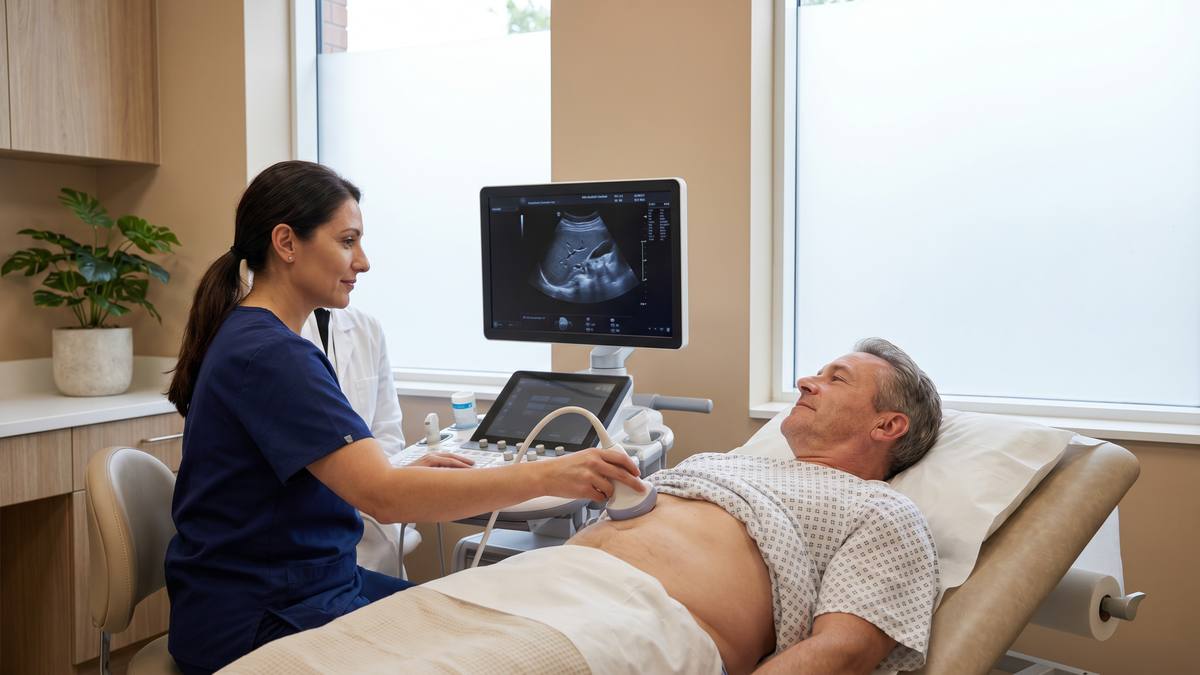
Indigestion or Gallstones? What an Ultrasound Can Tell You
By the Sonoworld clinical team, 29 Weymouth Street, Marylebone · CQC-registered clinic · Medically reviewed by Daniela Stan, Consultant Sonographer, MSc — 2 August 2026 · Last reviewed: 2 August 2026
Ultrasound is the test of choice for gallstones and it is very good at it. What it does not see is the stomach or the bowel — so if your symptoms are reflux, bloating, altered bowel habit or abdominal cramping, an ultrasound may not be the test that answers them. Knowing which half of the digestive system your symptoms point to is what decides whether this is the right scan.
See your GP urgently — not a scan — if you have: difficulty swallowing; unintended weight loss; blood in your stool or black tarry stools; persistent vomiting; a lump in your abdomen; yellowing of the skin or eyes; or new digestive symptoms over the age of 50. These warrant referral on an urgent suspected-cancer pathway, which aims for specialist assessment within two weeks.
The split that matters
Sound travels well through solid organs and fluid, and not at all through gas. That single fact divides the digestive system in two as far as ultrasound is concerned.
| Seen well |
Not seen |
| Gallbladder and bile ducts |
Oesophagus |
| Liver |
Stomach lining |
| Pancreas (head and body) |
Small bowel |
| Spleen |
Colon |
| Kidneys |
Rectum |
| Free fluid in the abdomen |
Pancreatic tail (often) |
The practical translation: ultrasound is an organ test, not a gut test. Reflux, ulcers, coeliac disease, inflammatory bowel disease, IBS and bowel cancer are all diagnosed by endoscopy, colonoscopy, blood tests or stool tests — not by a scan.
Gallstones: the classic mistaken-for-indigestion diagnosis
Gallstones are where abdominal ultrasound genuinely excels. It is the first-line test, detects the great majority of stones, and does so in a fifteen-minute appointment with no radiation.
The pattern worth recognising in yourself:
- Pain in the upper right abdomen, sometimes spreading to the right shoulder blade
- Coming on after eating, particularly fatty meals
- Lasting 30 minutes to a few hours then settling completely
- Often in the evening or at night
- Sometimes with nausea
That is biliary colic, and it is routinely mistaken for indigestion for months or years — partly because it responds temporarily to antacids and partly because it comes and goes.
The distinction from true indigestion: reflux tends to be central, burning, worse lying flat, and relieved by antacids. Gallbladder pain tends to be right-sided, gripping, unrelated to posture, and unrelieved by antacids.
Gallstone pain that does not settle within a few hours, or comes with fever, shivering or jaundice, needs same-day assessment. That combination suggests infection of the gallbladder or an obstructed bile duct, which are treated in hospital rather than in an outpatient clinic.
What else an ultrasound finds
- Gallbladder wall thickening and sludge — signs of inflammation or stasis
- Bile duct dilatation — suggesting an obstruction downstream
- Fatty liver — a very common incidental finding. See what a liver ultrasound shows
- Liver cysts and haemangiomas — usually benign and needing nothing
- Pancreatic changes — duct dilatation, cysts, calcification. See can an ultrasound see the pancreas
- An enlarged spleen
- Free fluid in the abdominal cavity
- Kidney stones and hydronephrosis — renal pain is frequently mistaken for a digestive problem
What it will not find
Worth stating plainly, because booking the wrong test costs you time as well as money:
- Reflux, gastritis and stomach ulcers — endoscopy
- Coeliac disease — blood tests, then endoscopy with biopsy
- Crohn’s disease and ulcerative colitis — colonoscopy, faecal calprotectin, MRI
- Bowel cancer — colonoscopy or CT colonography. An abdominal ultrasound does not screen for it
- IBS — a clinical diagnosis made after excluding other causes
- Most causes of bloating — though ultrasound is used to exclude ovarian and other pelvic causes, which matters in women. See bloating and when to investigate
If your symptoms are lower abdominal, related to bowel habit, or have changed recently, start with your GP rather than with a scan.
From our practice
From our practice
Right upper quadrant pain is one of the most common presenting symptoms in our abdominal ultrasound service. In a significant proportion of cases, the scan identifies gallstones the patient was not aware of.
In most of these cases, the patient has been experiencing intermittent symptoms for months or years and has attributed them to indigestion or a dietary intolerance. The scan provides a clear diagnosis, which they can then take to their GP to discuss management options.
The ability to access this investigation within days, without a referral, at a transparent price, is one of the most practical benefits of private abdominal ultrasound.
Drawn from typical cases seen at our Marylebone clinic. A composite scenario representative of patterns we encounter regularly, not any individual case.
Common questions
Can an ultrasound detect gallstones?
Yes — it is the first-line test and detects the great majority of gallstones. You need to fast for six hours beforehand so the gallbladder is full, because a contracted gallbladder cannot be assessed properly.
Can an ultrasound see my stomach or bowel?
No. Gas in the stomach and bowel blocks the sound waves. Reflux, ulcers, coeliac disease, inflammatory bowel disease and bowel cancer are diagnosed by endoscopy, colonoscopy or blood and stool tests.
How do I tell gallstone pain from indigestion?
Gallstone pain is typically upper right, gripping, comes on after fatty food, lasts 30 minutes to a few hours, and is not relieved by antacids. Reflux is usually central, burning, worse lying flat, and does respond to antacids. If in doubt, get it looked at.
Will an ultrasound tell me if I have bowel cancer?
No. Abdominal ultrasound does not assess the bowel lining and cannot screen for or exclude bowel cancer. If you have blood in your stool, a change in bowel habit lasting more than three weeks, or unexplained weight loss, see your GP urgently.
Do I need to fast?
Yes — six hours, water only. Eating empties the gallbladder and produces gas that obscures the pancreas and bile ducts.
I have bloating. Is an ultrasound useful?
Sometimes. It will not explain most bloating, but in women it is used to exclude ovarian and pelvic causes, which is an important thing to rule out. Persistent bloating — more than twelve times a month — should be discussed with your GP.
What does it cost and when do I get results?
An upper abdominal ultrasound is £235. You receive instant verbal results at the appointment, with the written report following within 24 hours.
Related: abdominal pain and when to get a scan, what your abdominal report means, and the upper abdominal ultrasound service page.
CQC-registered clinic · BMUS member · ICO-registered. Reports can be shared securely with your NHS GP or specialist at your request.