Book Scan
Cardiovascular Ultrasound · London

Private Echocardiogram in London (Heart Ultrasound)

A non-invasive ultrasound-scan that shows how your heart looks, moves, and pumps blood. Performed by consultant cardiac sonographers in our Marylebone clinic. Written report within 24 hours. No GP referral required. Insurance accepted.

No GP referral needed Report within 24 hours BSE-Accredited Sonographers CQC-Registered Clinic
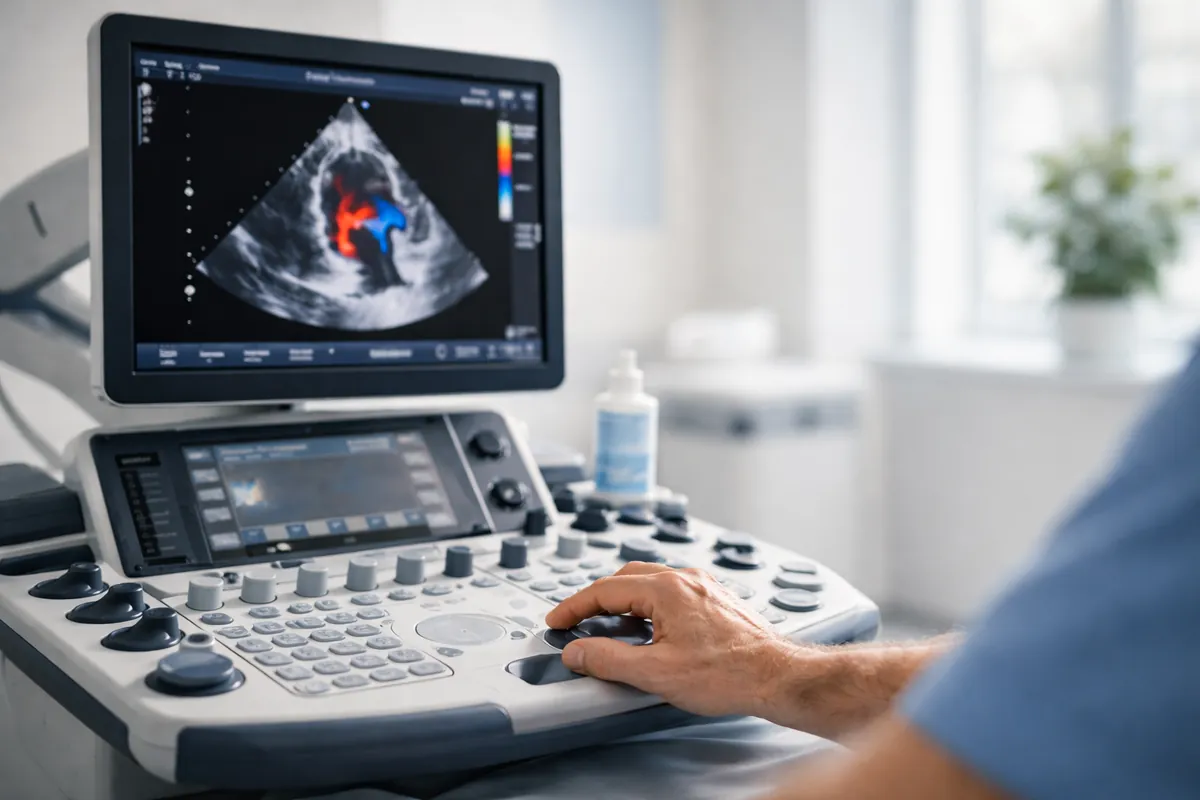
Clinician performing a transthoracic echocardiogram in a modern private clinic
From £350
Report included
30–45 min
Appointment length
No fast
No special prep
4.9 ★
Patient rating
About This Scan

What Is a Private Echocardiogram?

An echocardiogram (often called an "echo") uses high-frequency sound waves to create real-time moving images of your heart. It is the primary imaging tool for assessing heart structure and function — showing how the chambers fill and empty, how the valves open and close, and how blood flows through the heart with every beat.

At Sonoworld, every echocardiogram is performed by a consultant cardiac sonographer with specialist post-graduate training in cardiac ultrasound. Our team brings over 20 years of combined NHS and private cardiac imaging experience. The scan uses no radiation and requires no contrast dye or fasting — it is entirely non-invasive.

A written report — including measurements, Doppler findings, and clinical interpretation — is typically issued within 24 hours and can be shared directly with your GP, cardiologist, or referring clinician.

What an echocardiogram assesses

  • Heart size and pumping strength — including ejection fraction (EF), which measures how well the left ventricle pumps blood with each beat
  • Heart valves — opening, closing, narrowing (stenosis), and leakage (regurgitation) across all four valves
  • Pericardium — fluid around the heart (pericardial effusion) and any thickening
  • Aortic root — the first section of the main artery leaving the heart; assessed for dilatation
  • Doppler blood flow — direction, speed, and turbulence of flow through each valve and chamber
  • Chamber dimensions — whether any heart chamber is enlarged or the walls are thickened
Consultant sonographer reviewing echocardiogram findings with a patient in a private clinic

Key echo measurements explained

Ejection fraction (EF)
Percentage of blood pumped out per beat. Normal: 55–70%. Below 40% suggests reduced function.
Chamber dimensions
Size of each heart chamber. Enlargement can indicate volume overload or long-standing hypertension.
Wall thickness
Thickening (hypertrophy) can result from hypertension or cardiomyopathy.
Valve gradients & regurgitation grade
Doppler measurements quantifying narrowing or leakage — graded mild, moderate, or severe.

Clinical team

Every echo at Sonoworld is performed by a consultant cardiac sonographer — not a general ultrasonographer.

  • HCPC-registered with post-graduate cardiac ultrasound qualification
  • BSE-accredited — British Society of Echocardiography standards
  • Complex findings escalated to consultant cardiologist where indicated
Clinical Assessment

Heart Conditions Assessed by Echocardiography

Echocardiography is the first-line imaging test for many cardiac conditions. The table below summarises the structures assessed and the clinical findings the scan can identify or monitor.

Structure / Parameter Assessment Method Conditions Identified
Left ventricle (LV) 2D dimensions; M-mode; ejection fraction (biplane Simpson) Dilated cardiomyopathy, LV systolic dysfunction, hypertrophic cardiomyopathy
Right ventricle (RV) 2D size; TAPSE; tricuspid annular motion RV dilatation, pulmonary hypertension, RV dysfunction
Aortic valve 2D morphology; Doppler gradients; planimetry Aortic stenosis, aortic regurgitation, bicuspid aortic valve
Mitral valve 2D leaflet motion; colour Doppler; pressure half-time Mitral regurgitation, mitral stenosis, mitral valve prolapse
Tricuspid & pulmonary valves Colour Doppler; spectral Doppler gradients Tricuspid regurgitation, pulmonary hypertension estimation
Left atrium (LA) 2D volume; LA size index LA dilatation (associated with AF, diastolic dysfunction)
Pericardium 2D circumferential assessment Pericardial effusion, cardiac tamponade, constrictive pericarditis
Aortic root & ascending aorta Parasternal long-axis measurement Aortic root dilatation, aortic aneurysm screening

Heart valve disease

Echo is the primary test for assessing valve stenosis (narrowing) and regurgitation (leakage). It measures severity grade and helps cardiologists decide whether to monitor, treat medically, or refer for surgical repair or replacement.

Heart failure & cardiomyopathy

Echo measures ejection fraction (EF) — the percentage of blood pumped per beat. Normal EF is 55–70%. Below 40% suggests reduced function. Serial echos track whether treatment is working, in line with NICE NG106 guidance.

Atrial fibrillation (AF)

While AF is diagnosed by ECG or Holter monitor, an echo is often requested alongside to check for underlying structural causes — enlarged left atrium, valve disease, or impaired ventricular function.

Hypertensive heart disease

Long-standing high blood pressure can cause the heart muscle to thicken (left ventricular hypertrophy). Echo detects and measures this thickening, influencing treatment decisions as outlined in NICE NG136.

Congenital & pericardial conditions

Some structural differences (bicuspid aortic valve, atrial septal defect) are first detected in adulthood. Pericardial effusion and cardiac tamponade can also be identified and assessed for haemodynamic significance.

Indications

When a Private Echocardiogram Makes Sense

Most patients book privately because they want reassurance or faster answers than the NHS pathway can provide. An echocardiogram is used to investigate symptoms, assess a known diagnosis, or provide a cardiac baseline before exercise programmes or surgery.

  • New or worsening breathlessness, especially with exertion
  • Palpitations, dizziness, or near-fainting episodes
  • Heart murmur detected on examination by a GP or other clinician
  • Swollen ankles or legs where a cardiac cause is suspected
  • Monitoring known conditions — valve disease, cardiomyopathy, or heart failure — as advised by your cardiologist
  • Pre-operative cardiac clearance — some surgeons request an echo before major procedures
  • Hypertension assessment — checking whether high blood pressure has affected heart structure
  • Pre-exercise or fitness baseline — increasingly requested by athletes and personal trainers

Seek urgent care — do not book a private scan

Severe crushing chest pain, sudden severe breathlessness at rest, loss of consciousness, or new stroke-like symptoms (FAST) require immediate A&E attendance or call 999. A private echocardiogram is for assessment and monitoring — not for emergencies.

Close-up of echocardiography ultrasound machine controls in a modern clinic

Compare cardiac tests

These three tests answer different questions about your heart. They are often complementary.

Test Best for
Echocardiogram Heart structure, valve function, pumping strength
ECG Heart rhythm, electrical conduction, AF detection
Holter monitor Intermittent palpitations, 24–72 hr rhythm recording

Not sure which test is right for you? Call us on 020 3633 4902 and we will guide you.

Before Your Appointment

How to Prepare for Your Echocardiogram

For a standard transthoracic echocardiogram, there is no special preparation. You do not need to fast, and you can eat, drink, and take your usual medications normally.

Clothing

Wear comfortable clothing that is easy to remove from the upper body. You will undress from the waist up and lie on a couch for the scan. A gown is provided.

Medications

Continue all medications as prescribed. There is no need to stop any medication for a standard transthoracic echo. Bring a list of your current medications (or photographs of the labels).

Food and drink

No fasting required. Eat and drink normally before your appointment. Stress echocardiograms and transoesophageal echocardiograms (not performed at Sonoworld) have different requirements.

Comfort note

The scan is non-invasive. You will feel only cool gel and gentle probe pressure on your chest. You may be asked to breathe in, breathe out, or hold your breath briefly — this is normal and helps capture clear images.

What to bring

  • List of current medications (or photos of labels)
  • Any prior echo, ECG, or Holter reports
  • GP or specialist referral letter (if you have one — not required)
  • Insurance authorisation code (if applicable)
  • A note of your symptoms and when they occur — helps the sonographer focus the assessment

Insurance patients

We accept most major private medical insurers including Bupa, AXA Health, Aviva, and Vitality. Before your appointment:

  1. Confirm echocardiography is covered by your policy.
  2. Obtain a referral letter or authorisation code from your insurer if required.
  3. Bring your authorisation code to the appointment.
Your Appointment

What Happens During Your Echocardiogram

The appointment is calm and unhurried. You will be guided step-by-step, with time to ask questions before, during, and after the scan. Here is what to expect at each stage.

1

Arrive & clinical history

We confirm your details, symptoms, medications, and any relevant history. If you have prior ECG, Holter, or echo reports, bring them — they help the sonographer focus the assessment. You sign a consent form before the scan begins.

2

Transthoracic echocardiogram (TTE)

You undress from the waist up and lie on your left side on the couch. Ultrasound gel is applied and the probe is placed on your chest in several positions to capture views of the heart chambers, valves, and blood flow.

3

Doppler & flow assessment

Colour and spectral Doppler are used to measure blood flow velocity, direction, and turbulence through each valve and chamber. You may be asked to breathe in, breathe out, or hold your breath briefly to improve image quality.

4

Preliminary discussion

After the scan, the sonographer shares initial observations in plain English. This is not a formal report but gives you an immediate sense of whether anything concerning has been seen and what the next steps are likely to be.

5

Written report within 24 hours

Your formal written report — including measurements, Doppler findings, and clinical interpretation — is typically delivered within 24 hours. It includes clear next-step guidance and can be sent directly to your GP or referring clinician.

Bright, calm private clinic environment in Marylebone with white and light-blue accents
Online Booking

Book Your Private Echocardiogram

Appointments are available Monday to Sunday. No GP referral is required. Same-day appointments are often available. Booking is confirmed immediately.

Book Your Echocardiogram

Sonoworld · 29 Weymouth Street, London W1G 7DB

Choose your preferred date and time on our secure booking page. Confirmation is sent immediately by email. No GP referral required.

Secure booking · Immediate confirmation · No hidden fees

Price

Transthoracic echocardiogram (TTE) From £350

Price includes the scan, verbal feedback, and written report within 24 hours. Insurance patients: please bring your authorisation code.

Preparation reminder

  • No fasting required — eat and drink normally
  • Wear clothing easy to remove from the upper body
  • Continue all medications as normal
  • Bring any prior echo, ECG, or Holter reports
  • Bring insurance authorisation code if applicable

What happens after the scan

  • Verbal feedback given immediately after the scan
  • Written report with measurements and clinical interpretation within 24 hours
  • Report designed to share with GP, cardiologist, or referring clinician
  • Complex findings escalated to consultant cardiologist where indicated
Transparent Pricing

Private Echocardiogram Price

One fixed price that includes the scan, verbal feedback, and written report. No GP referral required. Insurance accepted — please check your policy and obtain authorisation where required.

Insurance patients are welcome. Please bring your authorisation code. Sonoworld is recognised by most major insurers including Bupa, AXA Health, Aviva, and Vitality. See our full price list for all cardiac scans.

Frequently Asked Questions

Echocardiogram — Common Questions

Is an echocardiogram painful?

No. A transthoracic echocardiogram is completely non-invasive. You will feel only cool ultrasound gel and gentle probe pressure on your chest. There are no needles, no injections, and no internal examination. Most patients find the scan straightforward and comfortable.

How long does an echocardiogram take?

A standard transthoracic echocardiogram typically takes 30–45 minutes, depending on clinical complexity. This includes the clinical history, the scan itself, and the preliminary discussion at the end. Your appointment is never rushed — the sonographer will take time to explain findings clearly before you leave.

Do I need a GP referral for a private echocardiogram?

No. You can book a private echocardiogram at Sonoworld directly, without a GP referral. The scan is available to anyone who wishes to assess their cardiac health. If you have a referral letter from your GP or cardiologist, bring it along — it provides useful clinical context and may be required by your insurer.

What is the difference between an echocardiogram and an ECG?

An echocardiogram uses ultrasound to create moving images of the heart's structure — showing chambers, valves, and blood flow. An ECG (electrocardiogram) records the heart's electrical activity and is used to assess rhythm and conduction. They answer different clinical questions and are often complementary. If your concern is primarily about palpitations or irregular rhythm, an ECG or Holter monitor may be the more appropriate first test. If you are unsure, call us and we will guide you.

What is ejection fraction and what does my number mean?

Ejection fraction (EF) is the percentage of blood pumped out of the left ventricle with each heartbeat. A normal EF is typically 55–70%. An EF between 40–54% is mildly reduced; below 40% suggests reduced pumping function and may indicate heart failure. An EF above 70% can occasionally indicate hypertrophic cardiomyopathy. Your report will include your EF measurement and its clinical interpretation in plain English.

Can I have an echocardiogram if I have a pacemaker or defibrillator?

Yes. A transthoracic echocardiogram uses ultrasound — not magnetic fields or radiation — and is completely safe with pacemakers and implantable defibrillators (ICDs). Please let us know at the time of booking and mention it again when you arrive, so the sonographer can note it in your clinical history.

Is a private echocardiogram as good as one done on the NHS?

Yes. The scan is performed to the same BSE (British Society of Echocardiography) minimum dataset standards used in NHS cardiac departments. Our sonographers are HCPC-registered and BSE-accredited — the same professional standards required in NHS practice. The key differences are speed of access, a calm private environment, and a written report delivered within 24 hours rather than weeks.

When will I get my results?

You will receive verbal feedback from the sonographer immediately after the scan. A formal written report — including measurements, Doppler findings, and clinical interpretation — is typically issued within 24 hours. The report includes clear next-step guidance: reassurance, GP follow-up recommendation, or specialist cardiology referral if needed.

Can you send the report to my GP or consultant?

Yes. With your consent, we can send a copy of the report directly to your GP, cardiologist, or any other referring clinician. Please provide their contact details at the time of your appointment. You will always receive your own copy of the report regardless.

What can an echocardiogram not detect?

An echocardiogram assesses heart structure and function but does not directly image the coronary arteries (the blood vessels that supply the heart muscle). Coronary artery disease — the cause of most heart attacks — requires a different test such as CT coronary angiography or stress testing. If your concern is chest pain on exertion or suspected coronary artery disease, discuss this with your GP or cardiologist, who can direct you to the appropriate investigation. An echo is also not a substitute for an ECG or Holter monitor if your primary concern is heart rhythm.

Can I cancel or reschedule my appointment?

Yes. Appointments can be cancelled or rescheduled up to 24 hours before the appointment time without charge. Cancellations made within 24 hours may be subject to a cancellation fee. Please call 020 3633 4902 or email info@sonoworld.co.uk to make changes.

Find Us

Sonoworld — Marylebone, London (near Harley Street)

Clinic address

29 Weymouth Street
London W1G 7DB

Nearest stations: Regent's Park (Bakerloo) · Great Portland Street (Circle, H&C, Metropolitan) · Baker Street (Jubilee, Bakerloo, Metropolitan)

Open in Google Maps

Opening hours

Monday – Friday08:00 – 20:00
Saturday09:00 – 17:00
Sunday10:00 – 16:00

Ready to book your echocardiogram?

Same-day appointments available. No GP referral needed. Report within 24 hours.

Related cardiovascular tests

Echocardiography focuses on heart structure. If your concern involves heart rhythm, circulation, or stroke risk, one of these tests may complement your echo.

Rhythm

ECG Test

Heart rhythm & electrical conduction. 5–10 min.

Rhythm

Holter Monitor

24–72 hr continuous rhythm recording.

Vascular

Carotid Doppler

Plaque & narrowing in carotid arteries.

Vascular

DVT Scan

Deep vein clot assessment — leg swelling.

crossmenu
Not sure which scan you need?
Sono AISonoworld Scan Advisor
Tap to Call