Book Scan
Vascular Stroke Screening Ultrasound | Private Clinic London | Sonoworld
Vascular Screening Package

Vascular Stroke Screening
Ultrasound-Scan

A comprehensive vascular ultrasound-scan package assessing the carotid arteries, abdominal aorta, and bilateral leg arteries — the three most clinically significant sites for stroke and cardiovascular risk. One appointment, same-day written report.

CQC Registered HCPC Registered BMUS Member Same-Day Report No GP Referral Needed
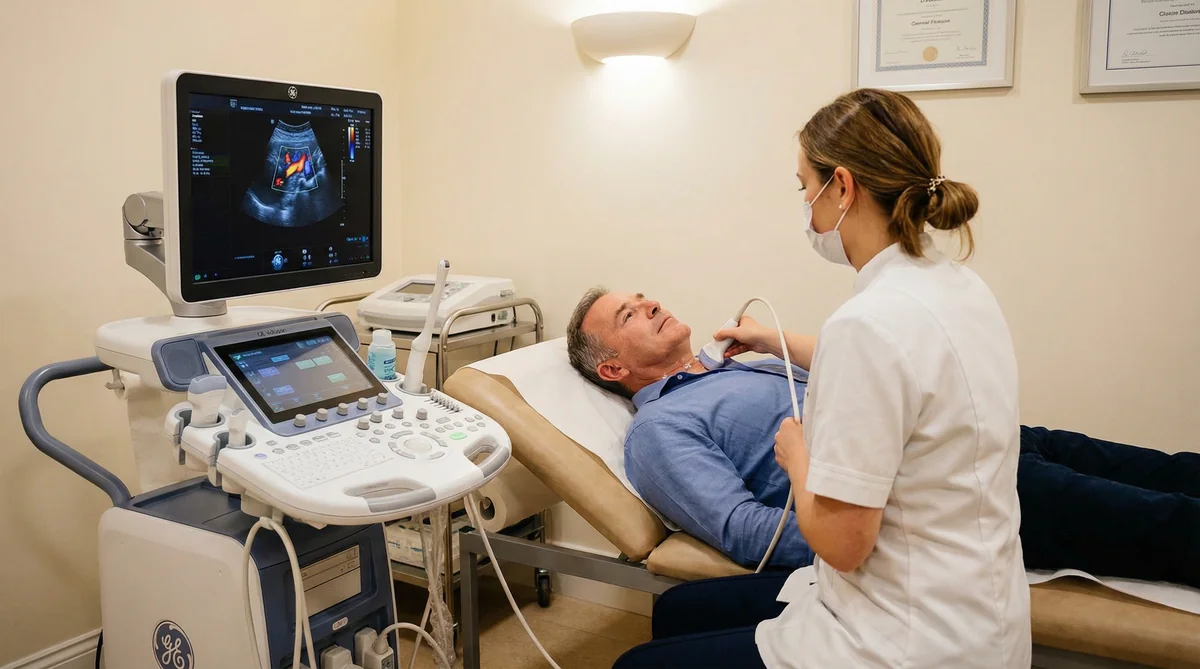
Sonographer performing carotid artery ultrasound scan on a patient at Sonoworld London
£699
Package Price
~45 min
Appointment Length
3 Areas
Vascular Sites Assessed
4.9 ★
Patient Rating
What Is It?

Vascular Stroke Screening: What the Package Assesses

Stroke is the fourth leading cause of death in the UK and the single largest cause of complex disability. Around 100,000 people have a stroke each year in England, and up to 80% of strokes are preventable when vascular risk factors are identified and managed early. The Sonoworld Vascular Stroke Screening package uses high-resolution colour Doppler ultrasound to examine the three arterial territories most directly linked to stroke and cardiovascular events.

Unlike a single-site vascular scan, this package combines three examinations into one 45-minute appointment. The carotid duplex assesses plaque burden and stenosis in the neck arteries supplying the brain. The abdominal aortic aneurysm (AAA) scan measures aortic diameter to detect aneurysmal dilatation before rupture. The bilateral leg arterial evaluation identifies peripheral arterial disease (PAD), which shares the same atherosclerotic pathology as carotid disease and is a strong independent predictor of future cardiovascular events.

This Package Includes

  • Carotid Duplex Ultrasound-Scan — bilateral carotid and vertebral arteries, plaque, stenosis, CIMT
  • Abdominal Aortic Aneurysm (AAA) Scan — aortic diameter measurement, morphology, iliac arteries
  • Bilateral Leg Arterial Evaluation — femoral, popliteal, and tibial arteries; peripheral arterial disease (PAD) assessment
  • Colour Doppler & Spectral Waveform Analysis — blood flow velocity, resistance indices, stenosis grading
  • Verbal Feedback — findings explained during the appointment
  • Same-Day Written Report — sent to you and your GP or specialist
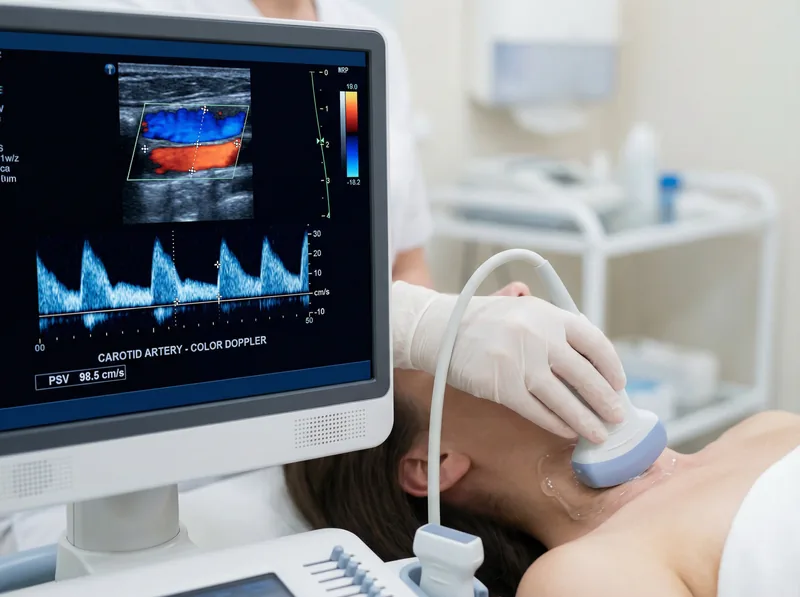
Colour Doppler carotid artery ultrasound scan showing blood flow through the carotid artery

Why Three Scans Together?

Atherosclerosis — the build-up of fatty plaques in artery walls — is a systemic disease. Plaque in the carotid arteries frequently coexists with aortic dilatation and peripheral arterial disease. Examining all three territories in one appointment gives a complete picture of your systemic vascular health, rather than a partial view from a single-site scan.

Clinical Detail

What Each Scan Area Assesses

Each of the three examinations uses high-frequency B-mode imaging combined with colour Doppler and spectral waveform analysis to characterise both vessel anatomy and blood flow dynamics.

1

Carotid Duplex Ultrasound-Scan

The carotid arteries are the primary blood supply to the brain. Atherosclerotic plaque at the carotid bifurcation — where the common carotid artery divides into the internal and external carotid — is the most common source of embolic stroke. The carotid duplex assesses:

Intima-Media Thickness (CIMT)
Measurement of arterial wall thickness — an early marker of subclinical atherosclerosis before symptoms develop
Plaque Characterisation
Presence, location, echogenicity, and surface morphology of plaques — soft plaques carry higher embolic risk than calcified plaques
Stenosis Grading
Peak systolic velocity (PSV) and end-diastolic velocity (EDV) measurements to grade stenosis severity per NASCET criteria
Vertebral Artery Flow
Direction and quality of vertebral artery blood flow — reversed flow (subclavian steal) indicates proximal subclavian stenosis
2

Abdominal Aortic Aneurysm (AAA) Scan

An abdominal aortic aneurysm is a localised dilatation of the aorta exceeding 3 cm in diameter. AAAs are largely asymptomatic until rupture, which carries a mortality rate exceeding 80%. The NHS AAA screening programme invites men at age 65, but women and younger men with risk factors receive no routine NHS screening. This scan assesses:

Aortic Diameter
Anteroposterior and transverse measurements at multiple levels — normal <3 cm, aneurysmal ≥3 cm, surgical threshold typically ≥5.5 cm
Aortic Morphology
Fusiform vs saccular shape, mural thrombus, calcification, and extent of dilatation relative to renal arteries
Iliac Arteries
Common and external iliac artery assessment for aneurysmal extension and occlusive disease
Colour Doppler Flow
Blood flow patterns within the aortic lumen — turbulent flow or slow swirling in large aneurysms indicates elevated thrombus risk
3

Bilateral Leg Arterial Evaluation

Peripheral arterial disease (PAD) affects approximately 20% of people over 60 in the UK. Most cases are asymptomatic or present only with exertional leg pain (intermittent claudication). PAD is a powerful marker of systemic atherosclerosis — people with PAD have a two- to three-fold increased risk of myocardial infarction and stroke compared to those without. This evaluation assesses:

Femoral Arteries
Common, superficial, and deep femoral arteries — plaque, stenosis, and occlusion
Popliteal Artery
Behind-knee arterial assessment — popliteal aneurysms are the most common peripheral aneurysm
Tibial Arteries
Anterior and posterior tibial arteries — distal disease assessment relevant to diabetic vascular complications
Waveform Analysis
Triphasic, biphasic, or monophasic waveform patterns — monophasic flow indicates significant proximal stenosis
Who Should Book

Who Should Have Vascular Stroke Screening?

Vascular stroke screening is most valuable for people who carry one or more established cardiovascular risk factors but have no current symptoms. The screening identifies subclinical disease — arterial changes that are present and progressing but have not yet caused a TIA, stroke, or other vascular event.

Consider Screening If You Have:

  • High blood pressure (hypertension) — the single most important modifiable stroke risk factor
  • High cholesterol (hyperlipidaemia) — LDL cholesterol drives atherosclerotic plaque formation
  • Type 2 diabetes or pre-diabetes — accelerates atherosclerosis and peripheral arterial disease
  • Current or former smoker — smoking is the most potent risk factor for peripheral arterial disease
  • Family history of stroke, TIA, AAA, or heart attack — first-degree relative with vascular disease doubles your risk
  • Age 55 or over — arterial stiffness and plaque accumulation increase significantly after 55
  • Atrial fibrillation (AF) — AF combined with carotid disease substantially elevates embolic stroke risk
  • Obesity (BMI >30) or metabolic syndrome — associated with accelerated atherosclerosis

Seek Urgent Medical Attention If You Have:

Sudden facial drooping, arm weakness, or speech difficulty (FAST symptoms); sudden severe headache; sudden loss of vision in one eye; or sudden loss of balance. These are symptoms of an active stroke or TIA and require immediate emergency care — call 999, not a screening clinic.

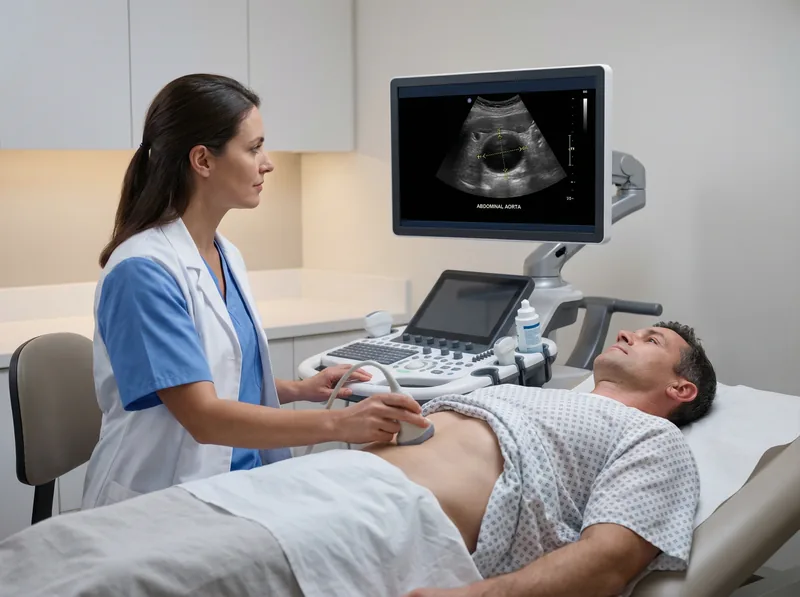
Abdominal aortic aneurysm ultrasound scan showing aortic diameter measurement

Symptoms That Warrant Screening

  • Transient visual disturbance (amaurosis fugax)
  • Brief episodes of dizziness or unsteadiness
  • Leg pain on walking that eases with rest (claudication)
  • Cold feet or legs with reduced hair growth
  • Pulsating sensation in the abdomen
  • Neck bruit heard by a doctor on auscultation
Clinical Reference

Risk Factors, Conditions Detected & Clinical Significance

The table below maps each scan area to the conditions it detects and the clinical action that follows a positive finding.

Scan Area Condition Detected Clinical Significance Action if Found
Carotid Duplex Carotid stenosis ≥50% Embolic stroke risk increases proportionally with stenosis severity; ≥70% stenosis may warrant endarterectomy Urgent vascular surgery referral; antiplatelet therapy review
Carotid Duplex Soft (echopenic) carotid plaque Unstable plaque with higher embolic potential than calcified plaque, even at moderate stenosis Intensified statin therapy; GP/cardiologist review
Carotid Duplex Increased CIMT (>0.9 mm) Subclinical atherosclerosis; independent predictor of future MI and stroke Lifestyle modification; lipid-lowering therapy; GP review
AAA Scan Aortic diameter 3.0–4.4 cm (small AAA) Surveillance required; annual growth rate ~2–3 mm/year Vascular surgery referral; 12-monthly surveillance
AAA Scan Aortic diameter 4.5–5.4 cm (medium AAA) Rupture risk ~1% per year; 3-monthly surveillance indicated Urgent vascular surgery referral; 3-monthly surveillance
AAA Scan Aortic diameter ≥5.5 cm (large AAA) Rupture risk ~25% per year; surgical repair indicated Same-day urgent vascular surgery referral
Leg Arterial Peripheral arterial disease (PAD) 2–3× increased risk of MI and stroke; limb ischaemia risk if untreated GP referral; antiplatelet therapy; cardiovascular risk factor management
Leg Arterial Popliteal aneurysm Thrombosis and distal embolisation risk; limb-threatening if untreated Vascular surgery referral
Your Appointment

How the Stroke Screening Appointment Works

The entire package is completed in a single 45-minute appointment by an HCPC-registered vascular sonographer. No GP referral is required.

1

Clinical History

The sonographer takes a brief cardiovascular history — symptoms, risk factors, current medications, and family history. This guides the clinical focus of the examination and ensures all relevant areas receive appropriate attention.

2

Carotid & Vertebral Assessment

You lie on your back with your head turned to one side. The sonographer applies gel to the neck and uses a high-frequency linear probe to examine both carotid arteries and vertebral arteries. Colour Doppler and spectral waveform analysis are performed at each key site.

3

Abdominal Aorta Assessment

The probe moves to the abdomen. The aorta is measured at multiple levels from the diaphragm to the bifurcation. Colour Doppler assesses flow patterns. The iliac arteries are also evaluated. A 4-hour fast is required for this part of the examination to reduce bowel gas interference.

4

Bilateral Leg Arterial Evaluation

Both legs are examined from the groin to the ankle. The sonographer assesses the femoral, popliteal, and tibial arteries using B-mode imaging and Doppler waveform analysis. You will be asked to lie on your front for the popliteal assessment.

5

Feedback & Same-Day Report

Findings are explained verbally at the end of the appointment. A comprehensive written report is sent to you — and to your GP or specialist if requested — the same day. The report includes measurements, images, and clinical recommendations for any abnormal findings.

Before Your Appointment

How to Prepare for Your Stroke Screening

The abdominal aorta assessment requires a 4-hour fast to minimise bowel gas. The carotid and leg arterial components require no special preparation.

4-Hour Fast Required (Aorta Assessment)

Do not eat for at least 4 hours before your appointment. You may drink water freely — staying well hydrated actually improves image quality. Avoid fizzy drinks, which increase bowel gas.

Continue Your Medications

Take all regular medications as normal, including antihypertensives, statins, and antiplatelet agents. Do not stop any medication before the scan.

What to Wear

Wear loose, comfortable clothing. A two-piece outfit is ideal — the sonographer will need access to your neck, abdomen, and both legs. Avoid tight trousers or leggings that are difficult to roll up.

What to Bring

  • Insurance authorisation code (if using private health insurance)
  • List of current medications (or medication packets)
  • Any previous vascular scan reports or blood test results
  • GP referral letter (if you have one — not required)

Scan Inclusions

  • Carotid duplex (bilateral) with CIMT measurement
  • Vertebral artery assessment (bilateral)
  • Abdominal aortic aneurysm measurement
  • Iliac artery assessment
  • Bilateral leg arterial evaluation (femoral to tibial)
  • Colour Doppler and spectral waveform analysis throughout
  • Verbal feedback during appointment
  • Same-day written report with images
Pricing

Stroke Screening Package Price

One all-inclusive price for all three vascular examinations, verbal feedback, and a same-day written report.

Complete Package
£699
All-inclusive — no hidden extras
  • Carotid duplex (bilateral)
  • Abdominal aortic aneurysm scan
  • Bilateral leg arterial evaluation
  • Colour Doppler throughout
  • Same-day written report
Book Now
Individual Scan Prices
If booked separately
  • Carotid Duplex — £235
  • AAA Scan — £235
  • Leg Arterial (bilateral) — £235
  • Individual total: £705 — package saves £6
Insurance accepted. Recognised by most major private health insurers. Quote your authorisation code at booking.
Related Scans

Other Vascular & Screening Ultrasound-Scans

Vascular

Carotid Duplex Ultrasound-Scan

Standalone carotid artery assessment — plaque, stenosis, CIMT, and vertebral artery flow.

£235
Vascular

Abdominal Aortic Aneurysm Scan

Standalone AAA ultrasound-scan measuring aortic diameter and assessing aneurysm risk.

£235
Screening

Men's Full Body Screening

Comprehensive 6-area package including thyroid, carotid, abdomen, urinary tract, aorta, and testes.

£785
FAQs

Frequently Asked Questions

Do I need a GP referral for the stroke screening package?

No GP referral is required. You can book directly online or by telephone. If you have a GP referral letter, bring it to the appointment — it provides useful clinical context. The report is sent to your GP automatically if you provide their details.

Is the scan painful or uncomfortable?

Ultrasound is entirely non-invasive and painless. The probe is pressed gently against the skin with a small amount of warm gel. The only mild discomfort some patients experience is during the popliteal (behind-knee) assessment, which requires lying face-down for a few minutes.

How long does the appointment take?

The full package takes approximately 45 minutes. Allow a little extra time for the clinical history at the start and for verbal feedback at the end. You will not need to stay after the appointment — the written report is sent electronically the same day.

What happens if the scan finds something abnormal?

The sonographer will explain any findings verbally during the appointment. The written report includes clinical recommendations — for example, GP review, specialist referral, or repeat surveillance at a specified interval. For findings that require urgent action (such as a large aortic aneurysm), the sonographer will advise you to seek same-day medical review and will contact your GP directly if you consent.

Can women have the stroke screening package?

Yes. Although the NHS AAA screening programme targets men aged 65, women with cardiovascular risk factors — particularly hypertension, smoking history, or a family history of AAA — also benefit from vascular screening. Carotid disease and peripheral arterial disease affect both sexes. The package is available to all adults.

Is the stroke screening package covered by private health insurance?

Sonoworld is recognised by most major private health insurers. Contact your insurer before booking to confirm coverage and obtain an authorisation code. Bring the code to your appointment. If your insurer does not cover screening, self-pay is available at the package price of £699.

How often should I repeat the vascular screening?

If the initial screening is entirely normal and your cardiovascular risk factors are well controlled, a repeat screen every 3–5 years is reasonable. If the scan identifies mild disease — such as early plaque or a small AAA — the report will specify the recommended surveillance interval. Your GP or vascular specialist can advise on the appropriate frequency based on your overall cardiovascular risk profile.

Find Us

Clinic Location & Opening Hours

Sonoworld London

Address:
27 Welbeck Street, Marylebone
London W1G 8EN

Telephone:
020 3633 4902

Email:
info@sonoworld.co.uk

Opening Hours:
Monday – Friday: 8:00 am – 7:00 pm
Saturday: 9:00 am – 5:00 pm
Sunday: Closed

Open in Google Maps

Nearest Transport Links

  • Bond Street — 5 min walk (Central & Jubilee lines)
  • Baker Street — 7 min walk (Bakerloo, Circle, Jubilee, Metropolitan lines)
  • Regent Street — multiple bus routes
CQC Registered
HCPC Registered
BMUS Member
ICO Registered

Book Your Vascular Stroke Screening

One appointment. Three vascular territories. Same-day written report. £699 all-inclusive.

crossmenu
Not sure which scan you need?
Sono AISonoworld Scan Advisor
Tap to Call