Book Scan
Echocardiogram vs ECG vs Cardiac MRI vs CT | Sonoworld
Which Heart Test Do I Need?

Echocardiogram vs ECG vs Cardiac MRI vs CT Coronary Angiography

Not all heart tests answer the same question. An echocardiogram shows structure and function. An ECG shows rhythm and electrical activity. A cardiac MRI quantifies scar and viability. A CT coronary angiogram shows the coronary arteries themselves. Picking the right first test saves time, money, and unnecessary worry. This page explains what each test does, where they overlap, and which one matches your clinical question.

Clinical comparison, not sales copy NICE-aligned guidance Honest about what we don’t do CQC-Registered Clinic

New to cardiac imaging? Start with our private echocardiogram overview or see our full echocardiogram cost breakdown.

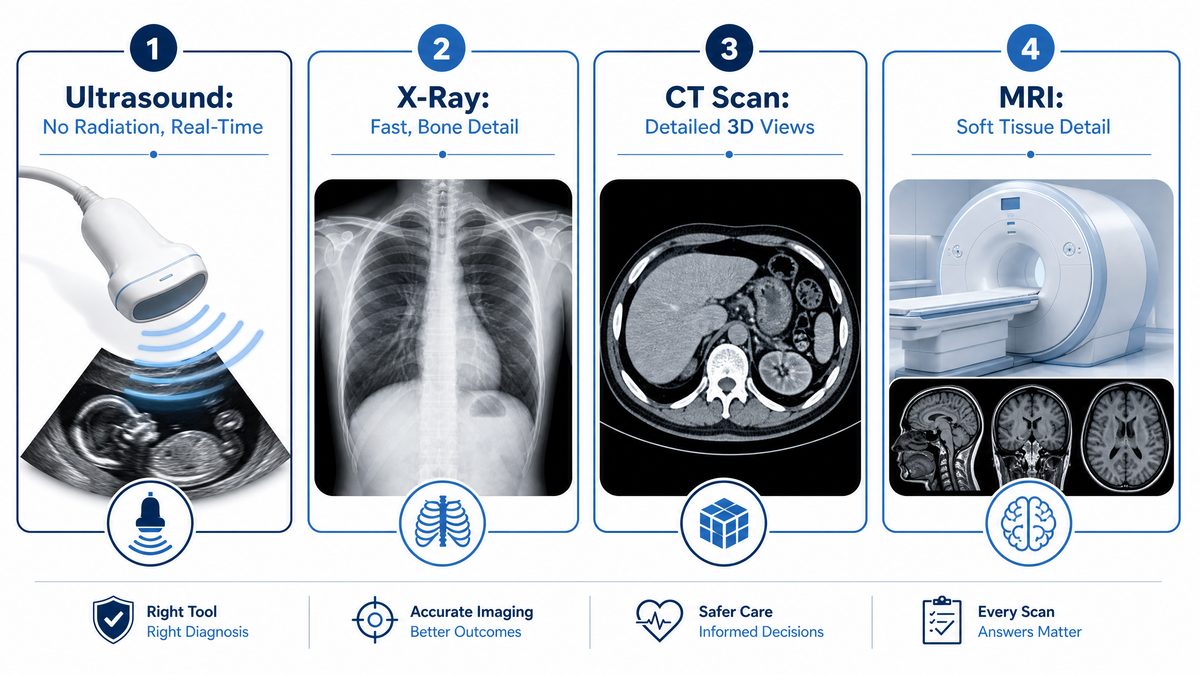
Side-by-side cardiac imaging modalities including echocardiogram ECG cardiac MRI and CT coronary angiography
Structure
Echo, MRI, CT
Rhythm
ECG, Holter
Function
Stress echo, stress MRI
Arteries
CT coronary, invasive angio
First Principles

Three Things Cardiac Tests Can Show

Every cardiac test you have ever heard of falls into one of three categories. Understanding which category your clinical question belongs to is the single most useful thing you can do before booking anything. Most confusion about which test to have comes from mixing up these categories — for example, expecting an ECG to show a leaky valve, or expecting an echocardiogram to detect a heart rhythm that only happens once a week.

Category 1

Electrical Activity & Rhythm

Tests that record the electrical signals the heart produces as it beats. They tell you about heart rate, rhythm, conduction pathways, and some indirect evidence of chamber enlargement or prior heart attack — but they do not show the heart’s structure or how well it is pumping.

Tests in this category: 12-lead ECG, Holter monitor, event recorder, implantable loop recorder.

Category 2

Structure & Function

Tests that image the heart itself — the walls, chambers, valves, pericardium, and the way the muscle moves as it contracts. They tell you about pumping strength, valve disease, chamber size, and pericardial fluid. They do not directly image the coronary arteries or map the electrical system.

Tests in this category: Echocardiogram (TTE), transoesophageal echo (TOE), contrast echo, stress echo, cardiac MRI.

Category 3

Coronary Artery Anatomy

Tests that image the coronary arteries — the blood vessels that supply the heart muscle itself. They tell you whether arteries are narrowed or blocked and quantify calcium and plaque burden. They do not tell you anything directly about valve function or rhythm.

Tests in this category: CT coronary angiography, invasive coronary angiography, stress cardiac MRI (indirectly, via perfusion).

Why this matters

If your symptom is palpitations, a category 1 test is the first step. If your symptom is breathlessness with a suspected heart failure diagnosis, a category 2 test is the first step. If your symptom is exertional chest pain suggesting coronary disease, a category 3 test (usually CT coronary angiography under NICE CG95) is the first step — though a functional category 2 test such as stress echo is an alternative. Many patients end up needing two tests because their situation spans two categories — for example, palpitations plus a murmur, or chest pain plus a family history of cardiomyopathy.

Side-by-Side

The Full Comparison Table

Every non-invasive cardiac test commonly used in adult medicine, with what it shows, what it does not show, its main strengths, and its typical first-line indication. The table includes tests that are available at Sonoworld and tests you would need to book at a specialist imaging centre elsewhere in London.

Test Category Shows Does Not Show Radiation Available at Sonoworld
12-lead ECG Rhythm Current heart rhythm, conduction, hypertrophy signs, prior MI pattern Intermittent arrhythmias, valve disease, pumping strength None Yes
Holter monitor (24–72 hr) Rhythm Intermittent arrhythmia, heart rate variability over 1–3 days Rare events, structural disease, ischaemia None Yes
Event recorder / loop recorder Rhythm Rare or very intermittent arrhythmias, long-duration recording Structural disease, ischaemia None No — referred
Echocardiogram (TTE) Structure Chambers, valves, ejection fraction, pericardium, estimated pressures Coronary arteries, rhythm, detailed scar None Yes
Stress echocardiogram Structure + Function Inducible ischaemia, valve disease under load, functional capacity Coronary anatomy, scar quantification None Yes
Contrast echocardiogram Structure Apical thrombus, patent foramen ovale, clearer LV borders Coronary anatomy, detailed scar None Yes
Transoesophageal echo (TOE) Structure Left atrial appendage, prosthetic valves, endocarditis, PFO characterisation Coronary anatomy, scar None Yes
Cardiac MRI Structure + Function Detailed anatomy, scar and fibrosis quantification, myocarditis, cardiomyopathy characterisation Rhythm; limited coronary visualisation None (gadolinium contrast) No — referred to specialist centre
Stress cardiac MRI Function Inducible ischaemia via perfusion, scar and viability Rhythm; direct coronary anatomy None (gadolinium) No — referred
CT coronary angiography Arteries Coronary artery anatomy, narrowings, plaques, calcium score Rhythm, chamber function (limited) Low-dose X-ray + iodinated contrast No — referred to specialist CT centre
Invasive coronary angiography Arteries Direct imaging of coronary arteries via arterial catheter; treats at the same time if needed Rhythm, chamber function (limited) X-ray + iodinated contrast No — hospital procedure

Sonoworld offers all ultrasound-based and ECG-based cardiac tests. Cardiac MRI, CT coronary angiography, and invasive angiography require specialist equipment not present in any ultrasound clinic — we will happily refer you to an appropriate centre if that is what your situation needs. For pricing on the tests we do offer, see our echocardiogram cost page.

Match Test to Symptom

Which Test Matches Your Symptom?

This is not a diagnostic tool — if you are unsure, call the clinic and talk it through with a clinician. But for the most common presentations, the first-line test is usually predictable. Here is how the seven most common reasons people book a private cardiac investigation map onto the test that is likely to answer their question.

Palpitations or awareness of heartbeat

First-line: ECG, usually followed by a Holter monitor.

Palpitations are a rhythm question. A 12-lead ECG captures the current rhythm; a Holter monitor records the rhythm continuously over 24–72 hours to catch intermittent events. An echocardiogram is often added to check for any underlying structural cause, but it is the rhythm test that answers the actual question.

Breathlessness at rest or on mild exertion

First-line: Echocardiogram.

Breathlessness is usually about pumping function or valve disease. A standard echocardiogram measures ejection fraction, assesses the valves, and estimates filling pressures — which is what heart-failure workup depends on. If the breathlessness only happens with effort, a stress echocardiogram may be needed instead.

Chest pain on exertion (stable angina pattern)

First-line under NICE CG95: CT coronary angiography. Stress echo is a valid alternative.

Chest pain on exertion usually means the question is whether a coronary artery is narrowed. Under NICE CG95, CT coronary angiography is the recommended first-line test in most cases — this is not offered at Sonoworld and we would refer you to a specialist CT centre. If CT is unsuitable or you need functional assessment, a stress echocardiogram is an excellent alternative.

Murmur detected on examination

First-line: Echocardiogram.

A heart murmur is a structure question. A standard echo will identify the underlying cause, grade its severity, and determine whether it requires follow-up. Only a small minority of murmurs need anything beyond an echo.

Unexplained stroke or TIA in a younger patient

First-line: Bubble study contrast echo.

In younger patients with stroke or TIA and no obvious cause, the question is usually whether a patent foramen ovale is providing a route for a clot to reach the brain. A bubble study is the non-invasive screening test, and a positive result is typically followed by a TOE to characterise the defect.

Suspected cardiomyopathy or family history

First-line: Echocardiogram; cardiac MRI for complex cases.

An echocardiogram is the right first step for any suspected cardiomyopathy — it will detect hypertrophy, chamber dilatation, and most systolic and diastolic abnormalities. Cardiac MRI is added when the diagnosis is uncertain, when tissue characterisation is needed, or when scar quantification is required to guide prognosis. MRI is not performed at Sonoworld.

Pre-participation or high-performance sports screening

First-line: ECG + echocardiogram.

Sports cardiac screening combines a rhythm test with a structural test, following the pattern used by many professional sporting bodies. The combination detects most of the inherited conditions relevant to exercise safety. Additional tests are only added if the first two raise concerns.

Known heart condition needing monitoring

First-line: Same test that confirmed the diagnosis.

For known valve disease, cardiomyopathy, or heart failure, the follow-up test is almost always a repeat of the test that established the diagnosis — usually an echocardiogram at an interval set by your cardiologist. Consistency between scans matters more than using a different modality.

Honest Positioning

What Sonoworld Offers — and What We Don’t

Sonoworld is an ultrasound-led cardiac diagnostic clinic. The equipment, staff, and premises are built around ultrasound and rhythm testing — not CT or MRI. That means we can offer same-day echocardiograms and Holter monitors with rapid reports, but it also means there are tests we deliberately do not provide. If your clinical question needs one of those tests, we will tell you and point you in the right direction rather than try to sell you something that does not answer your question.

We Will Refer You

Not Available at Sonoworld

These tests require specialist equipment and premises that an ultrasound clinic does not and should not have. If your clinical question needs one of these, we will be honest with you about it and point you to a reputable specialist centre.

  • Cardiac MRI — needed for cardiomyopathy workup, scar quantification, and complex congenital cases. Available at specialist imaging centres across London.
  • Stress cardiac MRI — an alternative functional ischaemia test for patients who cannot have stress echo or CT.
  • CT coronary angiography — first-line for most stable chest pain under NICE CG95. Available at specialist CT centres.
  • Coronary calcium scoring — a short CT scan that quantifies coronary calcium as a risk marker.
  • Invasive coronary angiography — a hospital-based cardiac catheterisation procedure performed when a definitive answer is needed or when stenting is being considered.
  • Event recorders & implantable loop recorders — for rhythm events that are too rare to capture on a 72-hour Holter.
  • Electrophysiology studies & ablation — hospital-based interventional procedures for arrhythmia treatment.

Our triage commitment

Call us with your symptoms and we will give you an honest answer about whether an echo or ECG is the right test for your situation. If it is not — if you need CT or MRI — we will tell you that clearly before any booking is confirmed. We would rather send you to the right place once than perform a test that does not answer your question.

Common Questions

The Most Commonly Asked Comparisons

These are the five comparisons patients ask us about most often. Each one has a clear, short answer — the longer explanation of any of them lives on the individual test pages linked below.

Echocardiogram vs ECG

The single most commonly confused pair. An echocardiogram uses ultrasound to image the heart’s structure — chambers, valves, ejection fraction, pericardium. An ECG records the heart’s electrical activity — rhythm, rate, conduction, evidence of prior MI. They answer completely different questions and are often done together for a complete picture.

Echocardiogram → · ECG →

Echocardiogram vs Holter monitor

An echocardiogram is a structural snapshot lasting 30–45 minutes. A Holter monitor is a continuous rhythm recording lasting 24–72 hours. If your symptom is palpitations that come and go, a Holter catches the rhythm; an echo does not. If your symptom is breathlessness with a suspected valve or muscle problem, an echo answers it; a Holter does not.

Echocardiogram → · Holter monitor →

Standard echo vs Stress echo

A standard echocardiogram images the heart at rest. A stress echocardiogram adds a second set of images captured during exercise or under dobutamine, so that regions of heart muscle with inadequate blood supply can be identified by their abnormal motion under load. Many patients with suspected coronary disease have a completely normal resting echo — the abnormality only appears with stress.

Standard echo → · Stress echo →

Echocardiogram vs Cardiac MRI

An echocardiogram is the first-line structural heart test — quicker, cheaper, widely available, and answers most questions. Cardiac MRI adds detailed tissue characterisation, scar quantification, and complex anatomical assessment, and is the gold standard for cardiomyopathy workup. For routine assessment of heart function and valves, echo is sufficient. For complex or uncertain cases, cardiac MRI adds information echo cannot. We offer echo; we do not offer cardiac MRI.

Echocardiogram →

Echocardiogram vs CT coronary angiography

These tests answer different questions entirely. An echocardiogram shows the heart’s structure and function but does not directly image the coronary arteries. A CT coronary angiogram shows the coronary arteries and any narrowings but does not show chamber function. For exertional chest pain with suspected coronary disease, NICE CG95 recommends CT coronary angiography first-line — not echo. We offer echo and stress echo; we do not offer CT coronary angiography.

Stress echo →

Stress echo vs Stress MRI vs Myocardial perfusion

All three assess for inducible ischaemia, with roughly comparable diagnostic accuracy for most patients. Stress echo is the ultrasound-based option — no radiation, no contrast, widely available. Stress cardiac MRI is the MRI-based alternative, used particularly for complex or repeat cases. Myocardial perfusion imaging uses a radioactive tracer and is less commonly used in younger patients because of the radiation dose. Choice between them depends on local availability, patient factors, and the specific clinical question.

Stress echo →

When You Need More Than One

Common Test Combinations

Many cardiac situations straddle more than one category and benefit from two or three tests done together. These are the combinations we most often suggest at the triage stage, matched to the underlying clinical question.

1

Echo + ECG

The classic baseline cardiac assessment — structure plus rhythm in one visit. Good for heart health screening, pre-participation sports medicine, and anyone wanting a simple foundation check.

2

Echo + ECG + Holter

Used when palpitations or dizziness are reported alongside any structural concern. The echo rules out an underlying cause; the ECG and Holter characterise the rhythm problem itself.

3

Echo + Carotid Doppler

A stroke-risk combination — the echo assesses cardiac sources of embolism while the carotid scan looks at plaque in the neck arteries that supply the brain.

4

Echo + Bubble Study

Performed in the same appointment when a patent foramen ovale needs to be excluded alongside a standard structural assessment — for example in younger stroke or TIA patients.

5

Stress Echo + Cardiac Blood Panel

Exertional symptoms plus cardiovascular risk assessment in one visit. The stress echo answers the functional question; the bloods (cholesterol, BNP, HbA1c, inflammatory markers) characterise overall risk.

6

TOE + TTE

A standard echo is almost always performed before or alongside a TOE, so that the standard views are available as baseline and the TOE can focus on the specific question that requires the higher-resolution oesophageal approach.

For combination pricing, see our cardiac screening packages — most of the combinations above are available at a package rate below the sum of the individual tests.

Ready to Decide

Not Sure Which Test You Need? Call for Triage Advice

If, after reading this page, you are still not sure which test matches your situation, the best thing you can do is call us and talk it through. The conversation is free, the advice is honest, and there is no obligation to book anything. If your situation needs a test we do not offer, we will tell you.

Book Directly or Call First

Sonoworld · 29 Weymouth Street, London W1G 7DB

If you already know which scan you need, book online for a same-day slot. If you are not sure, call the clinical team and we will help you decide — including recommending tests we do not offer if that is the right answer for your situation.

Free triage advice · No obligation · Honest answers

Quick decision reference

  • Palpitations? ECG + Holter first
  • Breathlessness? Echo first
  • Exertional chest pain? CT coronary angiography or stress echo
  • Murmur? Echo first
  • Unexplained stroke? Bubble study + TOE
  • Cardiomyopathy family history? Echo first; MRI if uncertain
  • Sports screening? Echo + ECG

One final principle

When in doubt, a standard transthoracic echocardiogram and a 12-lead ECG are the correct first tests for almost any cardiac concern in adult medicine. They answer the structure and rhythm questions that underlie most diagnoses, and they guide the decision about whether any further imaging is actually needed. If you only do one or two things, do these.

Frequently Asked Questions

Cardiac Test Selection — Common Questions

What is the difference between an echocardiogram and an ECG?

An echocardiogram uses ultrasound to image the heart’s structure — the chambers, walls, valves, and how well it pumps. An ECG records the heart’s electrical activity using sticky electrodes on the skin. They answer completely different questions. An echo is the right test for heart failure, murmurs, and valve disease; an ECG is the right test for rhythm problems, conduction issues, and acute chest pain assessment. Many patients need both to get a complete picture.

Which test should I have first — echo or cardiac MRI?

Echo first, in almost every case. An echocardiogram answers most structural cardiac questions — ejection fraction, valve disease, chamber size, pericardial effusion — and is quicker, cheaper, and more widely available than cardiac MRI. Cardiac MRI is added when the diagnosis is uncertain, when detailed tissue characterisation is needed (for example in suspected cardiomyopathy or myocarditis), or when scar quantification is required to guide prognosis. We offer echocardiography but not MRI; if your situation needs MRI we will refer you to an appropriate specialist centre.

Can an echocardiogram detect coronary artery disease?

Not directly. A standard echocardiogram does not image the coronary arteries themselves — they are too small and too superficial to be seen from chest-wall ultrasound. What an echo can do is detect the consequences of coronary disease: a previous heart attack may show as a region of impaired wall motion, and a stress echocardiogram can identify inducible ischaemia when the heart is placed under load. For direct coronary artery imaging, you need CT coronary angiography or invasive coronary angiography — neither of which are ultrasound-based tests, and neither of which we offer at Sonoworld.

If I have palpitations, will an echocardiogram show them?

Only if the palpitations happen to occur during the scan itself, which is unusual. An echocardiogram is a structural test — it shows the heart’s anatomy and function but does not record the electrical rhythm. For palpitations the right tests are an ECG (which captures the current rhythm during the appointment) and a Holter monitor (which records the rhythm continuously over 24 to 72 hours, catching events that happen when you are not in clinic). An echo is often added to look for any underlying structural cause, but the rhythm tests are what answer the actual question about the palpitations themselves.

Do you offer CT coronary angiography or cardiac MRI?

No. Sonoworld is an ultrasound-led cardiac diagnostic clinic. CT coronary angiography and cardiac MRI require dedicated CT and MRI scanners — equipment that is not present in any ultrasound clinic. If your clinical question needs one of these tests, we will be honest with you about it at the point of enquiry and direct you to a reputable specialist imaging centre. We would rather send you to the right place once than perform a scan that does not answer your question.

Is a stress echocardiogram as good as a CT coronary angiogram?

They answer different questions, so "as good as" does not quite apply. A CT coronary angiogram is an anatomical test — it shows coronary artery narrowings directly. A stress echo is a functional test — it shows whether the heart muscle gets enough blood on demand. Under NICE CG95, CT coronary angiography is recommended first-line for most stable chest pain. Stress echo is used when CT is unsuitable or contraindicated, or when the clinical question is specifically about the functional significance of a known narrowing. For direct anatomical assessment of the coronary arteries, CT wins; for functional assessment of whether a narrowing matters clinically, stress echo is comparable or better.

Why would a cardiologist order more than one cardiac test?

Because most cardiac situations involve more than one question. A patient with atrial fibrillation and a murmur needs a rhythm test (ECG and Holter) and a structural test (echo) — one modality alone would only tell half the story. A patient with exertional chest pain and breathlessness needs both a functional ischaemia test and a structural assessment. Combining tests at a single visit saves time, money, and the frustration of returning for a second appointment. Our cardiac screening packages are priced to reflect this.

I already had an echocardiogram last year. Should I have the same test again, or something different?

For monitoring a known condition, repeat the same test. The point of follow-up imaging is to compare like with like, and consistency between scans matters more than switching to a different modality. Your cardiologist will set the interval — usually annual for stable valve disease or heart failure, more often if the condition is changing. If your symptoms have changed significantly since the last scan, or if the question has shifted (for example, new breathlessness on exertion), a different or additional test may be appropriate. Call us with your previous report and we will help you decide.

If the tests all cost different amounts, which one is the best value?

The best value is the test that answers your actual question — paying less for a test that does not answer it is the most expensive outcome, not the cheapest. For most people, a standard echocardiogram (from £350) is both the lowest-cost first-line test we offer and the one most likely to give a useful answer. For specific questions — palpitations, exertional symptoms, suspected PFO, prosthetic valves — a more specialised and more expensive test will be worth it because it answers the question the standard echo cannot. Our cost page lists every price transparently, and our triage team will never recommend a more expensive test than your situation needs.

What if my symptoms are severe — should I still read this page or go straight to A&E?

Severe or acute cardiac symptoms need emergency assessment, not a private outpatient scan. Chest pain at rest, sudden severe breathlessness, new one-sided weakness or facial droop, sudden speech difficulty, collapse, or any symptoms suggestive of a heart attack or stroke — call 999 or go to your nearest A&E immediately. Private diagnostic scans are planned investigations for stable, investigative situations, not for acute cardiac events. Once you are stable and a specific clinical question has emerged from the acute workup, a private scan may well be useful as a follow-up step.

Find Us

Sonoworld — Marylebone, London (near Harley Street)

Clinic address

29 Weymouth Street
London W1G 7DB

Nearest stations: Regent's Park (Bakerloo) · Great Portland Street (Circle, H&C, Metropolitan) · Baker Street (Jubilee, Bakerloo, Metropolitan)

Open in Google Maps

Opening hours

Monday – Friday08:00 – 20:00
Saturday09:00 – 17:00
Sunday10:00 – 16:00

Still not sure?

Call us for free triage advice. Honest answers, no obligation to book.

The full cardiac cluster

All cardiac tests offered at Sonoworld — clinical details, indications, preparation, and pricing.

First-line

Standard Echo

Non-invasive heart ultrasound.

Functional

Stress Echo

Heart under exercise or dobutamine.

Enhanced

Contrast Echo

Bubble study or LV opacification.

Specialist

TOE

Imaging from inside the oesophagus.

Rhythm

ECG

12-lead electrical recording.

Rhythm

Holter

24–72 hr continuous rhythm.

crossmenu
Not sure which scan you need?
Sono AISonoworld Scan Advisor
Tap to Call