A fast, non-invasive ultrasound assessment of your heart’s structure and function — performed in a calm private clinic near Harley Street. We accept self-referrals and medical insurance.
Location: 29 Weymouth Street, Marylebone, London W1G 7DB • Directions & transport
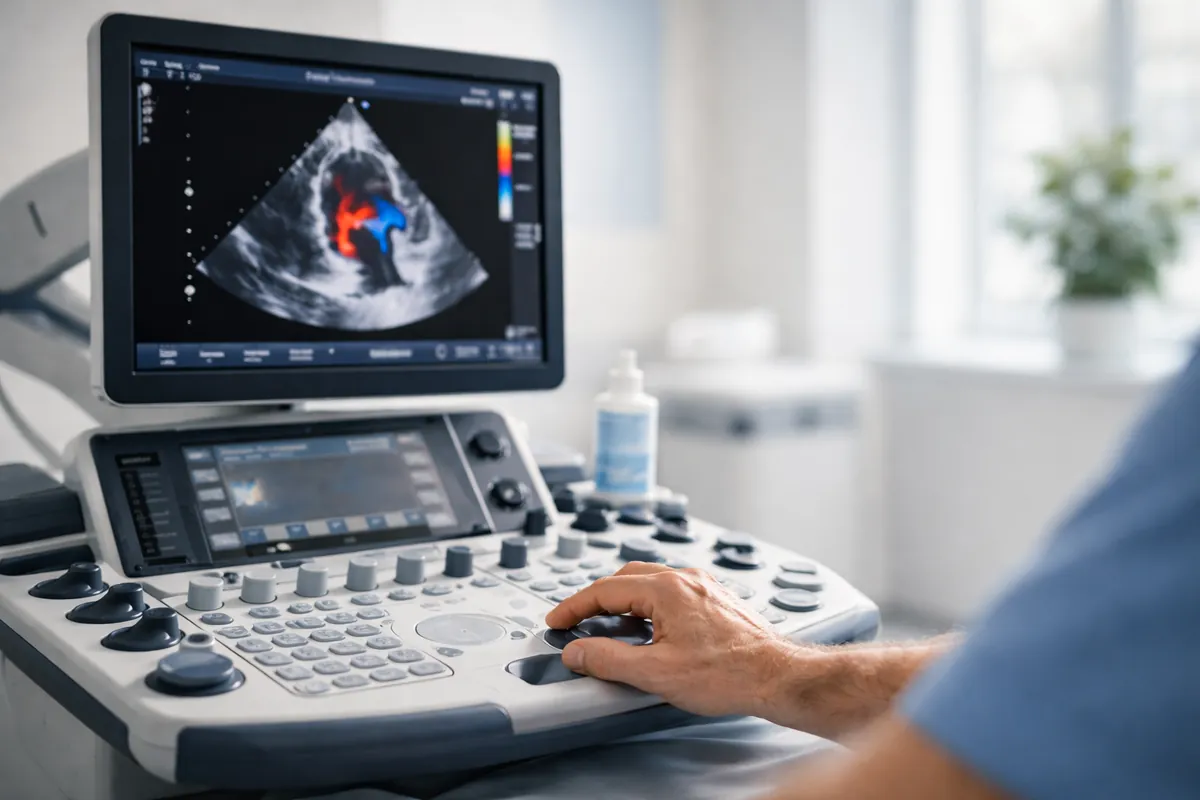
An echocardiogram (often called an “echo”) uses ultrasound to create moving images of the heart. It helps clinicians assess how the heart looks, how it moves, and how blood flows through the chambers and valves.
If you’re mainly worried about leg swelling or possible clots, you may need a DVT ultrasound instead. If you’re unsure, call us and we’ll guide you.
Most people book privately because they want reassurance or faster answers. In practice, an echocardiogram is often used to investigate symptoms, to assess a known diagnosis, or to provide a baseline before treatment or exercise plans.
If you have severe chest pain, severe breathlessness at rest, or feel acutely unwell, seek urgent medical care first. A private scan is best for assessment and clarification — not emergency treatment.
We keep the process simple and respectful. You’ll be guided step-by-step, with time to ask questions.
We confirm your details, symptoms, and any relevant history (including medications and prior tests).
You’ll undress to the waist and lie on the couch. We apply ultrasound gel and place the probe on the chest to capture heart views.
You receive your report and guidance on what to do next — whether that’s reassurance, GP follow-up, or specialist referral.
Need to coordinate with your insurer? See the insurance section below.
For a standard transthoracic echocardiogram, there’s usually no special preparation. Wear comfortable clothing that’s easy to remove from the upper body.
Some advanced echo types (e.g., stress or transoesophageal echo) have different requirements. If your clinician requests a specific echo type, let us know when booking.
You can book directly without a GP referral for most private scans. If you’re using private medical insurance, we can usually accommodate that too — the key is getting the right pre-authorisation steps done first.
Confirm an echocardiogram is covered and whether you need a referral letter or authorisation code.
Use online booking or call us. Provide your insurer details and authorisation code (if required).
We provide written findings and next-step guidance for you and your clinician.
Prefer to talk it through? Call 020 3633 4902 or message us.
Short, direct answers to the questions people ask right before booking.
Fast-access appointments, clear reporting, and guidance you can act on — whether you’re self-referring or using insurance.
Prefer to speak to someone first? Call 020 3633 4902 or email info@sonoworld.co.uk.
People often book an echocardiogram because they want a clear answer fast. An echo is excellent for structure and function—but it’s important to understand where it fits among other cardiac tests.
Shows how the heart chambers move, how valves open/close, whether pumping looks reduced, and whether there’s fluid around the heart. Doppler helps evaluate blood flow and valve leakage/narrowing.
Echo does not directly image the coronary arteries in a way that reliably diagnoses coronary artery blockage. Depending on symptoms and risk, clinicians may use ECG, blood tests, CT coronary angiography, or stress testing.
When you know what the test is designed to answer, you book with confidence—no wasted appointments, no “maybe it will show it” uncertainty.
If your main concern is circulation (legs/neck/aorta), a vascular Doppler scan may be a better first step: Cardiovascular (vascular) ultrasound hub.
This section is designed to mirror how people actually decide to book—based on symptoms. Use it as a quick guide. If you have severe symptoms or feel acutely unwell, seek urgent medical care.
Echo helps assess pumping function and valve disease that can contribute to breathlessness—especially if symptoms are new or worsening.
Echo evaluates structure; ECG/Holter evaluates rhythm. Together they provide a more complete picture.
Echo is the primary imaging test to assess valve narrowing/leakage and its haemodynamic significance.
Echo can assess cardiac contributors. If DVT is suspected, consider a DVT ultrasound urgently.
Echo may help evaluate function and valves, but acute chest pain needs urgent assessment (ECG + blood tests).
Follow-up echo can track valve disease, cardiomyopathy, or changes over time as advised by your clinician.
If you have severe chest pain, fainting, severe breathlessness at rest, or one-sided leg swelling with sudden pain, seek urgent medical care immediately. Private scanning is ideal for assessment and clarity, but emergencies require immediate clinical support.
Trust in diagnostic imaging comes from three things: equipment, operator skill, and structured reporting. We focus on all three so the result is clinically actionable.
For circulation-focused concerns, explore our cardiovascular ultrasound cluster: Vascular scans • Carotid Doppler • AAA scan
Sonoworld is located at 29 Weymouth Street, Marylebone, London W1G 7DB — just off Harley Street. Many patients choose us for speed, discretion, and an easy central London visit.
Phone: 020 3633 4902 • Email: info@sonoworld.co.uk