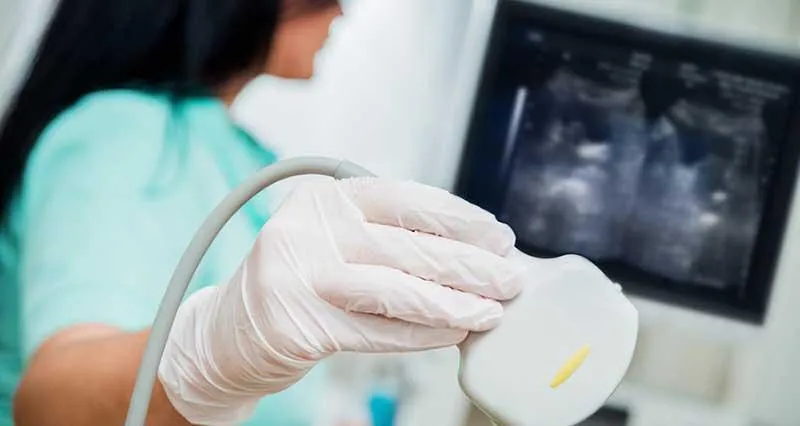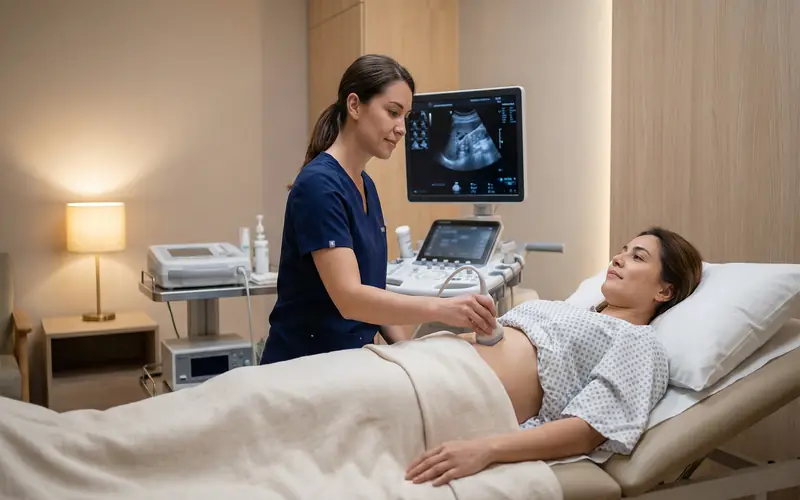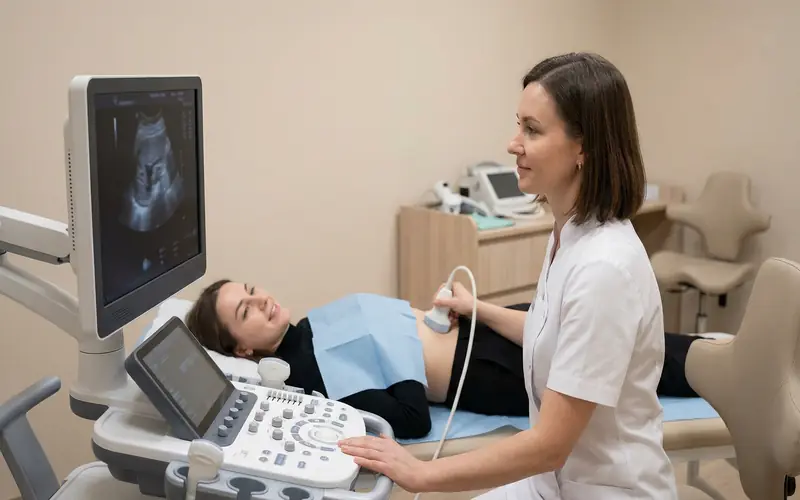
A combined ultrasound examination of the upper abdominal organs and the complete urinary tract — liver, gallbladder, pancreas, spleen, kidneys, ureters, and bladder — in a single 40-minute appointment. Available to men and women. No GP referral required.
Prefer to speak to us first? Call 020 3633 4902
The abdomen and urinary tract scan combines two of the most commonly requested ultrasound examinations into a single appointment. The upper abdominal organs — liver, gallbladder, pancreas, and spleen — are assessed first, followed by a systematic evaluation of both kidneys, the ureters where visible, and the bladder.
This combined scan is particularly useful when symptoms overlap both regions: for example, right-sided abdominal pain may originate from the liver or gallbladder, but also from the right kidney. Booking a combined scan rather than two separate appointments saves time and cost, and gives your sonographer a broader clinical picture in a single session.
The scan is available to both men and women. It is performed by a HCPC-registered consultant sonographer using a GE LOGIQ E10 ultrasound system at our clinic at 29 Weymouth Street, Marylebone — a short walk from Harley Street. A written report with annotated images is provided on the same day.
29 Weymouth Street, Marylebone, London W1G 7DB — a short walk from Harley Street and easily accessible from Great Portland Street and Regent's Park tube stations.
Each component of the scan addresses a distinct anatomical area. Your sonographer will explain findings in each region as they go, providing immediate verbal feedback throughout.
The liver is assessed for fatty infiltration, focal lesions, and signs of cirrhotic change. The gallbladder is examined for stones, polyps, and wall thickening. The pancreatic head, body, and tail are evaluated where visualisation permits. A 4-hour fast is required for this component to ensure the gallbladder is fully distended and bowel gas is minimised.
The spleen is measured and assessed for splenomegaly, focal lesions, and accessory spleens. The abdominal aorta is measured to screen for aneurysmal dilatation — particularly relevant for patients over 50 or those with cardiovascular risk factors. An aortic diameter above 3 cm warrants surveillance.
Both kidneys are examined for cortical thinning, echogenicity changes, stones, cysts, and hydronephrosis. The proximal ureters are assessed where visible. Renal cell carcinoma, transitional cell carcinoma, and obstructive uropathy can all be identified or excluded at this stage. A full bladder is required for optimal visualisation.
The bladder is assessed for wall thickening, trabeculation, stones, and focal lesions. Post-void residual volume can be measured where clinically indicated — particularly relevant for men with lower urinary tract symptoms or women with recurrent urinary tract infections. A comfortably full bladder is required before the scan begins.
The abdomen and urinary tract scan is appropriate when symptoms could originate from either the digestive organs or the urinary system — or when you want to assess both regions simultaneously. It is also used as a follow-up investigation after abnormal blood results, including raised liver enzymes, elevated creatinine, or haematuria.
This combined scan has two preparation requirements that must be followed simultaneously. Correct preparation is essential for diagnostic-quality images — particularly for the gallbladder and bladder.
Do not eat for at least 4 hours before your appointment. This reduces bowel gas and ensures the gallbladder is fully distended for clear visualisation. You may drink plain water. Avoid milk, fizzy drinks, and chewing gum.
Drink 1 litre of still water approximately 1 hour before your appointment and do not empty your bladder before the scan begins. A comfortably full bladder is required for clear visualisation of the bladder wall and kidneys.
From booking to receiving your report, the process is straightforward. Most patients are in and out within 40 minutes.
The abdomen and urinary tract scan is priced at £280 for the complete combined examination. There are no hidden fees, no separate report charges, and no additional costs for images. Everything is included in the single price.
A standard abdominal scan covers the liver, gallbladder, pancreas, spleen, and aorta. The abdomen and urinary tract scan includes all of these, plus a full assessment of both kidneys and the bladder. If you have symptoms that could relate to either the digestive organs or the urinary system — or if your GP has requested both — the combined scan is the more efficient and cost-effective option.
No. You can self-refer and book directly online or by calling 020 3633 4902. If the scan identifies findings that require follow-up, we provide a detailed written report that you can share with your GP or a specialist of your choice.
Fast for a minimum of 4 hours before your appointment — no food, no milk, no fizzy drinks. You may drink plain water. Drink 1 litre of still water approximately 1 hour before your appointment and do not empty your bladder before the scan begins. Both requirements must be followed simultaneously.
Yes. The abdomen and urinary tract scan does not include a pelvic or transvaginal component, so your menstrual cycle does not affect the examination or the results. You can attend at any time of the month.
Your written report with high-resolution annotated images is provided on the same day as your scan. You will also receive immediate verbal feedback from your sonographer during the examination. The report is accepted by GPs, consultants, and private medical insurers.
Yes. We accept AXA Health, Healix, and WPA. Please obtain pre-authorisation from your insurer before your appointment and bring your authorisation reference number. We will provide an itemised invoice for your insurer on request.
Sonoworld is located at 29 Weymouth Street, Marylebone, London W1G 7DB — a short walk from Harley Street and easily accessible by tube, bus, and car.