A dedicated vascular ultrasound-scan that measures the diameter of the abdominal aorta and iliac vessels, detecting aneurysms before they become life-threatening. Same-day written report. No GP referral required.
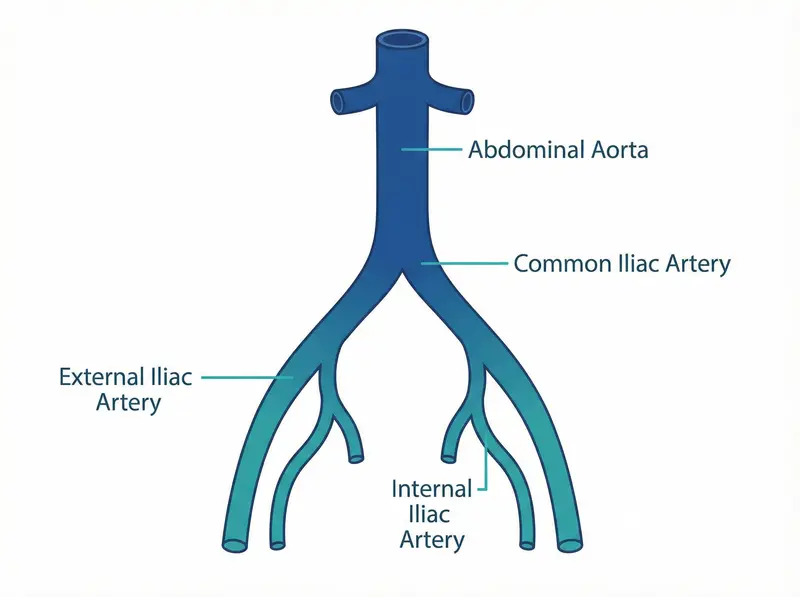
The abdominal aorta is the largest artery in the body. It runs from the heart through the chest and abdomen, supplying blood to the lower body. When the wall of the aorta weakens, it can balloon outward — a condition known as an abdominal aortic aneurysm (AAA). An aorta measuring more than 3 cm in diameter is considered dilated; above 5.5 cm it carries a significant risk of rupture.
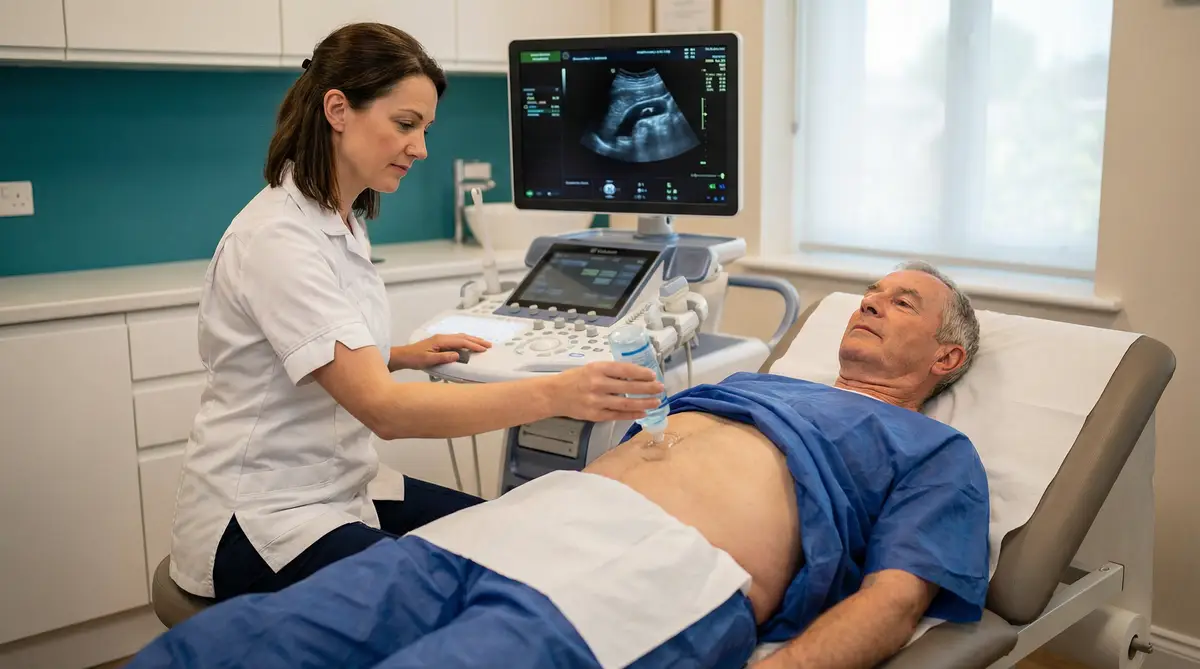
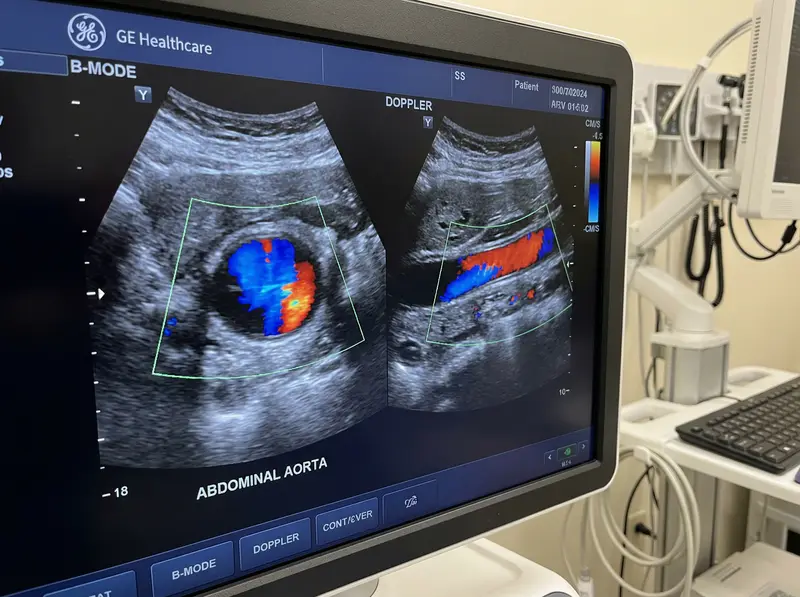
Ultrasound-scan is the gold-standard imaging method for AAA detection and surveillance. The scan is painless, uses no radiation, and produces real-time images of the aorta and its branches. At Sonoworld, the examination is performed by an HCPC-registered vascular sonographer using a GE Voluson system, with a written report issued within 24 hours.
The examination evaluates the aorta and iliac vessels using greyscale imaging and colour Doppler. The table below summarises the structures assessed and the conditions identified.
| Structure | Measurement / Assessment | Conditions Identified |
|---|---|---|
| Abdominal aorta | Anterior-posterior and transverse diameter; wall thickness | AAA, aortic dilation, dissection, atherosclerosis |
| Aortic bifurcation | Greyscale morphology; bifurcation point | Bifurcation aneurysm, plaque, stenosis |
| Common iliac arteries | Bilateral diameter; Doppler waveform | Iliac aneurysm, occlusion, stenosis |
| Colour Doppler flow | Flow direction, velocity, turbulence | Thrombus, flow reversal, high-grade stenosis |
| Aortic wall | Intraluminal thrombus; calcification | Mural thrombus, calcified plaque, wall irregularity |
The NHS offers a one-off AAA ultrasound-scan to men aged 65. Women, younger men, and those with risk factors are not routinely screened. A private AAA ultrasound-scan at Sonoworld allows anyone to access this assessment without waiting for an NHS invitation.
If your NHS scan identified a small or medium AAA, regular surveillance ultrasound-scans are recommended. Sonoworld provides rapid-access surveillance appointments with no waiting list.
AAA is often asymptomatic until rupture. Identifying it early through ultrasound-scan surveillance is the most effective way to reduce mortality. Book an AAA ultrasound-scan if you have any of the following:
Sudden, severe abdominal or back pain — particularly if it is tearing or ripping in character — combined with dizziness, collapse, or a pulsating abdominal mass. These symptoms may indicate an AAA rupture, which is a life-threatening emergency. Call 999 immediately.
If your GP or cardiologist has recommended a broader vascular assessment, these scans are available alongside the AAA ultrasound-scan:
You do not need to fast, but avoid foods that cause significant abdominal gas for 4–6 hours before the scan. These include beans, lentils, carbonated drinks, cabbage, and onions. Excess bowel gas can obscure the aorta and reduce image quality.
Unlike pelvic ultrasound-scans, you do not need a full bladder for an AAA examination. You may drink water normally before your appointment.
Take all prescribed medications as normal. There is no need to stop anticoagulants, antihypertensives, or any other medication before this scan.
Wear loose, comfortable clothing that allows easy access to your abdomen. A two-piece outfit (top and trousers) is ideal. You will be asked to expose your abdomen from the lower chest to the pelvis.
The appointment takes approximately 20 minutes from start to finish. Here is what to expect at each stage.
The sonographer takes a brief cardiovascular history, confirms your risk factors, and explains the procedure. You sign a consent form before the scan begins.
You lie on the examination couch and expose your abdomen. Warm ultrasound gel is applied and the probe is moved across the skin. The aorta is measured in both transverse and longitudinal planes.
Doppler colour flow is applied to assess blood flow direction and velocity within the aorta and iliac vessels. This identifies turbulence, thrombus, and areas of stenosis.
Both common iliac arteries are measured and assessed for dilation or occlusion. The bifurcation point is examined for plaque or aneurysmal change.
The sonographer provides verbal feedback at the end of the scan. A written report with measurements and clinical recommendations is issued within 24 hours and can be shared with your GP or cardiologist.
Choose your preferred date and time below. Booking is confirmed immediately. No GP referral is required.
Ultrasound is regularly being used to evaluate abdominal aortic aneurysms. Abdominal aneurysm is a swelling of the aorta, the main blood vessel that brings blood for your heart to the rest of the body. The aorta is around 2.5 in the abdominal area, it can, however, swell to more than 5 cm.
Aneurysms are more common in men of 65+ years of age than in women and younger men, and they can be fatal as large aneurysms can burst. According to NHS Choices 8 out of 10 people with aortic aneurysm or AAA die.
It is highly unlikely that small aneurysms will cause any symptoms but large aneurysm can cause the following symptoms:
Price includes the scan, verbal feedback, and written report. Insurance patients: please bring your authorisation code.
One fixed price. No hidden fees. No GP referral required.
Insurance patients are welcome. Please bring your authorisation code. Sonoworld is recognised by most major insurers including Bupa, AXA Health, Aviva, and Vitality.
No. You can book an AAA ultrasound-scan at Sonoworld directly, without a GP referral. The scan is available to anyone who wishes to assess their aortic health, regardless of whether they have been referred by a doctor.
Ultrasound-scan has a sensitivity of over 95% for detecting AAA and is the imaging method recommended by NICE and the NHS AAA Screening Programme. It is non-invasive, uses no radiation, and provides real-time measurements of aortic diameter with high reproducibility.
If an AAA is detected, the sonographer will provide verbal feedback immediately and the written report will include the measured diameter and a clinical recommendation. For small AAAs (3.0–4.4 cm), surveillance every 12 months is recommended. For medium AAAs (4.5–5.4 cm), surveillance every 3 months is advised. Large AAAs (≥ 5.5 cm) require urgent referral to a vascular surgeon. Sonoworld can arrange rapid follow-up surveillance appointments.
The AAA ultrasound-scan is completely painless. Warm gel is applied to the abdomen and a probe is moved gently across the skin. There is no radiation, no needles, and no internal examination. Patients with a tender abdomen may experience mild discomfort from probe pressure, which the sonographer will minimise.
The written report is issued within 24 hours of your appointment. It includes the aortic diameter measurements, assessment of the iliac vessels, Doppler findings, and a clinical recommendation. The report can be emailed directly to your GP or vascular surgeon on request.
Yes. Although AAA is more common in men aged 65 and over, women — particularly those with hypertension, a smoking history, or a family history of AAA — can also develop the condition. Women are not included in the NHS AAA Screening Programme, making a private scan the only way to access this assessment proactively.
Yes. Appointments can be cancelled or rescheduled up to 24 hours before the appointment time without charge. Cancellations made within 24 hours may be subject to a cancellation fee. Please call 020 3633 4902 or email info@sonoworld.co.uk to make changes.
29 Weymouth Street
London W1G 8NP
Nearest stations: Regent's Park (Bakerloo) · Great Portland Street (Circle, H&C, Metropolitan) · Baker Street (Jubilee, Bakerloo, Metropolitan)
Open in Google Maps