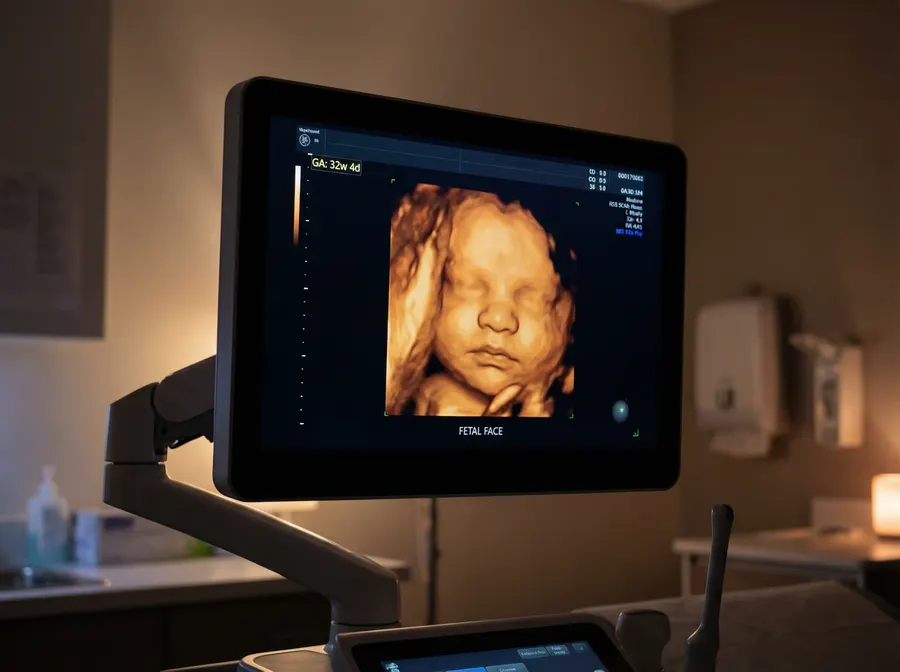
See your baby's face, hands, and movements in live 3D/4D at our CQC-registered Harley Street clinic. The optimal bonding experience, best between 26 and 32 weeks. Includes printed images and a digital recording. No GP referral required.
Best between 26–32 weeks. Partners and family welcome to attend.
A 3D/4D baby scan uses advanced ultrasound technology to create real-time, three-dimensional images of your baby in the womb. Unlike standard 2D diagnostic scans, which produce flat cross-sectional images, a 4D scan renders your baby's face, hands, and body in lifelike detail — and the "4D" element means you see these images in live motion, as your baby yawns, stretches, and moves.
At Sonoworld, our 4D scans are performed by HCPC-registered consultant sonographers using high-resolution GE ultrasound equipment. The scan is performed abdominally and is entirely safe for both mother and baby. It is a bonding and keepsake experience — not a diagnostic examination — and does not replace your routine NHS antenatal care.
The quality of 4D images depends on your baby's position, the amount of amniotic fluid, and your body type. Our sonographers are experienced in optimising image quality and will take time to get the best possible views of your baby.
See your baby's nose, lips, cheeks, and eye sockets in three-dimensional detail. Many parents see family resemblances for the first time during a 4D scan. The optimal window is 26–32 weeks, when facial features are fully formed but the baby is not yet too large.
Watch your baby yawn, suck their thumb, open and close their hands, and kick in real time. The "4D" element means these movements are captured as live video — not just still images — making the experience genuinely memorable.
In addition to the bonding experience, your sonographer will check the fetal heartbeat, confirm the baby's position, and assess the amniotic fluid level. Any concerns will be communicated to you immediately and documented in a brief written note.
The optimal window for a 3D/4D baby scan is between 26 and 32 weeks of pregnancy. At this stage, your baby has developed well-defined facial features and has enough subcutaneous fat to give the 3D images a lifelike, rounded appearance. There is also still sufficient amniotic fluid surrounding the baby to provide a clear acoustic window for imaging.
Before 26 weeks, the baby's face is less developed and the images tend to look skeletal rather than lifelike. After 32 weeks, the baby is larger and more engaged in the pelvis, which can make it harder to obtain clear facial views. We recommend booking between 27 and 30 weeks for the best results.
Please note that if your baby is in an unfavourable position (e.g., face-down or back-to-front), our sonographer will take time to encourage movement and optimise the scan. In rare cases where clear images cannot be obtained, we offer a complimentary rescan at a reduced fee.
Arrive at our Harley Street clinic. Partners and guests are welcomed into the scan room from the start. Our team will take a brief clinical history and confirm your gestational age before the scan begins.
Gel is applied to your abdomen and your consultant sonographer begins the scan. The session lasts up to 45 minutes. Your sonographer will work to obtain the best possible views of your baby's face and movements, switching between 2D, 3D, and 4D modes throughout.
Your sonographer will confirm the fetal heartbeat, baby's position, and amniotic fluid level, and will share their observations with you during the scan. Any concerns will be communicated clearly and documented.
You will receive printed 3D images to take home and a digital recording of the scan session. These are yours to keep and share with family and friends.
Looking for other pregnancy scans? View our full range on the Pregnancy Scans Hub, including early pregnancy scans, dating scans, anomaly scans, and growth scans — all at £235.
Yes. Diagnostic ultrasound has been used in obstetric care for over 50 years and has an excellent safety record. The British Medical Ultrasound Society (BMUS) states that there is no confirmed evidence of harm from diagnostic ultrasound when used appropriately. At Sonoworld, all scans are performed by HCPC-registered consultant sonographers who adhere to the ALARA (As Low As Reasonably Achievable) principle, using the lowest power output necessary to obtain clear images.
We can check the baby's gender during your 4D scan if you wish, provided the baby is in a suitable position. However, if gender determination is your primary goal, we recommend booking a dedicated Baby Gender Scan from 16 weeks, where the sonographer can focus specifically on obtaining a clear view of the genital area.
If your baby is face-down or back-to-front, our sonographer will take time to encourage movement — asking you to change position, walk around, or have a cold drink. In most cases, the baby moves during the session. In rare cases where clear facial images cannot be obtained, we offer a complimentary rescan at a reduced fee. We will always be transparent about image quality during the session.
No. The 4D scan at Sonoworld is a bonding and keepsake experience, not a diagnostic anomaly scan. It does not replace your routine NHS antenatal care or the 20-week anomaly scan. If you have not yet had your anomaly scan, we recommend booking a dedicated Anomaly Scan separately.
The scan session lasts up to 45 minutes. Partners and up to two guests are warmly welcome to attend and will be in the room throughout the scan. Please let us know in advance if you are bringing young children so we can ensure the room is suitable.