Book Scan
MSK · Musculoskeletal Ultrasound

Private MSK Ultrasound
Scans in London

Expert musculoskeletal ultrasound imaging for joints, tendons, ligaments, and soft tissue at our CQC-registered Marylebone clinic. Same-day appointments are often available, no GP referral is required, and a written report follows within 24 hours. MSK imaging is one of the ultrasound scans in London that Sonoworld provides at 29 Weymouth Street, Marylebone.

CQC Registered Good No GP Referral Needed Same-Day Results Marylebone, London

20% off with code SONO26 · new bookings

Not sure which joint scan you need? Call our clinical team for guidance.

Private MSK ultrasound scans London, Sonoworld Marylebone clinic
8Joint scan types
24hWritten report
Same DayAppointments
CQCRated Good
Expert MSK Imaging

Specialist Musculoskeletal Ultrasound in Central London

Musculoskeletal ultrasound is the gold-standard imaging modality for assessing soft tissue injuries, joint pathology, and tendon disorders. Unlike MRI, it provides real-time dynamic imaging, allowing our clinicians to assess structures in motion, compare both sides simultaneously, and provide immediate verbal feedback during the examination.

At Sonoworld, all MSK scans are performed by consultant sonographers with specialist musculoskeletal expertise. Every examination uses high-resolution GE ultrasound equipment, and a comprehensive written report is delivered within 24 hours. No GP referral is required.

Why patients choose Sonoworld
  • CQC-registered clinic: inspected and rated Good.
  • Consultant sonographers with specialist MSK expertise.
  • Dynamic real-time imaging: structures assessed in motion.
  • Instant verbal results and a written report within 24 hours.
  • No GP referral required: self-refer online or by phone.
  • Transparent pricing with no hidden fees.
Our MSK Scans

Our MSK Ultrasound Scans

Choose the scan that matches your affected joint or area. If you are unsure, call our team for guidance.

Private shoulder ultrasound scan London
Joint & Tendon

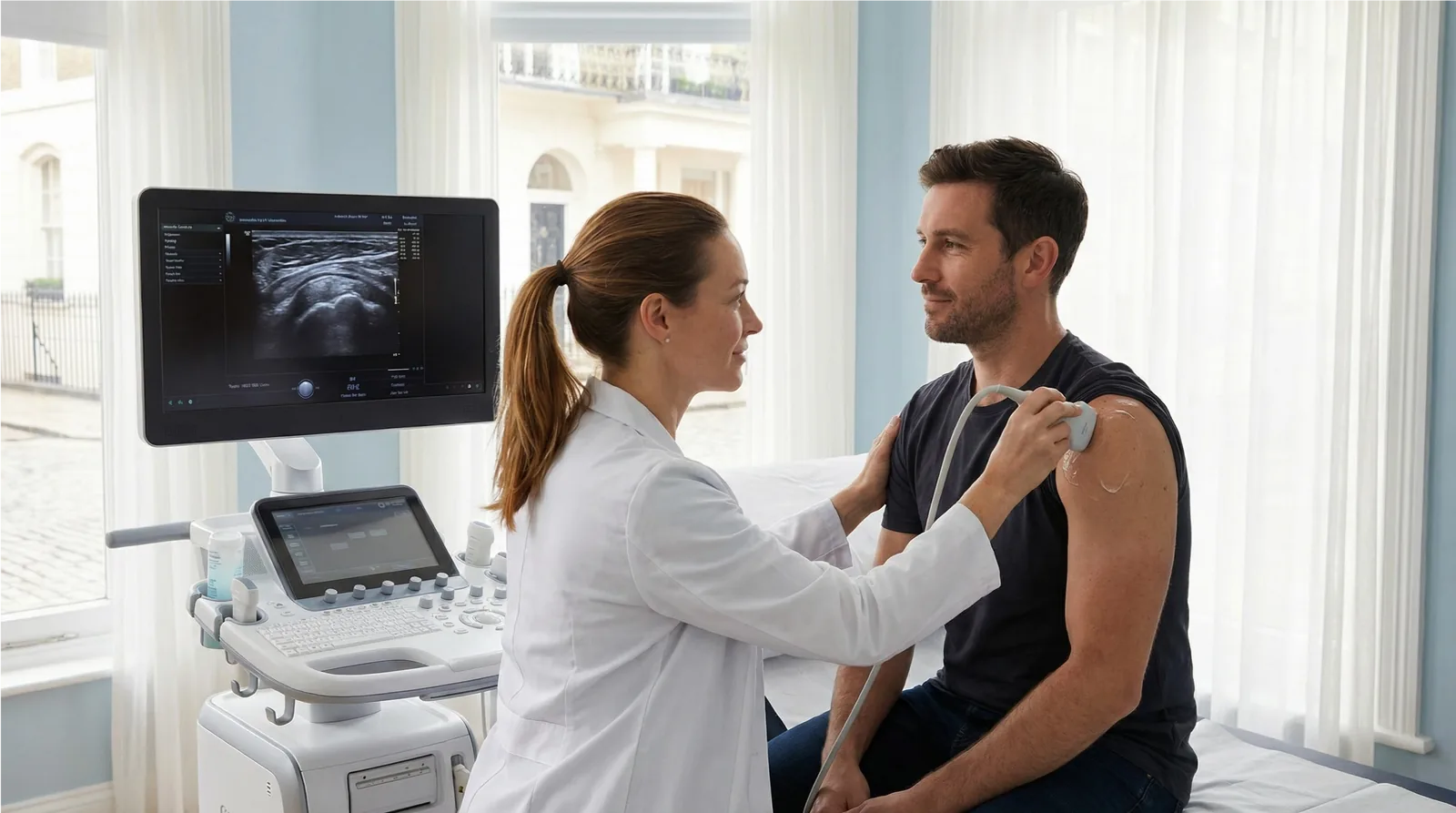
Shoulder Ultrasound Scan

Assessment of the rotator cuff, biceps tendon, subacromial bursa, and acromioclavicular joint. The first-line investigation for shoulder pain, impingement, and suspected rotator cuff tears.

Private knee ultrasound scan London
Joint & Ligament

Knee Ultrasound Scan

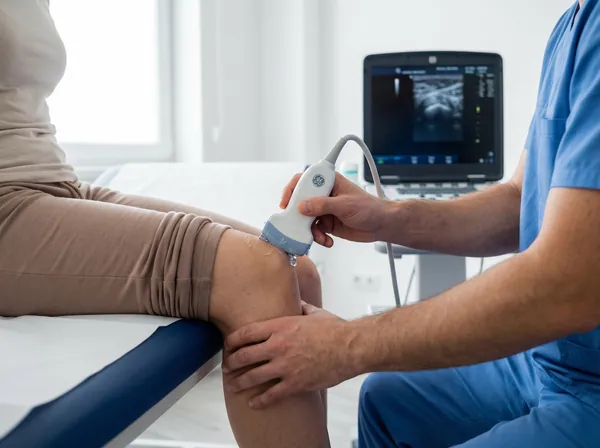
Evaluation of the patellar tendon, quadriceps tendon, collateral ligaments, Baker's cyst, and periarticular soft tissues. Ideal for knee pain, swelling, or suspected ligament injury.

Private hip ultrasound scan London
Joint & Bursa

Hip Ultrasound Scan

Assessment of the hip joint, trochanteric bursa, gluteal tendons, and hip flexor muscles. The preferred modality for trochanteric bursitis, gluteal tendinopathy, and hip flexor strains.

Private ankle ultrasound scan London
Tendon & Ligament

Ankle Ultrasound Scan

Detailed imaging of the Achilles tendon, peroneal tendons, ankle ligaments, and plantar fascia. Ideal for Achilles tendinopathy, ankle sprains, and plantar fasciitis.

Private wrist and hand ultrasound scan London
Wrist & Hand

Wrist & Hand Ultrasound

Assessment of the carpal tunnel, wrist tendons, De Quervain's tenosynovitis, trigger finger, and ganglion cysts. The preferred investigation for wrist pain, hand swelling, and nerve entrapment.

Private elbow ultrasound scan London
Tendon & Nerve

Elbow Ultrasound Scan

Evaluation of the lateral and medial epicondyle tendons, ulnar nerve, and elbow joint. The preferred investigation for tennis elbow, golfer's elbow, and ulnar nerve entrapment.

Private foot ultrasound scan London
Foot & Forefoot

Foot Ultrasound Scan

Assessment of the plantar fascia, forefoot tendons, Morton's neuroma, and metatarsal soft tissues. Ideal for plantar fasciitis, forefoot pain, and suspected Morton's neuroma.

Soft tissue lumps and bumps ultrasound scan London
Soft Tissue

Soft Tissue & Lumps

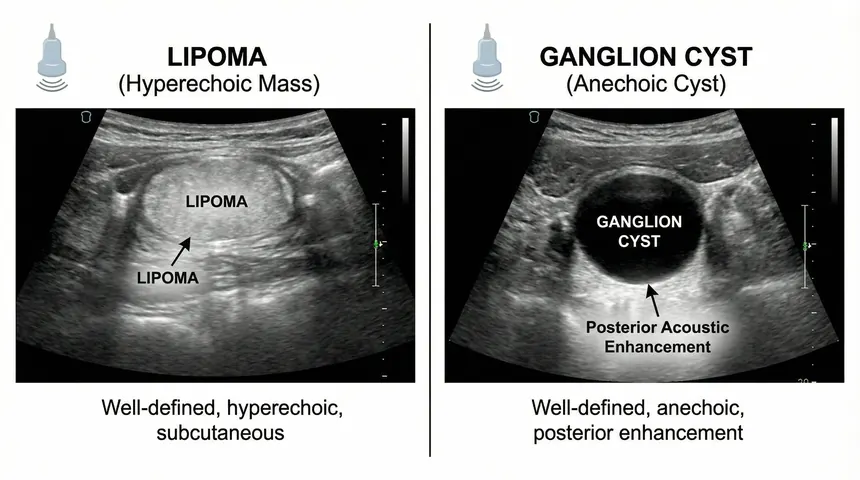
Characterisation of soft tissue masses, lipomas, ganglion cysts, and other lumps throughout the body. Provides rapid, accurate assessment to determine whether a lump requires further investigation.

Symptom Guide

Which MSK Scan Do You Need?

Use this guide to match your symptoms to the most appropriate scan. If you are unsure, our clinical team can advise.

Shoulder pain or weakness

Rotator cuff tear, impingement, or biceps tendinopathy

Shoulder Scan →
Knee pain or swelling

Patellar tendinopathy, Baker's cyst, or ligament injury

Knee Scan →
Achilles or ankle pain

Achilles tendinopathy, ankle ligament sprain, or plantar fasciitis

Ankle Scan →
Wrist pain or tingling

Carpal tunnel syndrome, De Quervain's tenosynovitis, or ganglion cyst

Wrist Scan →
Hip or groin pain

Trochanteric bursitis, gluteal tendinopathy, or hip flexor strain

Hip Scan →
The Process

What to Expect at Your MSK Scan

1 Arrival & Registration

Arrive at our Marylebone clinic. No preparation is required for most MSK scans; wear or bring comfortable, loose clothing for the area being scanned.

2 Dynamic Ultrasound Scan

Your consultant sonographer will apply gel to the skin and scan the affected area using a high-resolution probe. You may be asked to move the joint during the scan for dynamic assessment.

3 Immediate Verbal Feedback

Your sonographer will explain their findings immediately after the scan, answering any questions you may have about what was seen.

4 Written Report Within 24 Hours

A comprehensive written report is emailed to you within 24 hours. You may share this directly with your GP, physiotherapist, or specialist.

Compare before you book

Which MSK ultrasound scan do you need?

All eight joint scans cost £235, take about 30 minutes and need no preparation, so the choice is about where the problem is and what ultrasound can show there. This comparison also covers when an MRI is the better test and how the injection clinic fits in.

ScanPriceTimeTypical problemsPreparation
Shoulder£23530 minRotator cuff tears, impingement, biceps tendon, subacromial bursitisNone
Elbow£23530 minTennis or golfer's elbow, ulnar nerve entrapment, tendon injuryNone
Wrist£23530 minCarpal tunnel, De Quervain's, ganglion cystsNone
Hand and finger£23530 minTrigger finger, Dupuytren's, tendon injuries, small lumps, arthritisNone
Hip£23530 minTrochanteric bursitis, gluteal tendinopathy, hip flexor strain, effusionNone
Knee£23530 minPatellar tendinopathy, Baker's cyst, collateral ligament injuryNone
Ankle£23530 minAchilles tendinopathy, ligament sprains, peroneal tendons, plantar fasciitisNone
Foot£23530 minMorton's neuroma, plantar fasciitis, forefoot tendons, soft-tissue massesNone
Guided cortisone injectionFrom £25015 to 30 minPersistent inflammation of a joint, tendon sheath or bursa after a diagnostic scanDiscussed before booking
Guided hyaluronic acid injectionFrom £25015 to 30 minOsteoarthritis, most often the kneeDiscussed before booking

Choose by where it hurts, then by what ultrasound sees

MSK ultrasound is at its best for tendons, ligaments, muscles, bursae and nerves close to the skin, and it has one advantage no other scan offers: the joint can be moved while it is imaged, so a tendon that catches or a shoulder that pinches can be seen doing it. A shoulder scan is the usual first test for pain reaching overhead or lying on that side, because rotator cuff tears, impingement and bursitis are all soft-tissue problems. For the elbow, wrist and hand, the common questions are tendon irritation, nerve compression such as carpal tunnel, and lumps such as ganglions, and ultrasound answers all three. At the hip it targets the outer-hip tendons and bursa and can confirm fluid in the joint; at the knee it looks at the patellar tendon, the collateral ligaments and cysts behind the knee; and at the ankle and foot it covers the Achilles, ligament sprains, the plantar fascia and Morton's neuroma.

Ultrasound or MRI?

The two answer different questions. Ultrasound is the right choice for anything you can point to near the surface, for problems that change with movement, and when you want an answer the same day. MRI is better for bone, cartilage and the deep structures inside a joint: a suspected meniscal or cruciate tear in the knee, a labral tear in the hip or shoulder, or stress fractures. If your scan suggests one of those, the report will say so and you can take it to a specialist for the MRI request, having already excluded the soft-tissue causes that are far more common.

From diagnosis to injection

Many MSK problems settle with rest, physiotherapy and time. Where inflammation persists in a tendon sheath, bursa or joint, an ultrasound-guided cortisone injection places the medication exactly where the scan showed the problem, and for osteoarthritis, most often the knee, an ultrasound-guided hyaluronic acid injection is the alternative. Injections start from £250, a diagnostic scan usually comes first, and the process, the practitioner and the cost are confirmed with you before anything is arranged.

What the report tells you

An MSK report is written to be used. It names the structure involved, grades a tendon tear as partial or full thickness, measures a collection or cyst, notes whether there is active inflammation on colour Doppler, and states what the finding usually means for treatment: rest and physiotherapy, a guided injection, or a referral for MRI or a surgical opinion. Physiotherapists often ask for exactly this information before planning rehabilitation, and many patients book the scan for that reason rather than waiting for a hospital appointment.

Preparation and what you receive

No MSK scan needs preparation: eat and drink normally and wear clothing that gives easy access to the joint. Bring any previous imaging reports, as they help the sonographer focus. You will hear the findings in the room, and a written report with images follows within 24 hours, suitable for a GP, physiotherapist or orthopaedic specialist.

Still not sure?

A joint that is hot, red and swollen with a fever, or an injury where the limb looks deformed or you cannot bear weight, needs urgent care rather than a booked scan. Use the Scan Advisor, call 020 3633 4902, or book the scan that matches your main symptom: the clinician will tell you on the day if a different examination would answer your question better.

Patient Guides

MSK Health Guides

Evidence-based guides written by our clinical team to help you understand your symptoms and make informed decisions.

Shoulder Pain: When to Get a Scan

How to tell if your shoulder pain needs imaging, and what an ultrasound can reveal about rotator cuff health.

Read the guide →
Knee Pain: When to Get a Scan

A guide to the most common causes of knee pain and when ultrasound imaging is the right next step.

Read the guide →
Hip & Groin Pain: When to Get a Scan

Understanding trochanteric bursitis, gluteal tendinopathy, and other common causes of hip pain.

Read the guide →
Achilles Tendon Pain: A Complete Guide

From Achilles tendinopathy to partial tears: what ultrasound reveals and how to interpret your results.

Read the guide →
Tennis Elbow vs Golfer's Elbow: What's the Difference?

How ultrasound differentiates lateral from medial epicondylitis and guides treatment decisions.

Read the guide →
Carpal Tunnel Syndrome: Diagnosis & Imaging

When wrist pain and tingling needs investigation: the role of ultrasound in carpal tunnel diagnosis.

Read the guide →
Expert MSK Ultrasound, Same-Day Appointments Often Available

Frequently Asked Questions

Do I need a GP referral for an MSK ultrasound?

No. Sonoworld accepts self-referrals for all musculoskeletal scans and no GP letter is required. Your written report is yours to share with a GP, physiotherapist or consultant.

Ultrasound or MRI: which do I need?

They answer different questions. Ultrasound is excellent for tendons, ligaments, bursae and superficial soft tissue, and it is dynamic: the joint can be moved and imaged in real time. MRI is better for bone, cartilage and deep structures within the joint. For most tendon and soft-tissue problems, ultrasound is the appropriate first test.

Can you scan both sides in one appointment?

Yes. Comparing the symptomatic side with the other is often clinically useful, and a bilateral examination is priced at £350 rather than two separate scans.

Do I need to prepare?

No preparation is needed. Wear clothing that allows easy access to the area being scanned, or you will be given a gown.

Can I have an injection at the same appointment?

Not usually at the diagnostic appointment itself. The scan establishes what is wrong first; if an ultrasound-guided injection is appropriate, that is arranged through our injection clinic.

How long does it take and when do I get results?

Most MSK scans take around 20 to 30 minutes. You receive instant verbal results at the appointment, with your written report following within 24 hours.

crossmenu
Not sure which scan you need?
Sono AISonoworld Scan Advisor
Tap to Call