By Daniela Stan, Consultant Sonographer, MSc · 29 Weymouth Street, Marylebone · Medically reviewed by Daniela Stan, Consultant Sonographer, MSc — 25 July 2026 · Last reviewed: 31 July 2026
Shoulder ultrasound is the first-line imaging test for most shoulder pain. It detects rotator cuff tears with high accuracy, assesses the shoulder while it moves, and can guide an injection in the same appointment. Its most useful role is separating a tendon that is simply irritated from one that is torn — because those two findings lead to completely different treatment.
Shoulder pain is one of the most common musculoskeletal complaints in adults. The shoulder is the most mobile joint in the body, which makes it inherently vulnerable to soft tissue injury.
Condition
Typical presentation
Rotator cuff tear
Pain on lifting the arm, weakness, often worse at night; may follow a specific injury or develop gradually
Rotator cuff tendinopathy
Aching pain on overhead activity; no specific injury; often affects both shoulders
Subacromial bursitis
Pain on the outer aspect of the shoulder; painful arc between 60 and 120 degrees of abduction
Biceps tendon pathology
Pain at the front of the shoulder; may be associated with a pop or a visible deformity if the tendon ruptures
Acromioclavicular joint pathology
Pain at the top of the shoulder over the joint; often follows a fall onto the outstretched hand
Frozen shoulder (adhesive capsulitis)
Gradual stiffness and pain; loss of both active and passive movement; typically self-limiting over 18 to 24 months
Glenohumeral osteoarthritis
Deep aching pain; loss of range of movement; typically in older adults
The cuff passes through a narrow space beneath the acromion, which is why movement matters to the assessment.
When it needs a scan
Shoulder pain has persisted for more than four to six weeks without improvement
There is weakness on lifting the arm, which suggests a rotator cuff tear
There has been a specific injury — a fall or sudden movement — followed by persistent pain
You are being considered for a corticosteroid injection, where guidance significantly improves accuracy
You have had a previous injection that gave no relief, which may mean it was not accurately placed
Your GP or physiotherapist wants imaging to guide management
What a shoulder ultrasound shows
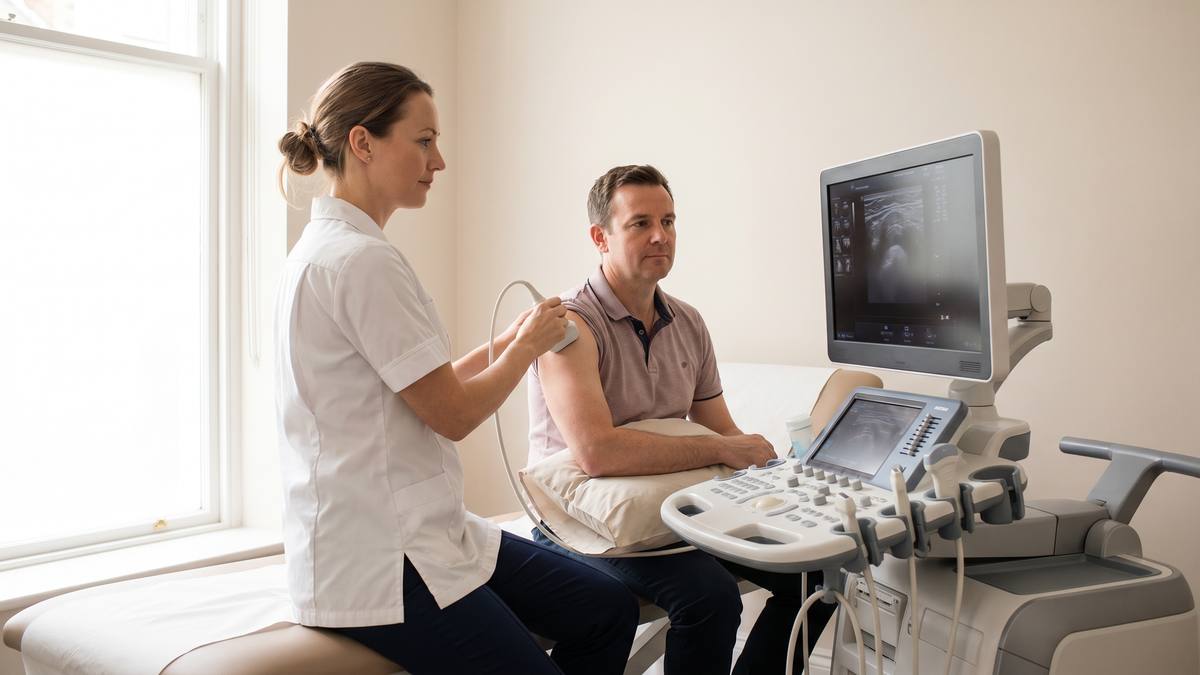
A shoulder ultrasound provides a dynamic, real-time assessment of the soft tissue structures, including:
Rotator cuff tendons (supraspinatus, infraspinatus, subscapularis, teres minor) — partial and full-thickness tears, tendinopathy and calcific deposits
Subacromial bursa — bursitis and impingement
Biceps tendon — tendinopathy, tears and subluxation
Acromioclavicular joint — effusion and osteophytes
Glenohumeral joint — effusion
The dynamic capability — imaging the shoulder in motion — is a genuine advantage over MRI for assessing impingement and cuff function, because impingement is something that happens during movement rather than a fixed appearance.
Ultrasound versus MRI
Factor
Ultrasound
MRI
Rotator cuff tears
Excellent, particularly for full-thickness tears
Excellent
Dynamic assessment
Yes — assesses impingement in real time
No — static images only
Guided injection at the same visit
Yes
No
Labral tears
Limited
Gold standard
Bone marrow oedema, nerve compression
No
Yes
Cost
Lower — £235
Higher; not available at our clinic
For most presentations of shoulder pain, ultrasound is the appropriate first-line investigation. MRI is reserved for cases where labral pathology, bone marrow oedema or nerve compression is suspected, and for surgical planning.
See a doctor rather than booking a scan if you have: shoulder pain after significant trauma with visible deformity or inability to move the arm; a hot, swollen, painful shoulder with fever; shoulder pain with chest pain, breathlessness or sweating; or pain with unexplained weight loss. Left shoulder pain occurring with chest discomfort needs emergency assessment.
From our practice
From our practice
The most common scenario we see is a patient who has been told by their GP that they have shoulder impingement and has been referred for physiotherapy. After six to eight weeks of physiotherapy without improvement, they come to us for a scan.
In a significant proportion of these cases, the ultrasound identifies a partial or full-thickness rotator cuff tear — a finding that changes the management pathway entirely. Physiotherapy alone is not the appropriate treatment for a significant rotator cuff tear; the patient needs a surgical opinion. Early imaging avoids months of ineffective treatment.
Describes general patterns across the patients we scan, not any individual case.
Common questions
Is a shoulder ultrasound scan painful?
No. Warmed gel is applied and a probe is moved over the skin. You will be asked to move your arm into several positions, which may briefly reproduce your symptoms, but the scan itself is painless.
Can ultrasound detect a rotator cuff tear?
Yes, with high accuracy, particularly for full-thickness tears. It also distinguishes a partial tear from tendinopathy, which matters because the two are managed differently.
What is the difference between impingement and a rotator cuff tear?
Impingement describes the tendon being compressed as the arm lifts, causing pain without the tendon being torn. A tear means tendon fibres are disrupted. Both can cause similar symptoms, which is why imaging is useful when physiotherapy is not working.
Do I need a GP referral?
No. You can book a shoulder ultrasound directly with us, and we can send the report to your GP, physiotherapist or a surgeon at your request.
Can I have an injection at the same appointment as my scan?
Where clinically appropriate, yes. Ultrasound-guided injections start from £250 and are discussed after the scan findings, not before.
What does it cost and when do I get results?
A shoulder ultrasound is £235. You receive instant verbal results at the appointment from the consultant performing your scan, with the written report following within 24 hours.