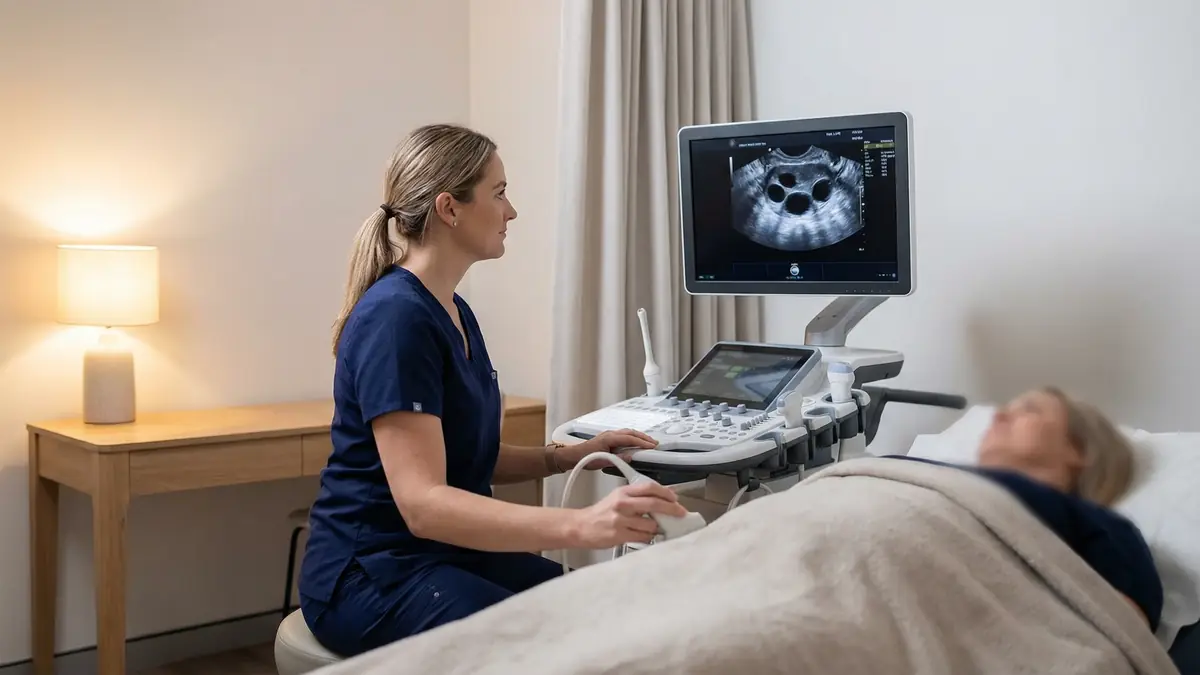
Serial transvaginal ultrasound scans to monitor follicle growth, confirm ovulation timing, and measure endometrial thickness. Used for natural conception support and IVF cycle monitoring. Instant verbal results; written report within 24 hours. No GP referral required.
CQC registered
Same-day availability
Written report within 24 hours
No GP referral needed
Follicular tracking — also called follicle monitoring or ovulation tracking — is a series of transvaginal ultrasound scans performed across a single menstrual cycle to observe how the ovarian follicles develop. Each follicle contains one immature egg, and as the cycle progresses, a dominant follicle grows and eventually releases that egg at ovulation.
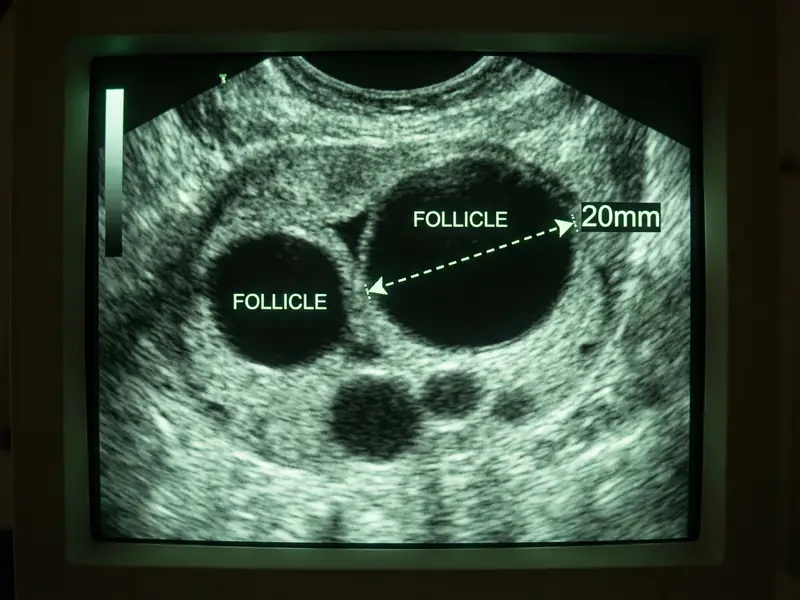
The scan measures the number and diameter of follicles in both ovaries, the thickness and pattern of the endometrial lining, and the presence of a corpus luteum after ovulation. Together these findings confirm whether ovulation has occurred, identify the most fertile window, and flag any structural issues that may be affecting conception.
At Sonoworld, follicular tracking is performed by consultant sonographers with specialist experience in reproductive ultrasound. The clinic has been providing diagnostic ultrasound services to NHS and private patients since 2012, and all scans are conducted using high-resolution equipment with immediate verbal feedback and a written report within 24 hours.
Each Scan Assesses
Number of follicles in each ovary
Dominant follicle diameter (mm)
Endometrial thickness and trilaminar pattern
Ovarian morphology and antral follicle count
Corpus luteum formation (post-ovulation scan)
Uterine cavity and any structural abnormalities
What Is a Follicle?
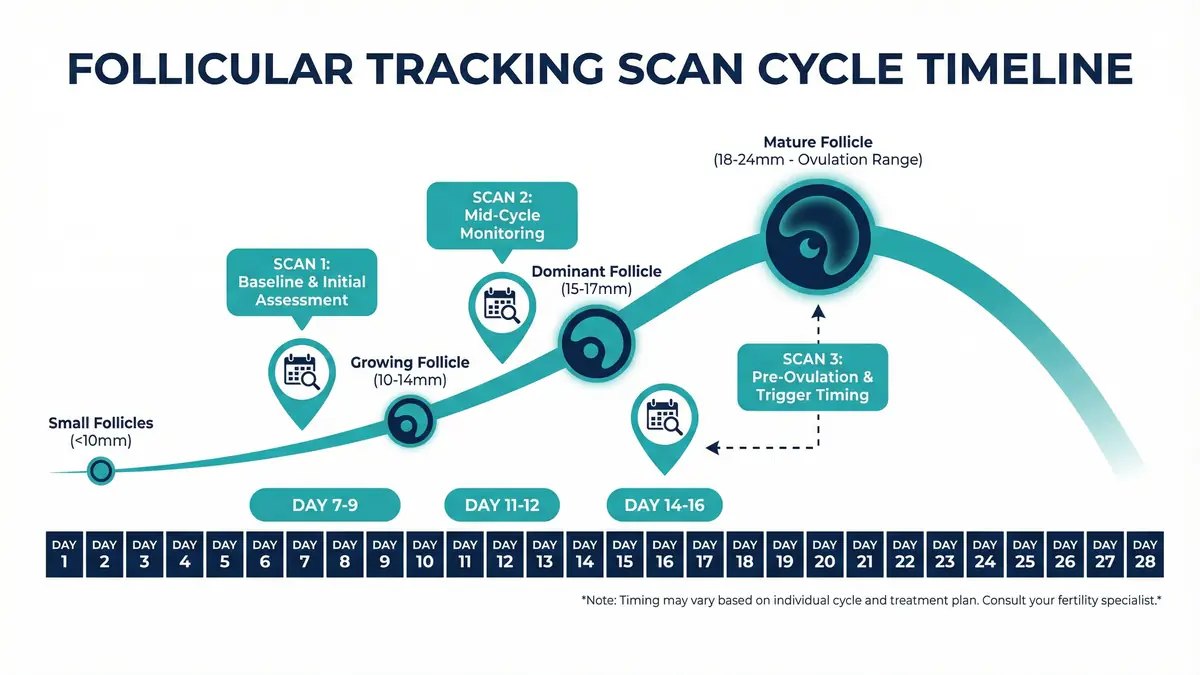
A follicle is a small fluid-filled sac within the ovary that contains an immature egg (oocyte). At the start of each cycle, several follicles begin to grow simultaneously. Typically, one becomes dominant and reaches a mature size of 18–24 mm, at which point ovulation occurs. The scan tracks this growth sequence to identify the precise fertile window.
Scan Findings
What the Scan Measures & Why It Matters
Each measurement from the follicular tracking ultrasound scan provides specific clinical information about your fertility status and cycle progress.
Measurement
Normal Range / Finding
Clinical Significance
Dominant follicle diameter
18–24 mm at ovulation
Confirms a mature follicle is ready to release an egg; guides timing of intercourse or trigger injection
Antral follicle count (AFC)
Typically 5–15 per ovary
Reflects ovarian reserve; low AFC may indicate reduced fertility potential
Endometrial thickness
≥8 mm at ovulation
Adequate lining thickness is required for implantation; thin endometrium (<7 mm) may reduce conception chances
Endometrial pattern
Trilaminar (three-layer) at ovulation
The trilaminar pattern is associated with optimal receptivity for embryo implantation
Corpus luteum
Present post-ovulation
Confirms ovulation has occurred; the corpus luteum produces progesterone to support early pregnancy
Follicle rupture
Collapsed follicle with free fluid
Direct evidence that ovulation has taken place; absence may indicate anovulation
Who Should Book
When Is Follicular Tracking Recommended?
Follicular tracking is appropriate in a range of clinical situations, from natural conception support to assisted reproduction monitoring. The scan provides objective data that helps you and your fertility team make informed decisions about timing and next steps.
Trying to conceive for 6 or more months without success
Irregular cycles where ovulation timing is uncertain
Polycystic ovary syndrome (PCOS) with anovulatory cycles
IVF or ICSI cycle monitoring as directed by your fertility specialist
Intrauterine insemination (IUI) cycle timing
Ovulation induction with clomifene citrate or letrozole
Confirming ovulation is occurring in a regular cycle
Planning natural conception and wanting to optimise timing
Seek Urgent Advice If You Have
Sudden severe pelvic pain during an IVF cycle (possible ovarian hyperstimulation)
Suspected ectopic pregnancy with positive pregnancy test and pelvic pain
Heavy or abnormal bleeding alongside fertility concerns
Follicular tracking requires between one and three ultrasound scan appointments timed across your cycle, starting from day 7–9 of your period. Each appointment takes approximately 20 minutes.
1
Day 7–9: Baseline Scan
The first scan is booked from day 7 of your cycle (counting from the first day of your period). The sonographer assesses both ovaries, counts the antral follicles, and identifies the dominant follicle beginning to grow. Endometrial thickness is recorded as a baseline.
2
Day 11–12: Growth Monitoring
The second scan monitors follicle growth. A healthy dominant follicle grows approximately 2 mm per day. At this stage it typically measures 15–17 mm. The endometrial lining should be thickening and beginning to show the trilaminar pattern.
3
Day 14–16: Pre-Ovulation Scan
The third scan confirms the dominant follicle has reached the mature ovulation range of 18–24 mm. This is the point at which intercourse timing, trigger injection, or IUI is most effective. The endometrial lining should measure ≥8 mm with a trilaminar pattern.
4
Post-Ovulation Confirmation
An optional fourth scan confirms ovulation has occurred by identifying follicle collapse and corpus luteum formation. This is particularly useful when anovulation is suspected or when confirming the outcome of a trigger injection.
5
Report in 24 Hours
After each scan the sonographer provides immediate verbal feedback. A written report with all measurements and images is sent digitally within 24 hours. The report can be shared directly with your GP, fertility consultant, or IVF clinic.
IVF Cycle Monitoring
During an IVF or ICSI cycle, your fertility specialist will provide a specific scan schedule based on your stimulation protocol. Sonoworld can accommodate these monitoring appointments, including early-morning slots. All scan reports are formatted to meet the requirements of major London fertility clinics. Please contact us to discuss your IVF monitoring requirements before booking.
Before Your Scan
How to Prepare
Follicular tracking uses the transvaginal approach, which means no fasting and no full bladder are required. The scan is performed with a thin, lubricated probe gently inserted into the vagina, providing a clearer view of the ovaries than an abdominal scan.
Preparation Checklist
No fasting required — eat and drink normally before your appointment
No full bladder needed — empty your bladder before the scan for comfort
Wear comfortable, loose clothing for easy access
Bring any previous scan reports or fertility test results if available
Note the first day of your last period to help the sonographer time the scan correctly
No GP referral is needed — you can self-refer and book directly
Is the Scan Painful?
Follicular tracking should not be painful. The transvaginal probe is narrow and well-lubricated. Some patients experience mild discomfort depending on probe angle, but the procedure is brief and the sonographer will adjust technique to minimise any discomfort.
Normal activities can be resumed immediately after the scan. There is no recovery time required.
Scan Timing Guide
Count day 1 as the first day of full menstrual flow. Book your first appointment for day 7, 8, or 9. If your cycle is shorter than 26 days, start on day 6–7. If your cycle is longer than 32 days, start on day 9–10.
For IVF cycles, follow the schedule provided by your fertility clinic rather than this general guide.
Transparent Pricing
Follicular Tracking Prices
All prices are all-inclusive. No hidden extras. The price shown is the price you pay.
£235
Single scan All-inclusive
£588
Series of 3 scans Recommended for full cycle monitoring
Each Scan Includes
Transvaginal ultrasound scan by a consultant sonographer
Follicle count and diameter measurements (both ovaries)
Endometrial thickness and pattern assessment
Immediate verbal feedback from your sonographer
Written report within 24 hours with images sent digitally
Private medical insurance: We accept AXA, Healix, WPA, and most major insurers. Call 020 3633 4902 before booking to process your authorisation code.
Most patients require two to three scans per cycle. The first scan on day 7–9 establishes a baseline, the second on day 11–12 monitors growth, and the third on day 14–16 confirms the dominant follicle has reached ovulation size. A single scan is useful if you simply want to confirm ovulation has occurred. For IVF cycles, your fertility clinic will specify the exact schedule.
What is the difference between follicular tracking and a pelvic scan?
A pelvic ultrasound scan is a single appointment that assesses the uterus, endometrium, and ovaries for structural abnormalities such as fibroids, cysts, or endometriosis. Follicular tracking is a series of scans performed at specific points in the cycle to monitor dynamic follicle development and ovulation timing. If you have a structural concern, a pelvic scan is the appropriate starting point. If your concern is ovulation timing or fertility monitoring, follicular tracking provides the serial data needed.
Do I need a GP referral for follicular tracking?
No referral is required. You can self-refer and book directly online or by calling 020 3633 4902. If the scan findings require follow-up, the written report provides all the information your GP or fertility specialist will need to advise on next steps.
What follicle size indicates ovulation is imminent?
A dominant follicle reaching 18–24 mm in diameter indicates it is mature and ovulation is imminent or has occurred. Ovulation typically happens within 24–36 hours of the LH surge, which corresponds to the follicle reaching this size range. The sonographer will advise on optimal timing for intercourse or trigger injection based on the measured diameter.
Can follicular tracking be used during IVF?
Yes. Follicular tracking is a standard component of IVF stimulation monitoring. During a stimulated cycle, multiple follicles are tracked simultaneously to assess the response to gonadotrophin injections and determine the optimal time for egg collection. Sonoworld can provide IVF monitoring scans, including early-morning appointments. Please call us to discuss your clinic's specific reporting requirements before booking.
When will I receive my scan report?
Your written report and scan images are provided within 24 hours of your appointment. The report is sent digitally and can be forwarded directly to your GP, fertility specialist, or IVF clinic.
20% off with code SONO26 · new bookings
Our Clinic
29 Weymouth Street, Marylebone
Sonoworld Diagnostic Services is located just off Harley Street in central London. The clinic is easily accessible from Regent's Park, Great Portland Street, and Oxford Circus Underground stations.