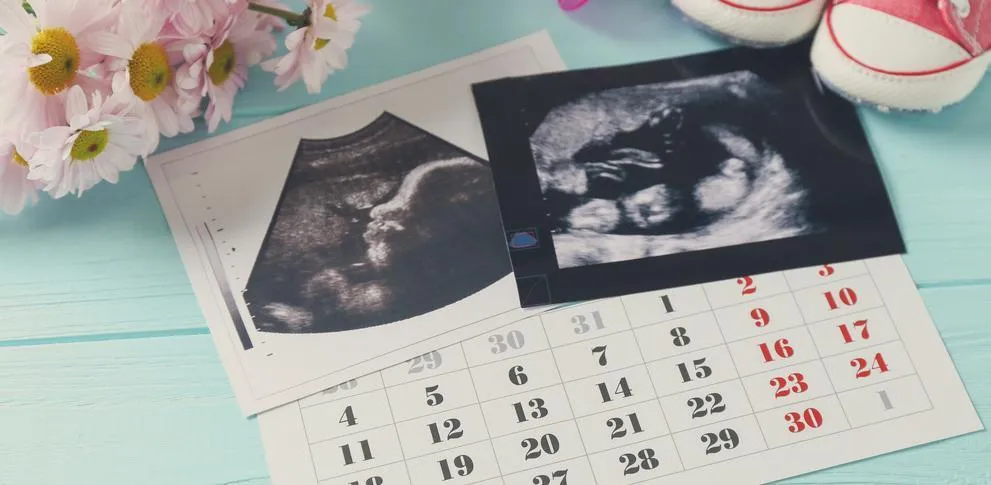

See your baby's heartbeat from as early as 6 weeks. A private early pregnancy ultrasound-scan at Sonoworld confirms viability, checks pregnancy location, and gives you the reassurance you need before your first NHS appointment. No GP referral required.
The first weeks of pregnancy are often the most anxious. You have a positive test, but the NHS booking appointment is weeks away. An early pregnancy ultrasound-scan at Sonoworld gives you direct, real-time visual confirmation of your pregnancy — the gestational sac, the yolk sac, and from around 6–7 weeks, the flickering heartbeat that tells you everything is progressing normally.
The scan uses high-frequency sound waves to produce images of the uterus and its contents. No radiation is involved. At very early gestations (6–9 weeks), a transvaginal approach is typically used — a slim probe placed gently inside the vagina gives a much clearer view than scanning through the abdomen at this stage. From around 10 weeks onwards, a transabdominal scan (gel on the tummy) usually provides sufficient detail.
At Sonoworld, every early pregnancy ultrasound-scan is performed by an HCPC-registered sonographer with specific experience in early pregnancy assessment. The scan is performed at our CQC-registered clinic at 29 Weymouth Street, Marylebone, and same-day emergency appointments are available for women who are bleeding, cramping, or acutely anxious.
| Earliest gestation | 6 weeks (from LMP) |
| Duration | 15–20 minutes |
| Scan type | Transvaginal (6–9 wks) or transabdominal (10+ wks) |
| Price | £235 all-inclusive |
| Photos included | Yes — printed to take home |
| GP referral needed | No |
| Same-day available | Yes — call to confirm |
| Sonographer | HCPC-registered, BMUS member |
The scan produces a structured assessment of the uterus and early pregnancy structures. What is visible depends on gestational age — the table below outlines what to expect at each stage.
| Gestation | What Is Typically Visible |
|---|---|
| 5–6 weeks | Gestational sac within the uterine cavity; confirms intrauterine pregnancy and rules out ectopic |
| 6–7 weeks | Yolk sac visible; fetal pole may be seen; heartbeat often detectable from 6 weeks 3 days onwards |
| 7–8 weeks | Fetal pole clearly visible; heartbeat confirmed; crown-rump length (CRL) measured for gestational age |
| 8–10 weeks | Embryo well-defined; limb buds visible; heart rate measured (normal range 120–180 bpm); CRL gives accurate EDD |
| 10–12 weeks | Fetal movement visible; nuchal translucency measurement possible; transabdominal approach usually adequate |
If a heartbeat is not seen at 6 weeks, this does not necessarily indicate a problem. Gestational age estimation from the last menstrual period (LMP) can be inaccurate, particularly with irregular cycles. A follow-up scan 7–10 days later is recommended in this situation, and the sonographer will explain the findings clearly at the time of the scan.
At 6–9 weeks, the embryo is very small and sits deep in the pelvis. A transvaginal scan uses a slim probe placed gently inside the vagina, which is much closer to the uterus and produces a significantly clearer image than scanning through the abdomen at this stage.
The transvaginal approach is safe, does not cause miscarriage, and most women find it more comfortable than the very full bladder required for a transabdominal scan at this gestation. Your sonographer will discuss both options with you before the scan begins.
There is no single right reason to book an early scan. Some women come because of specific symptoms or risk factors; others simply cannot bear the wait. All of these are valid reasons.
A previous loss makes every subsequent pregnancy feel fragile. Seeing a heartbeat as early as possible provides the reassurance that the NHS pathway cannot offer at 6–8 weeks. Weekly follow-up scans are available for continued support throughout the first trimester.
Following assisted reproduction, an early scan at 6–7 weeks confirms successful implantation, checks the number of embryos, and provides the first visual confirmation of a pregnancy that may have taken years to achieve.
Light bleeding in early pregnancy is common and often harmless, but it always warrants assessment. Same-day appointments are available for women experiencing bleeding or cramping who need prompt reassurance or investigation.
A previous ectopic pregnancy, one-sided pelvic pain, or a history of pelvic inflammatory disease all increase the risk of ectopic implantation. An early scan confirms that the pregnancy is inside the uterus — this is the single most important finding at this stage.
Irregular cycles, recent hormonal contraception, or uncertainty about the date of the last menstrual period can make it difficult to know how far along you are. Crown-rump length measurement gives the most accurate gestational age estimate available at this stage.
You do not need a clinical reason to book an early scan. If the wait until your NHS appointment is causing significant anxiety, a private scan at 6–8 weeks gives you the reassurance you need to enjoy the early weeks of your pregnancy.
Seek urgent care — do not book a private scan
Severe one-sided pain with shoulder-tip pain, heavy vaginal bleeding, dizziness, or collapse require immediate assessment at an NHS Early Pregnancy Unit or A&E. Call 999 or go directly to your nearest emergency department. A private early pregnancy scan is for reassurance and monitoring — not for emergency triage.
Preparation depends on the type of scan your sonographer uses. At 6–9 weeks, a transvaginal approach is most common and requires no special preparation at all.
No preparation is required. An empty or comfortably empty bladder is actually preferable — a full bladder pushes the uterus away from the probe and can reduce image quality. Eat and drink normally before your appointment.
Drink two to three glasses of water approximately one hour before your appointment. A comfortably full bladder lifts the uterus out of the pelvis and improves the view. Do not empty your bladder before arriving.
Wear comfortable, loose-fitting clothing. A two-piece outfit or a top with a separate waistband makes it easier to expose the lower abdomen if a transabdominal scan is performed. A gown is provided for the transvaginal scan.
Bring the date of your last menstrual period (LMP) if you know it — this helps the sonographer interpret findings in context. If you have had a previous scan, bring the report or images. Your partner or a support person is welcome to attend.
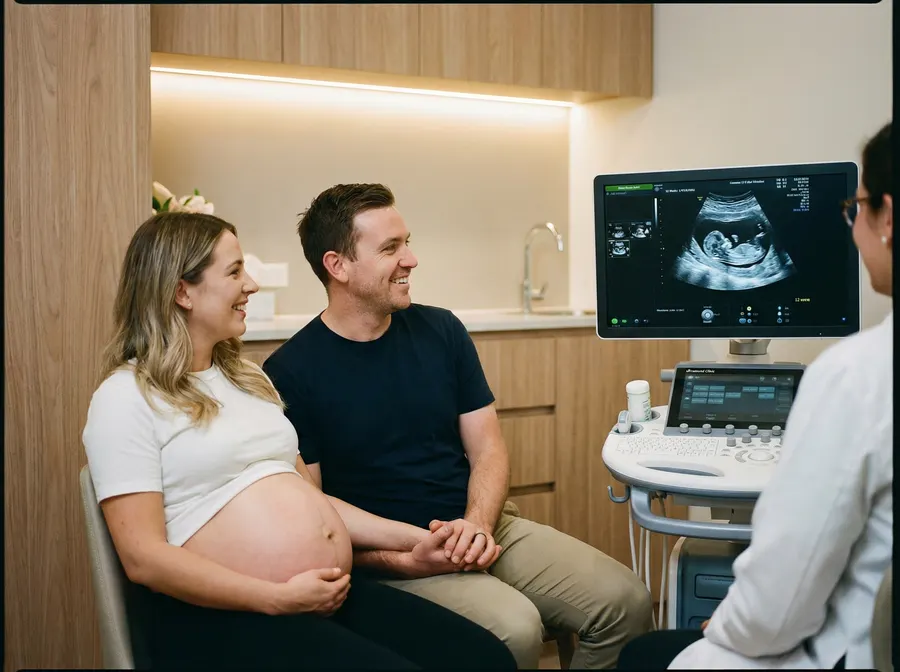
The appointment is calm, unhurried, and designed around you. Here is what to expect from the moment you arrive to the moment you leave with your photos.
Your sonographer confirms your LMP, any relevant symptoms (bleeding, pain), previous pregnancy history, and whether you have had any prior scans. This takes two to three minutes and helps contextualise the findings.
Your sonographer explains whether a transvaginal or transabdominal approach will give the best view at your gestation, and discusses this with you before proceeding. Consent is taken before any internal examination.
The sonographer systematically assesses the uterus, checks for the gestational sac, yolk sac, fetal pole, and heartbeat. Measurements are taken and the findings are narrated to you as the scan progresses — you see everything on the screen in real time.
Findings are discussed straight away. If a heartbeat is seen, you receive printed photos and an estimated due date. If it is too early to see a heartbeat, the sonographer explains what was seen, what it means, and when to return for a follow-up scan.
You receive guidance on when to book your next scan — whether that is a follow-up in 7–10 days, a dating scan at 11–14 weeks, or a referral to an Early Pregnancy Unit if concerns are identified. Weekly reassurance scans are available for women who have had previous losses.
Choose your preferred date and time below. Booking is confirmed immediately. No GP referral is required. Same-day emergency appointments are available — call 020 3633 4902 to check availability.
Choose your date and time online
Booking is confirmed immediately. No GP referral required. Same-day emergency appointments available — call us to check availability.
Secure booking · Immediate confirmation · No hidden fees
Price includes the scan, immediate verbal findings, and printed photos to take home. No hidden fees.
View all pregnancy scan prices →All prices are all-inclusive. There are no additional charges for the scan, verbal findings, or printed photos.
Weekly reassurance scans are available for women who have had a previous miscarriage or loss. Each scan is priced at the standard rate and includes the same full assessment.
Book Follow-up ScanSee our full pregnancy scan price list for dating scans, gender scans, growth scans, and 3D/4D scans.
Rated 4.9 out of 5 from 428 reviews for the early pregnancy scan.
"After two previous miscarriages, I was absolutely terrified. Seeing that tiny heartbeat flickering on the screen at 7 weeks was the most emotional, reassuring moment. The sonographer was so understanding and patient with my anxiety. I cried with relief. Thank you for helping me through those scary early weeks."
"IVF pregnancy after three years of trying. I couldn't wait for the NHS scan — I needed to know my embryo had implanted. Booked at 6 weeks 4 days and we saw the heartbeat. My husband and I both cried. The sonographer was wonderful. We've been back twice more for reassurance scans."
"Previous ectopic pregnancy so I was terrified about location. Booked at 6.5 weeks and the scan confirmed baby is in my uterus — and we saw a heartbeat. The sonographer took extra time to reassure me given my history. Now having weekly scans until 12 weeks. Worth every penny."
"I had some light bleeding at 6.5 weeks and panicked. Called Sonoworld and they got me in the same day. The transvaginal scan was painless and the sonographer found baby's heartbeat straight away — 123 bpm. The relief was overwhelming. Bleeding turned out to be nothing serious."
The earliest meaningful early pregnancy scan is at 6 weeks from the last menstrual period (LMP). Before this point, the gestational sac may be too small to see reliably, and a heartbeat is not yet detectable. At 6 weeks, a gestational sac and yolk sac are usually visible, and a heartbeat may be seen from around 6 weeks 3 days onwards. If you are unsure of your dates, your sonographer will advise whether it is worth scanning or whether to wait a few more days.
At 6–7 weeks, the scan shows the gestational sac (where the embryo is growing), the yolk sac (the early nutritional structure), and often the fetal pole with a heartbeat. The sonographer confirms that the pregnancy is inside the uterus, which rules out an ectopic pregnancy. From 7–8 weeks, the crown-rump length (CRL) can be measured to estimate gestational age and expected due date. By 10–12 weeks, the embryo is clearly defined and fetal movement is often visible.
A heartbeat is detectable from approximately 6 weeks 3 days, but this depends on the accuracy of your dates. If you are exactly 6 weeks from your LMP, there is a reasonable chance of seeing a heartbeat — but not a certainty. If no heartbeat is seen at 6 weeks, this does not mean something is wrong. The most likely explanation is that the pregnancy is slightly earlier than the dates suggest. A follow-up scan 7–10 days later will usually clarify the situation. Your sonographer will explain what was seen and what it means.
Yes. A transvaginal ultrasound-scan is safe at all stages of pregnancy and does not cause miscarriage. The probe used is slim and covered with a sterile sheath. The procedure is performed gently and takes only a few minutes. Most women find it more comfortable than the very full bladder required for a transabdominal scan at this gestation. If you prefer not to have a transvaginal scan, your sonographer will discuss whether a transabdominal approach is likely to give adequate images at your gestation.
For a transvaginal scan (the most common approach at 6–9 weeks), you do not need a full bladder — an empty bladder is actually preferable. For a transabdominal scan (more common from 10 weeks onwards), drink two to three glasses of water approximately one hour before your appointment. If you are unsure which approach will be used, contact the clinic before your appointment and we will advise you.
Yes. Light bleeding in early pregnancy is common and a scan is the most effective way to assess what is happening. Same-day appointments are available for women who are bleeding and need prompt reassurance. The scan will check whether the pregnancy is viable, confirm its location, and look for any obvious cause of the bleeding. If the bleeding is heavy, you are in significant pain, or you feel unwell, go directly to your nearest NHS Early Pregnancy Unit or A&E rather than waiting for a private appointment.
If the scan raises concerns — such as no heartbeat at a gestation where one would be expected, or findings suggestive of an ectopic pregnancy — your sonographer will explain the findings clearly and honestly, and will advise on the most appropriate next step. This may include a follow-up scan in 7–10 days, referral to an NHS Early Pregnancy Unit, or urgent GP contact. You will not be left without guidance. The sonographer will take as much time as needed to explain the findings and answer your questions.
The early pregnancy reassurance scan at Sonoworld costs £235. This is an all-inclusive price that covers the scan, immediate verbal findings, and printed photos to take home. There are no additional charges. Follow-up reassurance scans are also priced at £235. See our full pregnancy scan price list for all other pregnancy scans.
The NHS offers a dating scan at 11–14 weeks as part of the standard antenatal pathway. Early pregnancy scans before 11 weeks are not routinely offered unless there is a specific clinical concern — such as bleeding, pain, or a previous ectopic pregnancy. Even in these cases, NHS Early Pregnancy Units can have waiting times. A private early pregnancy scan at Sonoworld gives you access to a scan from 6 weeks, with same-day appointments available, without waiting for a GP referral or an NHS EPU appointment.
Yes. Your partner or a support person is welcome to attend your appointment. Sharing the experience of seeing a heartbeat for the first time is one of the most meaningful moments in early pregnancy, and we want you to have that support with you if you wish. Please let us know when booking if you are bringing someone, so we can ensure the room is set up appropriately.
Our CQC-registered private diagnostic ultrasound clinic is located in the heart of Marylebone, a short walk from Regent Street and Oxford Circus. The clinic is easily accessible from across London by tube, bus, or car.
29 Weymouth Street, Marylebone, London W1G 7DB
Nearest tube: Regent's Park (Bakerloo) · Great Portland Street (Circle/Metropolitan/Hammersmith & City)