Book Scan
Lumps and Bumps Ultrasound Scan: Private Soft Tissue Assessment | Sonoworld London
General Medical Scans · Soft Tissue Assessment

Lumps & Bumps Ultrasound Scan

A private soft tissue ultrasound scan that identifies and characterises any lump, swelling, or mass anywhere in the body. No GP referral required. Same-day written report included.

CQC registered Same-day report No GP referral Same-day availability
Soft tissue ultrasound scan for lumps and bumps at Sonoworld London
£235
Single lump
~20 min
Appointment duration
No prep
No fasting required
4.9 ★
328 patient reviews
What Is This Scan?

Soft Tissue Ultrasound: Answers Without the Wait

A lumps and bumps ultrasound scan uses high-frequency sound waves to image any palpable or visible mass in the soft tissues of the body. The scan produces real-time greyscale images that reveal the size, shape, depth, internal structure, and vascularity of a lump — information that tells a consultant sonographer whether a mass is solid or fluid-filled, well-defined or irregular, and whether it contains blood flow.

Ultrasound is the first-line imaging method for superficial soft tissue masses, recommended by the British Medical Ultrasound Society (BMUS) and the Royal College of Radiologists. The vast majority of lumps are benign — lipomas, ganglion cysts, and sebaceous cysts account for the most common presentations — but characterisation matters. Knowing what a lump is removes uncertainty and guides the next step, whether that is reassurance, monitoring, or onward referral.

At Sonoworld, the scan is performed by Daniela Stan, a consultant sonographer with an MSc in Medical Ultrasound and over 15 years of NHS and private practice experience. The written report is issued on the same day and is accepted by GPs, surgeons, and private medical insurers.

What the Scan Assesses

  • Size and dimensions — precise measurements in three planes
  • Internal structure — solid, cystic, mixed, or complex
  • Margins — well-defined or irregular borders
  • Depth — subcutaneous, intramuscular, or deep
  • Vascularity — colour Doppler to assess blood flow
  • Relationship to adjacent structures — nerves, vessels, tendons
  • Compressibility — behaviour under probe pressure

Body Areas Covered

The scan can assess lumps anywhere in the body except the breast, neck/thyroid, and joints — which have dedicated specialist scans:

  • Abdomen and trunk
  • Arms, forearms, and hands
  • Thighs, legs, and feet
  • Groin and inguinal region
  • Back and flank
Conditions Assessed

What the Scan Can Identify

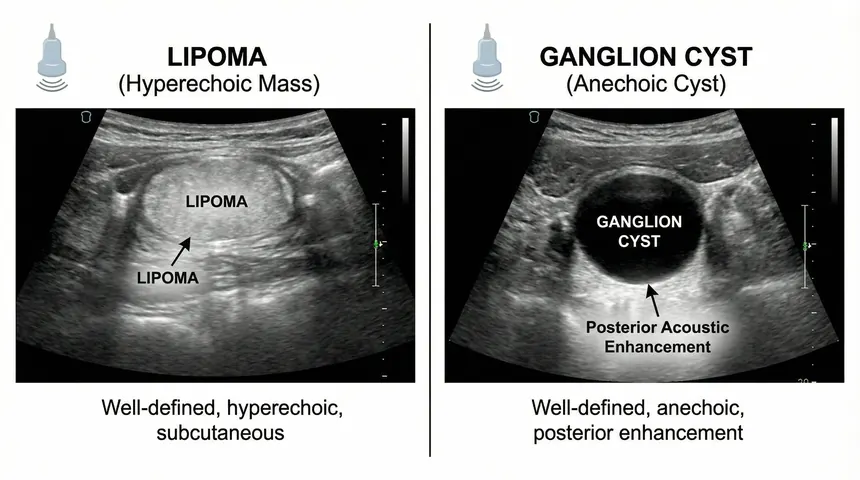
Soft tissue ultrasound produces characteristic appearances for most common benign masses, allowing confident diagnosis in the majority of cases. The table below covers the most frequently encountered presentations.

Ultrasound images showing lipoma and ganglion cyst appearances

Left: lipoma (hyperechoic, well-defined)  |  Right: ganglion cyst (anechoic, posterior enhancement)

Most Common Benign Masses

  • Lipoma — benign fatty tumour; soft, mobile, well-defined on ultrasound
  • Ganglion cyst — fluid-filled sac arising from a joint or tendon sheath
  • Sebaceous (epidermal) cyst — superficial, well-defined, often with a punctum
  • Haematoma — collection of blood following trauma or injury
  • Lymph node — reactive or enlarged; assessed for cortical thickening and vascularity
  • Fibroma — benign fibrous tissue growth, typically firm and well-circumscribed
  • Vascular malformation — haemangioma or venous malformation with Doppler flow
  • Abscess — infected fluid collection with surrounding oedema

Ultrasound Characteristics by Lump Type

Lump Type Ultrasound Appearance Typical Location Clinical Significance
Lipoma Hyperechoic or isoechoic, oval, well-defined, compressible Subcutaneous anywhere; back, arms, thighs Benign; no treatment required unless symptomatic
Ganglion cyst Anechoic (black), round, posterior acoustic enhancement Wrist, hand, foot, ankle Benign; may resolve spontaneously or require aspiration
Sebaceous cyst Hypoechoic, oval, superficial, may have echogenic punctum Scalp, face, back, scrotum Benign; excision if infected or cosmetically troublesome
Haematoma Variable echogenicity depending on age; may show internal echoes Any soft tissue after trauma Benign; monitor for resolution; drainage if large
Reactive lymph node Oval, echogenic hilum, preserved architecture, mild vascularity Axilla, groin, neck Usually benign; follow-up if cortex thickened or round
Suspicious mass Irregular margins, heterogeneous, deep, increased vascularity Any location, often deep Requires urgent MRI and surgical referral

When a Specialist Scan Is More Appropriate

Lumps in the breast, neck or thyroid, testicles, or within a specific joint are better assessed with dedicated specialist scans. Sonoworld offers a breast ultrasound, thyroid and neck scan, testicular scan, and a full range of MSK joint scans for these presentations.

Symptoms & Indications

When Should You Book This Scan?

Most people book a soft tissue scan when they notice a lump they cannot explain. Waiting weeks for an NHS referral when you have found something new and unfamiliar is a source of significant anxiety. A private scan provides answers quickly — usually within days.

The scan is appropriate for any of the following presentations:

  • A new lump or swelling that has appeared recently
  • A lump that is growing in size
  • Pain or tenderness at the site of a lump
  • Swelling following a sports injury or trauma
  • A lump that feels hard, irregular, or is fixed to underlying tissue
  • Pre-operative assessment before surgical removal of a known mass
  • Monitoring a known benign mass for interval change
  • Reassurance after a GP has found an unexplained mass on examination
Book Your Scan

Features Requiring Urgent Assessment

Book as soon as possible if your lump has any of the following features:

  • Larger than 5 cm in any dimension
  • Deep to the fascia (below the muscle layer)
  • Rapidly increasing in size over days or weeks
  • Associated with unexplained weight loss or night sweats
  • Hard, fixed, and non-compressible

Related Scans

Is your lump in a specific area? A dedicated scan may be more appropriate:

The Examination

What Happens During Your Scan

The scan takes approximately 20 minutes from start to finish. No preparation is required — you can eat, drink, and take medications as normal before attending. Wear comfortable clothing that allows easy access to the area being scanned.

The sonographer begins with a brief clinical history: when you first noticed the lump, whether it has changed, any associated symptoms such as pain, and any relevant medical or surgical history. This context directly informs the scanning protocol.

A small amount of ultrasound gel is applied to the skin over the lump. The probe is then moved across the area in multiple planes to build a complete picture of the mass. Colour Doppler is used to assess blood flow within and around the lump. The sonographer explains findings as the scan proceeds and provides immediate verbal feedback at the end.

Sonographer applying ultrasound gel to scan a soft tissue lump on a patient's arm
1
Clinical History The sonographer takes a brief history of the lump: onset, size change, symptoms, and relevant medical background.
2
Greyscale Imaging High-frequency ultrasound images the lump in multiple planes, assessing size, margins, internal structure, and depth.
3
Colour Doppler Doppler imaging is applied to assess vascularity — the presence and pattern of blood flow within the mass.
4
Verbal Feedback Immediate verbal findings are provided at the end of the scan. The sonographer explains what has been seen and what it likely means.
5
Written Report A detailed written report with annotated images is issued on the same day. Accepted by GPs, surgeons, and insurers.
Transparent Pricing

Scan Prices

All prices are all-inclusive. There are no hidden charges for the report, images, or verbal feedback.

£350
Multiple lumps
  • Two or more lumps / areas
  • Greyscale + colour Doppler
  • Same-day written report
  • Annotated images included
  • No GP referral required

Insurance & Self-Pay

Sonoworld accepts AXA, Healix, WPA, and most major private medical insurers. Please call 020 3633 4902 before booking online to ensure your insurance authorisation is processed correctly. Self-pay patients can book directly online.

FAQs

Questions About the Scan

Can ultrasound tell if a lump is cancerous?

Ultrasound cannot provide a tissue diagnosis — only a biopsy can confirm malignancy with certainty. However, ultrasound identifies features that are strongly associated with benign or suspicious masses. Well-defined, compressible, superficial masses with no internal vascularity are almost always benign. Irregular, deep, vascular, or rapidly growing masses require further investigation with MRI and surgical referral. The written report will state clearly whether the findings are reassuring or require urgent follow-up.

Do I need to prepare for the scan?

No preparation is required. Eat, drink, and take medications as normal. Wear loose clothing that allows easy access to the area being scanned. If the lump is on your torso or back, a gown will be provided.

What if my lump is in my breast, neck, or a joint?

Lumps in the breast, neck, thyroid, or testicles are better assessed with dedicated specialist scans that use specific protocols for those anatomical regions. Sonoworld offers a breast ultrasound, thyroid and neck scan, and testicular scan for these presentations. Joint lumps such as ganglion cysts at the wrist are covered by the MSK scan range. If you are unsure which scan is right for you, call 020 3633 4902 and a member of the team will advise.

How long does the scan take?

A single lump scan takes approximately 20 minutes from start to finish, including the clinical history and verbal feedback. Multiple lumps will take slightly longer. The written report is issued on the same day, usually within a few hours of the appointment.

Will I get a report I can share with my GP?

Yes. A detailed written report with annotated ultrasound images is issued on the same day. The report is produced by an HCPC-registered consultant sonographer and is accepted by GPs, surgeons, and private medical insurers. It includes the lump's measurements, ultrasound characteristics, Doppler findings, and a clinical impression with recommended next steps.

What happens if the scan finds something suspicious?

If the scan identifies features that require further investigation, the written report will include a clear recommendation — typically urgent MRI imaging and referral to a soft tissue sarcoma specialist via the two-week wait pathway. The sonographer will explain this verbally at the end of the scan and the report will provide the documentation your GP needs to make an urgent referral.

Our Clinic

29 Weymouth Street

Sonoworld is located just off Harley Street in Marylebone, central London. Easily accessible from Regent's Park, Great Portland Street, and Oxford Circus Underground stations.

29 Weymouth Street
Marylebone, London W1G 7DB
Nearest stations: Regent's Park · Great Portland Street · Oxford Circus

View on Google Maps
CQC Registered
HCPC Registered
BMUS Member
ICO Registered

Book Your Lumps & Bumps Scan Today

Same-day appointments available · No GP referral needed · £235 all-inclusive

Book Online
crossmenu
Not sure which scan you need?
Sono AISonoworld Scan Advisor
Tap to Call