
Home › Patient Guides › Pregnancy
Bleeding or Pain in Early Pregnancy: When to Get a Scan
Bleeding in the first twelve weeks is common, and many women who experience it go on to have an entirely normal pregnancy. That is true, and it is worth knowing. It is also true that some bleeding needs assessing the same day rather than waiting — and the difference is not something you can reliably judge from how heavy it is. This guide explains which symptoms need urgent care, when an early pregnancy scan helps, and what it can realistically show at each stage.
When early pregnancy symptoms need urgent care, not a booked scan
- Severe or one-sided abdominal pain, pain in the tip of your shoulder, feeling faint or collapsing — call 999 or go to A&E. These can indicate an ectopic pregnancy, which is a medical emergency.
- Heavy bleeding — soaking a pad in an hour or less, or passing large clots — go to A&E or your nearest Early Pregnancy Unit the same day.
- Bleeding with fever, shivering, or offensive-smelling discharge — seek same-day medical review; this may indicate infection.
- Any bleeding if you have had a previous ectopic pregnancy, tubal surgery, or are pregnant with a coil in place — contact your Early Pregnancy Unit or GP the same day, regardless of how light it is.
Early Pregnancy Units accept self-referral in many areas, and NHS 111 can direct you to your nearest. A private scan is for reassurance and clarity when you are stable — it is not the route for the symptoms above, and it should never delay them.
On this page
How common is bleeding in early pregnancy?
Bleeding in the first trimester is common — it affects a substantial minority of pregnancies, and in many of those the pregnancy continues normally. Knowing that helps, but it does not settle the question for any individual, because the same symptom can accompany outcomes that range from entirely benign to genuinely urgent.
That is the honest position, and it is why the red-flag list sits at the top of this page rather than at the bottom. Reassurance is legitimate; it just should not arrive before the safety information.
What can cause it
- Implantation bleeding. Light spotting around the time a period would have been due, as the pregnancy embeds in the uterine lining. Typically brief and light.
- Cervical changes. The cervix becomes more vascular in pregnancy, so light bleeding can follow sex or a smear test. Usually short-lived.
- Threatened miscarriage. Bleeding where the pregnancy is continuing and the cervix remains closed. Many of these pregnancies continue without further problems.
- Miscarriage. Bleeding, often with cramping, where the pregnancy is not continuing. This may be complete or incomplete, which affects what happens next.
- Ectopic pregnancy. The pregnancy implants outside the uterus, most often in a fallopian tube. This is the reason one-sided pain, shoulder-tip pain and faintness are emergencies — an ectopic can cause internal bleeding.
- Molar pregnancy. A rare abnormality of the developing placental tissue, needing specialist management.
- Subchorionic haematoma. A collection of blood between the pregnancy sac and the uterine wall, sometimes seen on a scan, which may cause bleeding and often resolves.
Pain and cramping — what is expected and what is not
Mild, central, period-like cramping is frequently reported in early pregnancy as the uterus grows and ligaments stretch. Discomfort that is mild, comes and goes, sits centrally and settles with rest is not usually a cause for alarm on its own.
What changes the picture is pain that is severe, persistent, or concentrated on one side; pain accompanied by dizziness, breathlessness or feeling faint; and pain felt at the tip of the shoulder. That last symptom is easy to dismiss because it seems unrelated to the abdomen, but it can indicate irritation of the diaphragm from internal bleeding, and it belongs in the emergency list above.
If you are unsure, be assessed. No article can distinguish a stretching ligament from an ectopic pregnancy, and the cost of over-caution here is an appointment you did not strictly need. The cost of under-caution is considerably higher.
From our practice
We routinely advise women who are under six weeks to wait before scanning, rather than booking straight away. The reason is simply what ultrasound can see at that point: below six weeks there is nothing to demonstrate other than a thickened endometrium.
Scanning earlier than that does not produce reassurance — it produces an inconclusive result and a repeat appointment. Waiting until the scan can actually answer the question is usually the shorter route to an answer, not the longer one.
If you are unsure of your dates, call us before booking and we will help you work out when a scan is likely to be informative.
Why timing changes what a scan can show
This is the single most useful thing to understand before booking, because it determines whether a scan can answer your question at all.
Ultrasound in early pregnancy is limited by what has developed so far, not by the quality of the equipment. Before around six weeks from your last menstrual period, a scan may show a gestational sac without yet showing a fetal pole or heartbeat — and that finding is often inconclusive rather than reassuring or concerning. It frequently leads to a repeat scan one to two weeks later to establish whether the pregnancy is developing.
From around six to seven weeks, a fetal pole and heartbeat can usually be identified, and the scan is far more likely to give a clear answer. This is why scanning too early can add anxiety rather than resolve it: an indeterminate result means waiting anyway, having already had the appointment.
If your dates are uncertain, or you are under six weeks, it is usually worth speaking to us before booking so you scan at a point where the result is likely to be meaningful.
What the scan involves
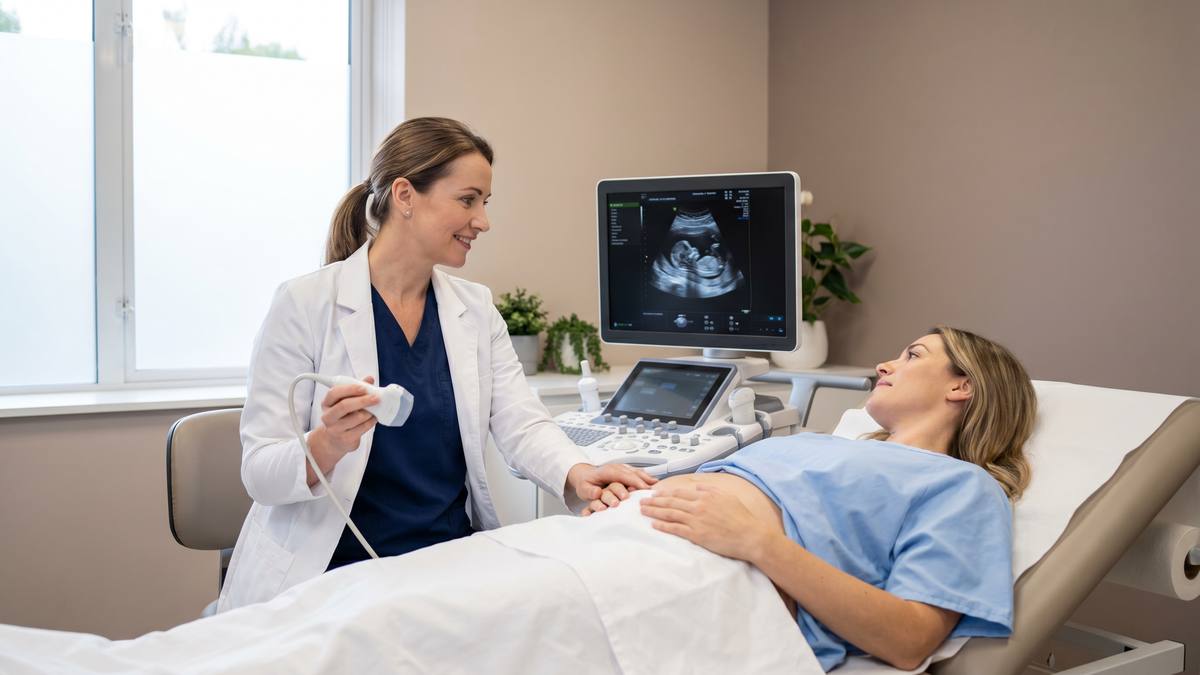
An early pregnancy scan is performed transvaginally in most cases, because this gives markedly clearer views of a small early pregnancy than scanning through the abdomen. A slim probe, covered and lubricated, is inserted a short distance into the vagina. It is not usually painful, though it can feel a little uncomfortable, and you can ask for the examination to stop at any point. A chaperone is available on request, and you are welcome to bring someone with you.
The sonographer will look at whether the pregnancy is within the uterus, whether a gestational sac and fetal pole are visible, whether a heartbeat is present, and measurements that allow the pregnancy to be dated. The ovaries and surrounding structures are also examined.
The scan takes around 20 minutes. No full bladder is needed for a transvaginal examination, and no GP referral is required. The cost is £235, with instant verbal results at the appointment and a written report within 24 hours.
We will tell you what we can see during the scan rather than leaving you to wait. Where a finding needs onward care — including where a pregnancy cannot be confirmed as being in the uterus — we will explain that at the time and direct you to the appropriate NHS service the same day.
Early Pregnancy Units and private scans
An Early Pregnancy Unit is the NHS service designed exactly for this situation. It combines scanning with clinical assessment, blood tests where needed — including serial hormone measurements that can help identify an ectopic pregnancy — and direct access to management if something is wrong. In many areas you can refer yourself, and NHS 111 or your GP can tell you where yours is.
A private scan offers a different thing: speed and choice of timing when you are clinically stable and the question is one of reassurance or dating. It does not include blood tests, and it is not a treatment pathway.
Put simply — if you have red-flag symptoms, or if you need answers that depend on blood results as well as imaging, the Early Pregnancy Unit is the right route. If you are stable, past six weeks, and want to be seen quickly for reassurance, a private scan is a reasonable choice.
Frequently Asked Questions
I am bleeding but have no pain. Do I still need to be seen?
Light bleeding without pain is common and often benign, but it should still be discussed with a healthcare professional — your GP, an Early Pregnancy Unit or NHS 111 — so that your individual circumstances, including any previous ectopic pregnancy or tubal surgery, are taken into account. Heavy bleeding, or bleeding with pain, dizziness or shoulder-tip pain, needs same-day assessment.
How early can a scan detect a heartbeat?
A fetal heartbeat can usually be identified from around six to seven weeks from your last menstrual period on a transvaginal scan. Before six weeks a scan may show only a gestational sac, which is often inconclusive and commonly requires a repeat scan one to two weeks later.
Will a transvaginal scan cause bleeding or harm the pregnancy?
Transvaginal ultrasound is widely used in early pregnancy and is not known to cause miscarriage. Very light spotting afterwards can occur because the cervix is more vascular in pregnancy. Bleeding that is heavy, or accompanied by pain, should be assessed rather than attributed to the scan.
Can a scan tell me whether I am miscarrying?
Often, but not always at a single visit. Where findings are indeterminate — for instance an early sac with no visible fetal pole — a repeat scan after an interval is the standard approach, because a definitive answer depends on whether the pregnancy has developed between scans. We will explain clearly what the scan can and cannot conclude on the day.
Do I need a full bladder?
Not for a transvaginal scan, which is how early pregnancy is usually examined. If an abdominal approach is used instead, a comfortably full bladder helps, and we will tell you in advance if that applies.
Can I bring someone with me?
Yes. You are welcome to bring a partner, family member or friend, and a chaperone is available on request.
Speak to us before you book
If you are unsure whether now is the right time to scan — or whether you should be seen by an Early Pregnancy Unit instead — call us and we will tell you honestly.
About the early pregnancy scan
29 Weymouth Street, London W1G 7DB · 020 3633 4902 · No GP referral needed · Instant verbal results, written report within 24 hours
Sources
- National Institute for Health and Care Excellence. Ectopic pregnancy and miscarriage: diagnosis and initial management (NG126).
- National Institute for Health and Care Excellence. Clinical Knowledge Summaries: Miscarriage; Ectopic pregnancy.
- Royal College of Obstetricians and Gynaecologists. Early miscarriage — patient information.
- NHS. Vaginal bleeding in pregnancy — patient information.
This article is for general information and does not replace individual medical advice. Obstetric ultrasound at Sonoworld is performed by HCPC-registered practitioners and reported in line with professional standards. Sonoworld is registered with and inspected by the Care Quality Commission. Health claims on this page are intended to comply with the CAP Code. If you have severe or one-sided pain, shoulder-tip pain, heavy bleeding, or feel faint, seek emergency care rather than booking a scan.