Experiencing shortness of breath (dyspnoea) can be distressing and significantly impact your quality of life. While often attributed to lung conditions or poor fitness, breathlessness is frequently the first sign of an underlying heart problem. This guide explores the cardiac causes of dyspnoea and explains how an echocardiogram provides a definitive diagnosis.
Dyspnoea is the medical term for shortness of breath. It is a subjective feeling of breathing discomfort that varies in intensity. While it is normal to feel breathless after strenuous exercise, experiencing dyspnoea during everyday activities, while resting, or when lying down is a clinical sign that requires investigation.
If your breathlessness comes on suddenly and is accompanied by severe chest pain, pain radiating to your arm or jaw, fainting, or coughing up pink, frothy sputum, call 999 immediately. These are signs of a medical emergency such as a heart attack or acute pulmonary oedema.
Cardiologists use the New York Heart Association (NYHA) scale to classify the severity of breathlessness and heart failure symptoms:
The heart and lungs work together in a continuous loop. The right side of the heart pumps blood to the lungs to receive oxygen, and the left side pumps that oxygen-rich blood to the rest of the body.
If the left side of the heart cannot pump efficiently, blood backs up into the pulmonary veins (the vessels returning blood from the lungs to the heart). This increased pressure forces fluid into the air sacs of the lungs (pulmonary congestion), making it difficult to breathe.
Clinical studies show that cardiac and pulmonary pathologies account for 85% of all cases of chronic breathlessness [1]. When evaluating dyspnoea, cardiologists look for several specific structural and functional heart conditions.
An irregular and often abnormally fast heart rate. AF reduces the heart's pumping efficiency by up to 30%, leading to blood pooling and breathlessness. Dyspnoea is the most common presenting complaint in patients with AF [2].
Conditions such as aortic stenosis (narrowing of the valve) or mitral regurgitation (a leaking valve) force the heart to work harder. This increased workload eventually leads to pulmonary congestion and shortness of breath on exertion.
Narrowed arteries reduce blood flow to the heart muscle. While this typically causes chest pain (angina), some patients experience "angina equivalent" — where transient myocardial ischaemia presents primarily as breathlessness rather than pain [3].
Diseases of the heart muscle itself, making it enlarged, thick, or rigid. As the muscle weakens, it cannot pump blood effectively, leading to fluid retention in the lungs and abdomen.
High blood pressure in the arteries of the lungs. This forces the right side of the heart to pump harder, eventually leading to right-sided heart failure and severe breathlessness [4].
Inflammation of the sac surrounding the heart (pericarditis) or fluid build-up within the sac (pericardial effusion). This restricts the heart's ability to expand and fill with blood properly.
Heart failure is a clinical syndrome where the heart is unable to pump blood around the body effectively. It affects approximately 1.6% of the UK population, though the true prevalence is likely higher due to undiagnosed cases [5]. It is the most significant cardiac cause of chronic breathlessness.
| Type of Heart Failure | Mechanism | Ejection Fraction (EF) | Patient Profile |
|---|---|---|---|
| HFrEF (Reduced Ejection Fraction) |
Systolic dysfunction: The heart muscle is weak and cannot contract forcefully enough to pump blood out. | Less than 40% | More common in men. Often caused by a previous heart attack or coronary artery disease. |
| HFpEF (Preserved Ejection Fraction) |
Diastolic dysfunction: The heart muscle is stiff and cannot relax properly to fill with blood between beats. | 50% or higher | More common in women (2:1 ratio). Strongly associated with older age, hypertension, obesity, and diabetes [6]. |
Because breathlessness can be caused by the heart, lungs, or other systemic issues, a structured diagnostic approach is essential. Clinical guidelines recommend a stepwise evaluation [8].
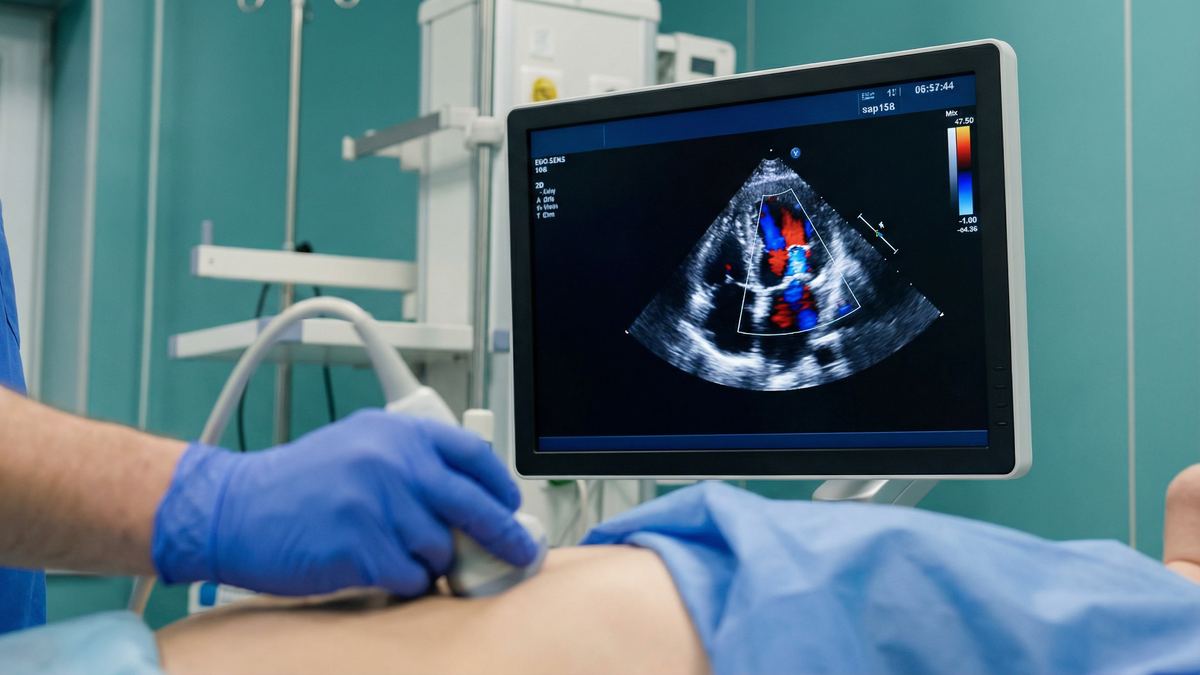
An echocardiogram is the first-line diagnostic imaging test for detecting myocardial, valvular, or pericardial disease as a cause of chronic dyspnoea [9]. It is a specialised ultrasound-scan of the heart.
During the scan, the sonographer will assess:
Alongside an echocardiogram, your doctor will likely request: