Chest pain is one of the most common reasons people seek urgent medical attention — and for good reason. While many cases have a benign explanation, such as acid reflux or a strained muscle, some causes are life-threatening and require immediate investigation. This guide explains the full spectrum of chest pain causes, how doctors differentiate between them, and when a private echocardiogram provides the clarity you need.
When a patient presents with chest pain, the clinical priority is always to rule out a cardiac cause first. Research published in Cureus (2024) found that cardiac chest pain accounts for approximately 53.7% of acute presentations in emergency settings.1 Understanding the specific characteristics of cardiac pain is critical for seeking timely intervention.
ACS encompasses a spectrum of conditions — unstable angina, NSTEMI, and STEMI — all caused by a sudden reduction in blood supply to the heart muscle. The pain is typically described as a crushing, pressure-like tightness in the centre of the chest. It frequently radiates to the left arm, jaw, neck, or back, and is associated with profuse sweating, nausea, and severe breathlessness. Central chest pain is more common in cardiac causes (60% vs 40%).1
This is a life-threatening emergency involving a tear in the inner layer of the aorta — the large blood vessel that carries blood away from the heart. The pain is sudden, severe, and characteristically described as a tearing or ripping sensation that radiates directly to the back between the shoulder blades. Uncontrolled hypertension is the most significant risk factor.
Pericarditis is inflammation of the pericardium — the fibrous sac that surrounds the heart. It causes sharp, pleuritic chest pain that worsens when taking a deep breath or lying flat. Patients typically find relief by sitting upright and leaning forward. The condition frequently follows a viral respiratory illness, and an echocardiogram is used to detect any associated pericardial effusion (fluid around the heart).
Myocarditis involves inflammation of the heart muscle itself. It presents with chest pain accompanied by breathlessness, fatigue, and sometimes heart palpitations. Like pericarditis, it is often triggered by a recent viral infection and can affect younger, otherwise healthy individuals. An echocardiogram assesses left ventricular function and wall motion abnormalities.
Stable angina is chest pain caused by reduced blood flow to the heart during physical exertion or emotional stress. The pain is predictable, typically relieved by rest within a few minutes, and is a sign of underlying coronary artery disease. A stress echocardiogram — which assesses heart function during exercise — has a 95.4% sensitivity for predicting cardiac outcomes in stable chest pain.7
Structural problems with the heart valves — such as aortic stenosis or mitral regurgitation — can cause chest pain, breathlessness, and dizziness. These conditions are often detected incidentally when a doctor hears an abnormal heart sound (murmur). An echocardiogram is the definitive diagnostic tool for assessing valve structure and function. Learn more about heart murmurs.
Non-cardiac chest pain (NCCP) is highly prevalent. In primary care, musculoskeletal conditions are the most frequent final diagnosis (33.1%), while life-threatening causes such as myocardial infarction account for only 8.4% of all chest pain presentations.2 The leading causes of NCCP span gastrointestinal, pulmonary, musculoskeletal, and psychological systems.
| System | Condition | Key Characteristics | Distinguishing Feature |
|---|---|---|---|
| Gastrointestinal | GORD / Acid Reflux | Burning retrosternal pain; worse after meals and lying down | Most common cause of NCCP3 |
| Gastrointestinal | Oesophageal Spasm | Severe squeezing pain; can mimic angina; may respond to nitrates | Often triggered by hot or cold liquids |
| Musculoskeletal | Costochondritis | Sharp pain at costochondral junction; reproducible on palpation | Worsens with movement or deep breathing |
| Musculoskeletal | Muscle Strain | Localised tenderness; history of exertion or trauma | Positional; no radiation to arm or jaw |
| Pulmonary | Pulmonary Embolism | Sudden pleuritic pain; breathlessness; haemoptysis | Risk: DVT, immobility, OCP, recent surgery |
| Pulmonary | Pneumothorax | Sudden sharp pain; breathlessness | More common in tall, thin young men |
| Pulmonary | Pneumonia / Pleuritis | Pleuritic pain; fever; productive cough | Worsens on inspiration |
| Psychological | Panic Disorder / Anxiety | Chest tightness; palpitations; hyperventilation | Respiratory comorbidities in 35% of NCCP cases4 |
Identifying which patients are at higher risk of a cardiac cause is a key part of clinical assessment. A 2024 study in Cureus identified the following as significant independent predictors of cardiac chest pain:1
Each additional year of age increases the odds of a cardiac cause by a factor of 1.05 (OR=1.05). Risk increases significantly after the age of 45 in men and 55 in women.
Current or former smokers have more than double the odds of a cardiac cause (OR=2.22). Smoking accelerates atherosclerosis — the build-up of fatty plaques in the coronary arteries.
High blood pressure is one of the strongest modifiable risk factors (OR=1.82). It damages arterial walls over time, increasing the risk of coronary artery disease and aortic dissection.
Diabetes increases the odds of a cardiac cause by a factor of 1.57 (OR=1.57). Diabetic patients may also experience atypical or "silent" chest pain due to autonomic neuropathy.
A family history of ischaemic heart disease (IHD) increases the odds of a cardiac cause (OR=1.42). This risk is particularly significant if a first-degree relative was affected before the age of 60.
Elevated LDL cholesterol promotes the formation of atherosclerotic plaques in the coronary arteries. Combined with hypertension or smoking, the risk of an acute coronary event increases substantially.
Accurate diagnosis requires a structured, evidence-based approach. The 2021 AHA/ACC Guideline for the Evaluation and Diagnosis of Chest Pain recommends risk stratification followed by targeted investigations.8 The diagnostic pathway typically begins with clinical history and physical examination, then proceeds to objective testing.
An ECG is the first-line investigation for acute chest pain. It records the heart's electrical activity and can rapidly identify ST-segment changes — a strong predictor of a cardiac origin such as myocardial infarction. However, a normal ECG does not rule out underlying structural heart disease, which is why further imaging is often needed.
Cardiac troponin is a protein released into the bloodstream when the heart muscle is damaged. Elevated troponin levels are a highly sensitive marker for myocardial infarction. Serial troponin measurements (taken 3–6 hours apart) are standard practice in emergency assessment of chest pain.
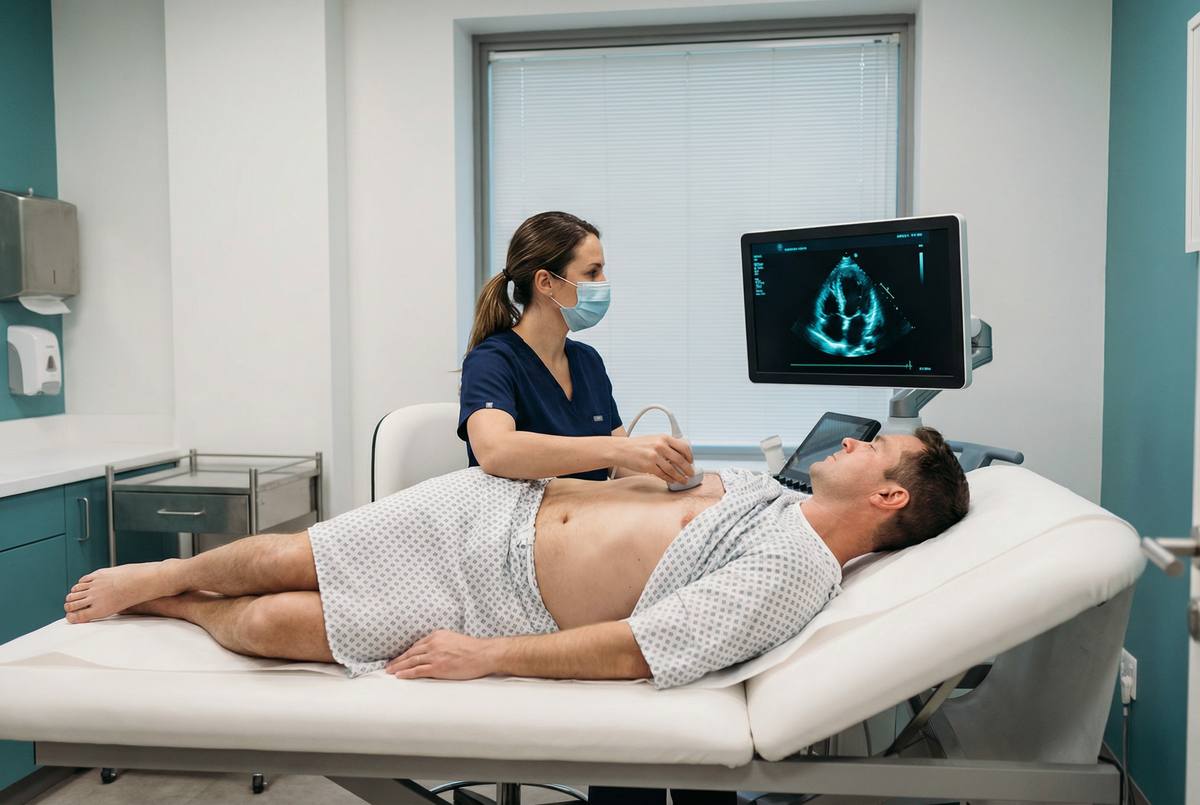
An echocardiogram is the most informative structural investigation for chest pain. This specialised ultrasound-scan provides real-time images of the heart's chambers, valves, and surrounding structures. Bedside transthoracic echocardiography (TTE) has a sensitivity of 97.4% and a specificity of 90.4% for identifying ischaemic chest pain.6 Point-of-care ultrasound (POCUS) shows near-perfect agreement (0.96) with the final clinical diagnosis in non-ST ACS.9
During an echocardiogram at Sonoworld, the sonographer assesses the following:
| Parameter Assessed | What It Reveals | Relevant Condition |
|---|---|---|
| Regional Wall Motion | Areas of the heart muscle not contracting normally | ACS, previous MI, ischaemia |
| Left Ventricular Function (EF) | How effectively the heart pumps blood with each beat | Heart failure, cardiomyopathy, myocarditis |
| Valve Structure & Function | Stenosis (narrowing) or regurgitation (leaking) of valves | Aortic stenosis, mitral regurgitation, heart murmur |
| Pericardial Effusion | Fluid accumulation in the pericardial sac | Pericarditis, cardiac tamponade |
| Aortic Root Diameter | Dilation or structural abnormality of the aortic root | Aortic aneurysm, Marfan syndrome |
| Right Heart Function | Right ventricular strain or dilation | Pulmonary embolism, pulmonary hypertension |
For patients with stable, exertional chest pain, a stress echocardiogram assesses how the heart responds to physical demand. The EVAREST study — a real-world analysis of stress echocardiography — demonstrated a sensitivity of 95.4% and a specificity of 96.0% for predicting cardiac outcomes.7 This makes it one of the most accurate non-invasive tests for diagnosing coronary artery disease.

References