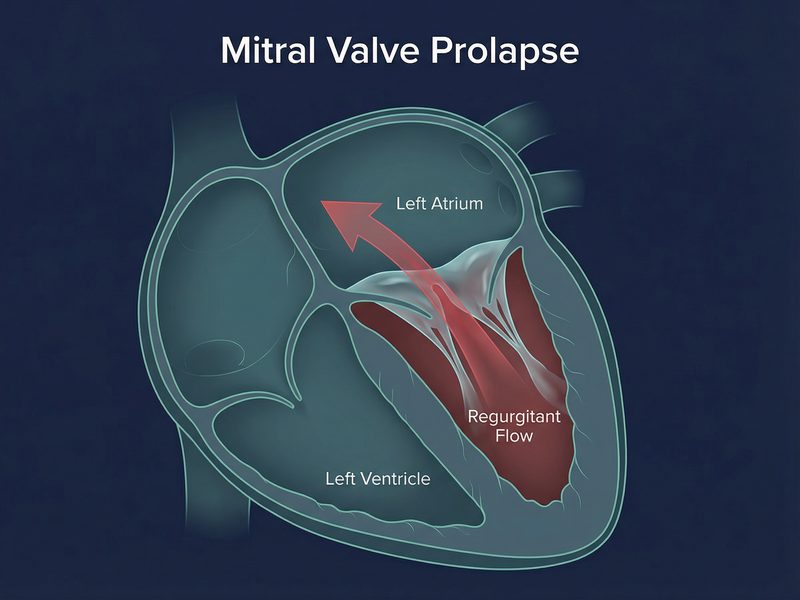
Mitral regurgitation is the most common valvular heart disease in Europe. It occurs when the heart's mitral valve does not close tightly, allowing blood to flow backwards into the left atrium. This comprehensive guide explains the causes, symptoms, and how an echocardiogram is used to accurately grade the severity of the condition and guide treatment.
The mitral valve is located between the left atrium (the upper chamber) and the left ventricle (the main pumping chamber) of the heart. Its job is to keep blood flowing in one direction. Mitral regurgitation (MR) occurs when the valve's two leaflets do not close properly, allowing blood to leak backwards into the left atrium each time the left ventricle contracts.
This backward flow means the heart has to work harder to pump enough oxygen-rich blood to the rest of the body. Over time, this extra workload can lead to heart enlargement, breathlessness, and eventually heart failure if left untreated. According to the European Registry of Mitral Regurgitation (EuMiClip), which analysed over 63,000 echocardiograms, MR is the most prevalent valvular heart disease in Europe [1].
In primary MR, the problem lies within the valve itself. The leaflets or the chordae tendineae (the "heart strings" that anchor the leaflets) are structurally abnormal.
In secondary MR, the valve leaflets are structurally normal, but the valve leaks because the left ventricle or left atrium has become enlarged or diseased, pulling the leaflets apart.
Mild mitral regurgitation often causes no symptoms and may only be discovered incidentally when a doctor hears a heart murmur through a stethoscope. However, as the condition progresses to moderate or severe, the heart struggles to compensate for the backward flow of blood, leading to noticeable symptoms.
Feeling short of breath, especially during physical exertion or when lying flat in bed at night (orthopnoea). This occurs because the backward flow of blood increases pressure in the lungs.
A persistent feeling of exhaustion, even after resting. Because blood is leaking backwards, less oxygen-rich blood is pumped forward to the muscles and organs.
Sensations of a fluttering, racing, or irregular heartbeat. The enlarged left atrium is highly susceptible to developing arrhythmias, particularly atrial fibrillation.
Swelling in the ankles, feet, legs, or abdomen. As the heart's pumping efficiency declines, fluid begins to build up in the body's tissues, a classic sign of heart failure.

An echocardiogram (ultrasound-scan of the heart) is the gold standard test for diagnosing mitral regurgitation. It allows the cardiologist or sonographer to visualise the valve leaflets in real-time, determine the exact cause of the leak, and precisely quantify its severity [5].
During the ultrasound-scan, several specific parameters are measured to grade the severity of the regurgitation from mild to severe:
While a standard transthoracic echocardiogram (TTE) is usually sufficient for diagnosis, a transoesophageal echocardiogram (TOE) may be required if surgery or a transcatheter intervention is being considered.
During a TOE, a specialised ultrasound probe is passed down the oesophagus (the food pipe), which lies directly behind the heart. This provides highly detailed, high-resolution 3D images of the mitral valve without the ribs or lungs getting in the way, which is essential for precise surgical planning [6].
The treatment for mitral regurgitation depends entirely on whether it is primary or secondary, how severe the leak is, and whether the patient is experiencing symptoms.
| Treatment Approach | How it works | Best suited for |
|---|---|---|
| Medical Therapy | Medications such as ACE inhibitors, beta-blockers, and diuretics do not fix the valve, but they reduce the workload on the heart and help clear excess fluid from the lungs. | Patients with mild to moderate MR, or as the first-line treatment for secondary (functional) MR to optimise heart failure management. |
| Surgical Valve Repair or Replacement | Open-heart surgery to physically repair the patient's own valve (preferred) or replace it with a mechanical or tissue valve. | Patients with severe primary MR who are experiencing symptoms, or asymptomatic patients who show signs of left ventricular dysfunction on their echocardiogram. |
| Transcatheter Edge-to-Edge Repair (TEER / MitraClip) | A minimally invasive procedure where a small clip is delivered via a catheter from the groin to the heart, clipping the two mitral leaflets together to reduce the leak. | Patients with severe secondary MR who remain symptomatic despite optimal medical therapy, or patients with primary MR who are at high surgical risk. |