Home ›
Blog ›
General Health ›
Gallstones on ultrasound
Gallstones on Ultrasound: What the Scan Shows and What Happens Next
Gallstones on ultrasound show up as bright spots inside the gallbladder that cast a
shadow and usually move when you change position. An abdominal ultrasound is the
first scan NICE recommends when gallstones are suspected. Many people have gallstones
without symptoms and need no treatment; stones that cause pain are usually treated by
removing the gallbladder.
Written by Sonoworld Clinical Team ·
Reviewed by Daniela Stan, Consultant Ultrasound Practitioner ·
Updated 25 November 2026
When gallstone pain needs urgent help
- Call 999 or go to A&E if you have sudden, severe pain in your tummy; pain that spreads from your tummy to your back and you are being sick; a very high temperature, or you feel hot, cold or shivery; or yellow skin or yellow whites of the eyes.
- Ask for an urgent GP appointment or contact NHS 111 if you have pain in your tummy that lasts longer than 30 minutes.
- Do not wait for a booked private scan if you have any of these symptoms.
What Are Gallstones?
Gallstones are small, hard stones that form in the gallbladder, the small pouch under
the liver that stores bile. They are common: NICE estimates that about 15% of adults
have gallstone disease, and most of them have no symptoms. The NHS says you may be
more likely to get gallstones if you are over 40, a woman, living with obesity, have
lost weight quickly, eat a high-fat and low-fibre diet, or have a condition such as
diabetes or Crohn's disease.
What Does Gallstone Pain Feel Like?
Gallstones only cause pain when they irritate the gallbladder or block the flow of
bile. The NHS describes the pain, called biliary colic, as severe and constant, lasting
longer than 30 minutes and up to several hours. It is felt in the middle of the tummy
or just under the ribs on the right side, and it can make you feel or be sick.
Pain that lasts longer than 30 minutes needs an urgent GP appointment or a call to
NHS 111. Pain with a high temperature, shivering or yellowing of the skin can mean the
gallbladder or bile ducts are inflamed or infected, which needs A&E. If your pain
is in a different part of the tummy, our guide to
abdominal pain and when to get a scan
covers other causes.
How Does an Ultrasound Find Gallstones?
NICE recommends liver function blood tests and an ultrasound scan for anyone with
suspected gallstone disease. Ultrasound is the method of choice for finding gallstones.
On the screen, a gallstone shows up as a bright, highly reflective spot inside the
gallbladder with a dark shadow behind it, and it usually moves when you change position.
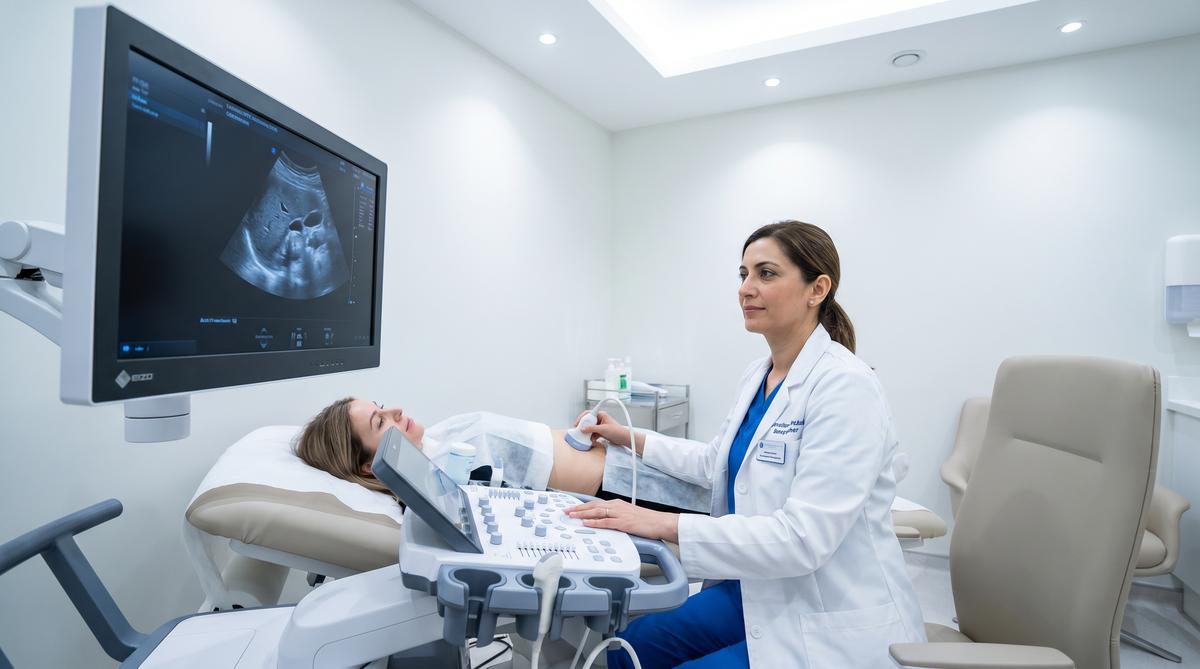
You lie on your back, and sometimes on your left side, while the sonographer moves a
probe over the right side of your upper tummy. You may be asked to take a deep breath
and hold it, which moves the gallbladder down from under the ribs. The gallbladder is
checked as part of an
abdominal ultrasound scan,
which also looks at the liver, bile ducts, pancreas, spleen and kidneys.
How Should You Prepare for a Gallbladder Scan?
Do not eat for 4 hours before your scan. You can drink plain water, and you can take
your usual medicines with a little water unless your doctor has told you otherwise.
Avoid fizzy drinks, which add gas to the bowel. The gallbladder fills with bile when
you have not eaten and empties after a meal, so a fast makes it much easier to see.
Our ultrasound preparation guide
has more detail.
What Can Your Ultrasound Report Show?
What the report includes depends on the scan you had and what the sonographer found.
For the gallbladder, it can describe:
- Gallstones, with their number and size where that helps your doctor.
- Sludge, a thick layer of bile that does not cast a shadow like a stone.
- Polyps, small growths on the gallbladder wall that stay still when you move.
- The gallbladder wall, which can look thickened when it is inflamed.
- The bile ducts, which can widen if something is blocking the flow of bile.
If everything looks normal, your report may say the gallbladder is "unremarkable".
Our guide to what your abdominal ultrasound report means
explains that and other common terms.
What Do We See in Our Clinic?
From our abdominal clinic
The most common reason people come to us about the gallbladder is pain under the
right ribs. For some it is related to food; for others it is not. We also often find
gallstones in people who came in for a different reason.
- Fasting: we ask for a 4-hour fast before an abdominal scan, so the gallbladder is full and easy to assess.
- Stones with symptoms: the report recommends a specialist opinion, which you arrange through your GP.
- Stones found by chance: the report records them so your GP has the information. National guidance says stones in a normal gallbladder with normal bile ducts usually need no treatment unless they start to cause symptoms.
- Polyps of 10 mm or more: the report recommends referral to a specialist.
- Further scans: the sonographer does not arrange scans such as MRCP. If one is needed, a specialist decides, through your GP.
This describes how Sonoworld reports these scans. Your GP or specialist will
explain what your own result means for you.
Do Gallstones Need Treatment?
Not always. NICE says people with gallstones that cause no symptoms, in a normal
gallbladder with normal bile ducts, should be reassured that they do not need
treatment unless symptoms develop. If gallstones do cause symptoms, NICE recommends
offering keyhole surgery to remove the gallbladder (laparoscopic cholecystectomy).
The NHS says stones that have moved into the main bile duct may be cleared with a
procedure called ERCP. While you wait for surgery, the NHS suggests painkillers,
avoiding foods that trigger your pain, and a low-fat diet. Your GP or specialist will
talk you through what suits you.
What If the Scan Finds a Gallbladder Polyp?
Gallbladder polyps are a common finding on ultrasound, and gallbladder cancer is
uncommon. European guidelines, written by radiology and surgical societies, base the
next step on the size of the largest polyp and on risk factors such as being over 60:
| Polyp size | Usual recommendation |
|---|
| 10 mm or more | Removal of the gallbladder, if you are fit for and agree to surgery |
| 6 to 9 mm, with risk factors | Removal of the gallbladder, if you are fit for and agree to surgery |
| 6 to 9 mm without risk factors, or 5 mm or less with risk factors | Repeat ultrasound at 6 months, 1 year and 2 years |
| 5 mm or less, no risk factors | No follow-up needed |
The guidelines also suggest removal for a smaller polyp if it is causing symptoms
and nothing else explains them. A specialist makes these decisions with you.
What Can Ultrasound Not Show?
Ultrasound shows stones inside the gallbladder well, but very small stones, under 2 to
3 mm, can be hard to see. Stones that have moved into the bile duct can also be missed.
NICE recommends considering an MRI scan of the bile ducts (MRCP) when ultrasound has
not shown a stone in the bile duct but the duct is widened or liver blood tests are
abnormal. That decision sits with a specialist.
Frequently Asked Questions
How long do I need to fast before a gallbladder ultrasound?
Do not eat for 4 hours before your scan. You can drink plain water and take your usual medicines with a little water unless your doctor has said otherwise. Avoid fizzy drinks. Fasting lets the gallbladder fill with bile, which makes stones much easier to see. If you eat by mistake, tell us before the scan starts.
Can an ultrasound always see gallstones?
Ultrasound is the method of choice for gallstones and shows stones in the gallbladder well. Very small stones, under 2 to 3 mm, can be hard to see, and stones in the bile duct can be missed. If your symptoms or blood tests suggest a stone in the duct, a specialist may arrange an MRI scan of the bile ducts, called MRCP.
I have gallstones but no pain. Do I need treatment?
Usually not. NICE says people with gallstones that cause no symptoms, in a normal gallbladder with normal bile ducts, do not need treatment unless symptoms develop. Your report records the stones so your GP has the information. See your GP if you later get pain under the right ribs, and get urgent help for severe pain, fever or yellow skin.
What does it mean if my gallbladder is "unremarkable"?
It means the gallbladder looked normal on the scan. "Unremarkable" is standard report wording for nothing abnormal seen. It is not a vague or worrying term. If you still have symptoms, your GP may look for other causes, and our guide to what your abdominal ultrasound report means explains other common report terms.
Are gallbladder polyps cancer?
Most are not. Polyps are a common finding on ultrasound and gallbladder cancer is uncommon. European guidelines use the size of the largest polyp and your risk factors to decide the next step: polyps of 10 mm or more are usually removed with the gallbladder, some smaller ones are watched with repeat scans, and the smallest need no follow-up.
What should I eat if I have gallstones?
While you wait for treatment, the NHS suggests avoiding foods that trigger your pain and eating a low-fat diet. Painkillers can help during an attack. If your pain lasts longer than 30 minutes, ask for an urgent GP appointment or contact NHS 111.
Which scan should I book to check for gallstones?
Book an abdominal ultrasound scan. It includes the gallbladder and bile ducts, as well as the liver, pancreas, spleen and kidneys, and costs £235. You do not need a GP referral. You get instant verbal results at the appointment and a written report within 24 hours, which you can share with your GP.
Book an abdominal ultrasound scan
£235, no GP referral needed. Instant verbal results; written report within 24 hours. Please do not eat for 4 hours before your scan.
Book an abdominal scan
29 Weymouth Street, London W1G 7DB · 020 3633 4902 · What happens at your visit
Sources
- NICE. Gallstone disease: diagnosis and management (CG188), recommendations 1.1.1, 1.1.2, 1.2.1 and 1.2.2, and introduction. Accessed 25 November 2026.
- NHS. Gallstones: symptoms, urgent advice, risk factors and treatment. Last reviewed 11 August 2025. Accessed 25 November 2026.
- Foley KG and others. Management and follow-up of gallbladder polyps: updated joint guidelines between the ESGAR, EAES, EFISDS and ESGE. European Radiology 2022;32(5):3358-3368. Accessed 25 November 2026.
- RadioGraphics, volume 20, issue 3. Review of imaging in gallstone disease (DOI 10.1148/radiographics.20.3.g00ma16751): ultrasound appearance of gallstones. Accessed 25 November 2026.
- Radiopaedia. Gallstones: ultrasound features and sludge. Accessed 25 November 2026.
- New developments in the ultrasonography diagnosis of gallbladder diseases. Gastroenterology Insights 2024;15(1):4: detection of small stones. mdpi.com. Accessed 25 November 2026.
This guide is general information and does not replace individual medical advice.
Sonoworld Diagnostic Services Limited is registered with the Care Quality Commission:
see our CQC registration.