Breech Baby: Your Options and What a Presentation Scan Shows
By the Sonoworld clinical team, 29 Weymouth Street, Marylebone · CQC-registered clinic · Medically reviewed by Daniela Stan, Consultant Sonographer, MSc — 31 July 2026 · Last reviewed: 31 July 2026
Contact your maternity unit immediately — do not book a scan — if your baby’s movements have reduced or changed, if you have vaginal bleeding, if your waters break, or if you have constant abdominal pain. These need assessment on a labour ward the same day.
A breech baby is bottom-down or feet-down instead of head-down. Around three to four in every hundred babies are still breech at full term. If yours is, you have real choices — a procedure to turn the baby, a planned caesarean, or in some cases a vaginal breech birth. All of them depend on knowing the position for certain, which is what a presentation scan settles.
What breech means
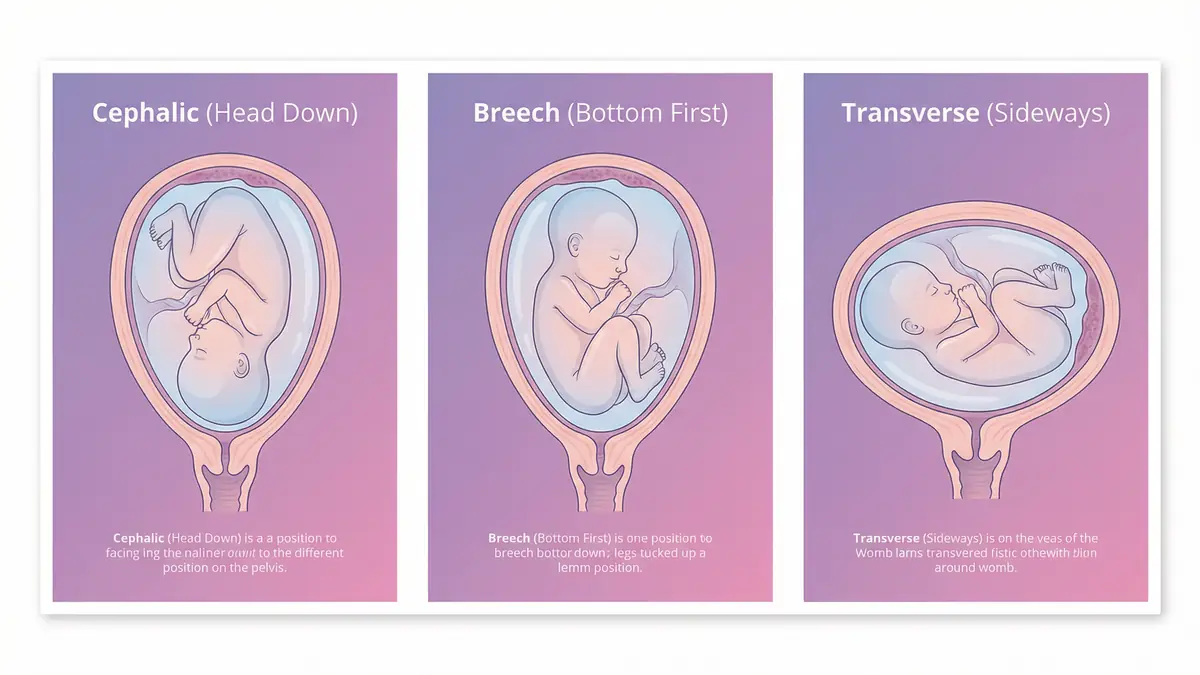
Most babies settle head-down (cephalic) in the last weeks of pregnancy, ready to be born head first. A breech baby has not done that. There are three main patterns, and which one your baby is in affects the options available:
Frank breech — bottom down with legs straight up in front of the body, feet near the head. The most common type.
Complete breech — bottom down with knees bent, sitting cross-legged.
Footling breech — one or both feet pointing down below the bottom.
A baby lying sideways is described as transverse, and one lying at an angle is oblique. Both are also non-cephalic and both need a plan before labour.
The three breech patterns compared with a head-down baby. Which pattern applies affects your options.
How common it is, and when it matters
Breech is normal earlier in pregnancy. At around 28 weeks roughly a quarter of babies are breech, and most turn on their own over the following weeks. By full term only about three to four in a hundred are still breech.
So the timing of the question matters enormously. Before about 36 weeks, breech is usually just a stage. From 36 weeks onwards it becomes a planning question, because there is progressively less room and less time for the baby to turn without help.
Why a midwife may be unsure
Position is normally checked by feeling the abdomen — a technique called palpation. It is quick, free and non-invasive, and in experienced hands it is often right. But it is not reliable enough to plan a birth around.
Research on routine 36-week scanning has repeatedly found that a meaningful proportion of term breech babies are not picked up by palpation alone, which is why some babies are only discovered to be breech once labour has already started. A firm bottom and a head can feel similar through the abdominal wall, particularly if the placenta is at the front, if there is plenty of fluid, or later in pregnancy when the baby is tightly packed.
This is the single most common reason women come to us for a presentation scan: the midwife was not certain, and the answer changes the birth plan.
What a presentation scan shows
A presentation scan is a short, focused ultrasound. It takes around 15 to 20 minutes, needs no preparation, and answers four questions:
Which way up is the baby — cephalic, breech (and which type), transverse or oblique.
How much amniotic fluid there is — relevant because fluid volume affects how easily a baby can be turned.
Where the placenta is — a placenta at the front or lying low changes what is safe and what is possible.
An estimate of the baby’s size, which feeds into planning.
What it tells you is the position on that day. That distinction matters and we return to it below.
Your options if the baby is breech
The scan establishes the facts; your maternity team decides the plan with you.
External cephalic version (ECV)
ECV is a procedure where an obstetrician turns the baby by applying firm, steady pressure to your abdomen. It is usually offered from around 36 to 37 weeks. UK guidance advises women that the success rate is approximately 50 per cent, and that where it succeeds, few babies turn back.
It is done in hospital with monitoring, and a medication to relax the womb is often used to improve the chance of success. It can be uncomfortable. Not everyone is suitable — a low-lying placenta, recent bleeding, reduced fluid or a twin pregnancy are among the reasons it may not be offered.
Planned caesarean section
A booked caesarean, usually from around 39 weeks, is the most common choice for a baby still breech at term in the UK. It removes the uncertainty of labour with a breech baby, at the cost of it being major abdominal surgery with a longer recovery.
Vaginal breech birth
A planned vaginal breech birth is possible in selected circumstances. It depends on the type of breech, the baby’s size and position of the head, your previous births, and crucially on having a team experienced in supporting breech delivery. Availability varies considerably between units, so it is worth asking your team directly and early.
From our practice
From our practice
Late in pregnancy, women booking a presentation scan are almost always trying to definitively confirm whether the baby is head-down or breech, in order to make imminent birth plans — deciding on an ECV, or on a caesarean section.
The appointment is usually midwife-prompted. The midwife felt something ambiguous during a routine abdominal palpation, and the patient booked privately rather than wait for an NHS slot at a point in pregnancy where waiting has a real cost.
We always make sure to explain the limit of what we are giving them. The scan absolutely confirms the baby’s exact position, the fluid levels and the placental location on that specific day. What it cannot do is mathematically guarantee that a stubborn baby will not perform a last-minute flip before labour actually begins. Babies move, and a scan is a photograph rather than a promise.
Describes general patterns among the patients we see, not any individual case. Decisions about ECV, caesarean or vaginal breech birth are made with your obstetric team.
Common questions
At what point should I worry about a breech baby?
Before around 36 weeks, breech is common and most babies turn on their own. From 36 weeks it becomes a planning question rather than a worry, because there is less room and less time for the baby to turn unaided.
Can a scan tell me for certain which way up my baby is?
Yes, for that day. Ultrasound is definitive about position, fluid and placental location at the time of the scan. It cannot guarantee the baby will not move afterwards, though movement becomes less likely as term approaches.
Does ECV hurt?
It is usually described as uncomfortable rather than painful, and it is done with monitoring so it can be stopped at any point. Discomfort varies a great deal between women.
Are there exercises or positions that turn a breech baby?
UK guidance is clear that there is no evidence postural techniques alone encourage a baby to turn. Some women choose to try moxibustion between 33 and 35 weeks under a trained practitioner. Discuss anything you are considering with your midwife first.
Do I need a referral for a presentation scan?
No. You can book directly with us. Bring your maternity notes if you have them, and we can send the report to your midwife or obstetric team at your request.
What does the scan cost and when do I get results?
A presentation scan is £235. You receive instant verbal results at the appointment from the consultant performing your scan, with the written report following within 24 hours.
CQC-registered clinic · BMUS member · ICO-registered. Reports can be shared securely with your midwife or obstetric team at your request.
References
Royal College of Obstetricians and Gynaecologists. External Cephalic Version and Reducing the Incidence of Term Breech Presentation (Green-top Guideline No. 20a). Accessed 31 July 2026.
Royal College of Obstetricians and Gynaecologists. Management of Breech Presentation (Green-top Guideline No. 20b). Accessed 31 July 2026.
Wanyonyi S et al. Routine 36-week scan: diagnosis and outcome of abnormal fetal presentation. Ultrasound in Obstetrics & Gynecology. Accessed 31 July 2026.
NHS. Breech baby at the end of pregnancy. Accessed 31 July 2026.