
Lump
Palpable breast lump
Any new or changing lump in the breast or axilla warrants imaging. Targeted ultrasound in women aged 30–39 has reported sensitivities of 84.6%–100% across systematic-review studies.[1]
A private breast ultrasound scan at Sonoworld is a same-day, consultant-led diagnostic test of the breast tissue, nipple-areolar complex and axillary lymph nodes, used to investigate palpable lumps, focal pain, nipple discharge and dense-breast concerns.
£235 unilateral or £350 bilateral, with instant verbal results in the room, with the BI-RADS written report within 24 hours.
Most women who book with us have noticed something specific and want a definitive answer in one appointment. The scan is set up to give you that.
20% off with code SONO26 · new bookings
For a 4-area health check covering the pelvis, abdomen, urinary tract and aorta, see the Well Woman Scan (£500).
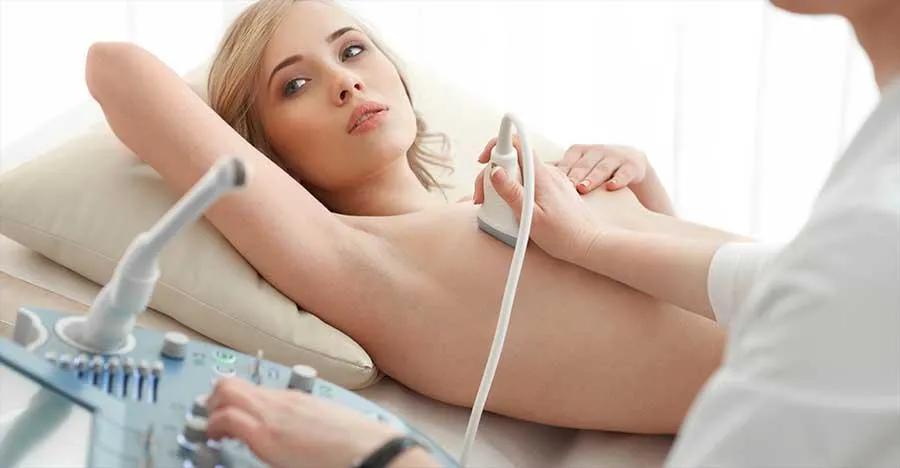
A breast ultrasound scan uses high-frequency sound waves to image breast tissue, the nipple-areolar complex and the axillary lymph nodes. It is the recommended first-line imaging modality for any palpable breast lump, focal pain or nipple discharge, and the preferred modality in women under 40 because dense breast tissue at this age limits the value of mammography.[1]
At Sonoworld the scan takes 20–30 minutes and is performed by Daniela Stan, a Consultant Ultrasound Practitioner with 20+ years' experience in breast imaging. Findings are explained verbally during the scan, lesions are graded using the ACR BI-RADS lexicon, and you receive instant verbal results in the room, with a structured written report within 24 hours. No GP referral is required.
| Procedure | Diagnostic breast ultrasound imaging (B-mode + colour Doppler) |
| Duration | 20–30 minutes |
| Preparation | None required |
| Radiation | None — sound waves only |
| Price | £235 (unilateral) · £350 (bilateral) |
| Report | Written BI-RADS report within 24 hours with images |
| GP referral | Not required |
| Insurance | AXA, Healix, WPA accepted |
Ready to book?
Book — £235 / £350The breast scan covers the full breast parenchyma in all four quadrants, the retro-areolar region and the ipsilateral axilla. Colour Doppler is used to characterise vascularity within any identified lesion, contributing to the BI-RADS descriptor set.
| Breast structure assessed | What is evaluated | Clinical relevance |
|---|---|---|
| Breast parenchyma | Glandular tissue, fibrous stroma, fatty distribution | Identifies architectural distortion or focal density change |
| Palpable breast lump | Size, shape, margins, echogenicity, posterior acoustic features | Differentiates solid from cystic; characterises solid masses |
| Cysts | Simple, complicated or complex cyst classification | Simple breast cysts are benign; complex cysts may require aspiration or follow-up |
| Solid breast masses | Fibroadenoma vs suspicious morphology (irregular margins, posterior shadowing) | Guides decision on whether tissue sampling (FNA) is needed |
| Nipple-areolar complex | Subareolar ducts, periareolar tissue | Relevant for nipple discharge, periareolar lumps |
| Axillary lymph nodes | Size, cortical thickness, fatty hilum preservation | Abnormal nodes may indicate lymphatic involvement |
| Colour Doppler | Vascularity within and around any breast lesion found | Increased peripheral vascularity raises suspicion; avascular lesions are typically benign |
| Breast implants | Implant shell integrity, peri-implant tissue, capsular contracture signs | First-line for suspected breast implant rupture: pooled sensitivity 73.7%, specificity 87.8%[2] |
Findings are reported using the ACR BI-RADS classification: 1 (negative), 2 (benign), 3 (probably benign — short-interval follow-up), 4 (suspicious — biopsy considered), 5 (highly suspicious — biopsy recommended). The category appears clearly on the report alongside the recommended next step, so onward referrals can move forward without delay.
Breast ultrasound is appropriate across a wide range of presentations. It is the preferred modality in women under 40 and in pregnancy or lactation, and is used alongside mammography in older women when a specific area needs further characterisation.
Any new or changing lump in the breast or axilla warrants imaging. Targeted ultrasound in women aged 30–39 has reported sensitivities of 84.6%–100% across systematic-review studies.[1]
Cyclical breast pain is usually hormonal. Localised, non-cyclical pain (especially with a tender area on examination) benefits from imaging to look for a structural cause such as a cyst, fibroadenoma or abscess.
Spontaneous, unilateral or blood-stained discharge needs evaluation. Ultrasound assesses the subareolar ducts and periareolar tissue for duct ectasia, intraductal papilloma or other causes.
Mammography sensitivity drops in dense breasts. Adding supplemental ultrasound detects approximately 3.8 additional cancers per 1,000 mammography-negative women, around a 40% increase in this group.[3,4]
Ultrasound is the first-line investigation for suspected implant rupture, peri-implant fluid or capsular contracture, with pooled sensitivity 73.7% and specificity 87.8% against surgical reference.[2]
Ultrasound has no ionising radiation and is safe at any stage of pregnancy and during breastfeeding. It is the preferred modality for breast symptoms in these periods.
A rapidly enlarging lump, skin dimpling or puckering, new nipple inversion, redness or warmth over the breast, or new swollen lymph nodes in the armpit. NICE guideline NG12 sets a 2-week wait standard for these features.[5] Same-day private appointments are available — call 020 3633 4902.
Each modality has different strengths. The right choice depends on age, breast density, the clinical question, and what previous imaging is available.
| Feature | Breast ultrasound | Mammography | Breast MRI |
|---|---|---|---|
| Radiation | None | Low-dose X-ray | None |
| First-line under 40 | Yes — preferred | Limited (dense tissue) | Selected high-risk only |
| Dense breast performance | Excellent — density-independent | Reduced sensitivity | Excellent |
| Microcalcifications | Limited | Best for detection | Moderate |
| Real-time biopsy guidance | Yes | Stereotactic only | Specialist centres only |
| Implant rupture | First-line investigation | Limited | Definitive when US equivocal |
| Pregnancy / lactation | Safe at any stage | Avoided where possible | Specialist use only |
| Available at Sonoworld | Yes — same-day | No | No |
| Sonoworld price | £235 / £350 | — | — |
Ultrasound identifies and characterises masses but cannot give a tissue diagnosis. If features are suspicious (BI-RADS 4 or 5), tissue sampling is needed: fine needle aspiration for cysts, core needle biopsy for solid masses. The Sonoworld report sets out the recommended next step the same day, so onward referrals do not lose time.
Three patterns recur in our breast-imaging casebook. They explain why the appointment is structured the way it is, and why women self-refer to Sonoworld over alternative pathways.
The single most common reason women book is a lump found that day or the day before. By the time they arrive, the worry has already done several days' work. Our protocol is built for this: brief history, full bilateral parenchymal sweep, focused interrogation of the area of concern, axillary check, BI-RADS assignment, verbal explanation, written report out the same day. The aim is one appointment, one definitive answer.
Vascularity is part of the BI-RADS lexicon. A solid lesion with avascular features is reassuring; one with peripheral vascularity changes the BI-RADS category and the recommended next step. Doppler is not an optional extra at Sonoworld because making the report directly actionable for any onward referral matters more than itemising line by line.
A regular subset of self-referrers had breast implants placed 8–15 years ago and have had no follow-up imaging since. Most are asymptomatic and want a baseline; some have noticed a change in shape, asymmetry or discomfort. Ultrasound is the first-line modality for shell integrity, with reported pooled sensitivity around 74% and specificity around 88% against surgical findings.[2] When ultrasound is equivocal, we say so plainly and recommend MRI as the next step.
These are general practice patterns described for context. Patterns are not diagnoses. Every patient's clinical picture is different, and decisions about treatment or further investigation should always be taken with a qualified clinician who has seen the full picture.
No specific preparation is required. You don't need to fast or follow any dietary instructions.
Wear a two-piece outfit. You'll undress to the waist and be given a gown or sheet for cover.
Avoid lotions, creams or talc on the breast area on the day. They interfere with gel adhesion and image quality.
No optimal cycle phase for a diagnostic breast scan. If you are premenopausal, the scan can be performed at any point in your cycle.
Previous breast imaging reports, mammogram films or a GP letter if you have them. Insurance patients should bring their authorisation number.

Six steps from booking to written report. Most patients leave the clinic with a clear answer and the report follows on the same day.
Choose a slot at the booking page or call 020 3633 4902. Same-day slots are usually available.
29 Weymouth Street, Marylebone W1G 7DB. 5 min from Regent's Park and Great Portland Street stations.
Brief conversation about symptoms, timing, family history and any previous breast imaging.
Systematic B-mode sweep of all quadrants and the retro-areolar region. Colour Doppler on any lesion. Ipsilateral axilla checked.
Daniela explains findings as she scans and gives a clear verbal summary at the end. You leave knowing what was found.
Structured report with BI-RADS classification, lesion measurements and recommended next steps, sent securely.
All-inclusive pricing. No separate report fees, no charge for Doppler or axillary node assessment.
We accept AXA Health, AXA Global, Healix and WPA. Insurance patients should obtain pre-authorisation before booking. For a combined women's health check covering pelvic, abdominal, urinary tract and aortic ultrasound, see the Well Woman Screening Package (£500).
The clinical examination is the same. What changes is how you reach the scan, how quickly the report comes back, and who performs it.
| Aspect | NHS pathway | Sonoworld private scan |
|---|---|---|
| Referral | GP referral required (2-week wait for red-flag features) | Self-referral; no GP needed |
| Time to scan | Up to 2 weeks for urgent cases; longer for routine | Same-day or next-day |
| Time to written report | 1–4 weeks after the scan, typically | Same day, with verbal feedback at the appointment |
| Operator | NHS sonographer or radiologist (variable seniority) | Consultant sonographer with 20+ years' breast imaging experience |
| Cost | Free at point of use | £235 unilateral · £350 bilateral; insurance accepted |
| Onward referral | Within NHS system | BI-RADS report suitable for NHS or private referral |
A private scan does not replace NHS care. It gives you a structured BI-RADS report you can take into either system without losing weeks.
Patient feedback for Sonoworld is published on independent review platforms. Read what patients have said on our Doctify profile, or see a selection on our patient reviews page.
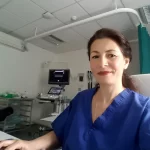
Consultant Ultrasound Practitioner · Sonoworld, Marylebone London
Daniela is a London-based Consultant Ultrasound Practitioner with more than 20 years of NHS and private experience. She holds an MSc in Medical Ultrasound and a Medical Doctor Licence in Family Medicine from the University of Medicine and Pharmacy Carol Davila, Bucharest. Her specialist areas include breast, gynaecological, abdominal, MSK and vascular ultrasound.
Daniela performs every breast ultrasound at Sonoworld personally. Findings are explained as the scan progresses, the BI-RADS classification is set out plainly, and the written report is formatted for direct use by a GP, breast surgeon or oncologist. This page reflects current practice consistent with NICE NG12 and the ACR BI-RADS Atlas (5th Edition).
No. You can self-refer for a private breast ultrasound scan at Sonoworld. If you have a GP letter or previous breast imaging, bring them as they help contextualise the findings, but they are not a prerequisite for booking.
No. The probe is moved gently across the skin with warm gel and there is no compression at any stage. If you have a tender area, tell the sonographer at the start so the examination can be paced accordingly.
Breast ultrasound identifies and characterises masses. It distinguishes simple cysts (benign) from fibroadenomas (typically benign) and from lesions with suspicious features such as irregular margins, posterior shadowing or increased Doppler vascularity. It cannot give a tissue diagnosis: confirmation requires fine needle aspiration or core needle biopsy if a lesion is BI-RADS 4 or 5.
Mammography uses low-dose X-rays and is best for detecting microcalcifications; it is the first-line modality from age 40 and the basis of NHS Breast Screening. Breast ultrasound uses sound waves, has no radiation, and is the preferred first-line investigation in women under 40 and for evaluating any palpable lump. The two modalities are complementary, and neither replaces the other.
For a specific symptom in one breast (a lump, focal pain or nipple discharge), the unilateral scan at £235 is appropriate. For a general breast health check, bilateral symptoms, family-history monitoring or implant surveillance, the bilateral scan at £350 covers both sides with a single consolidated report.
Yes. Ultrasound uses sound waves, not ionising radiation, and is safe at any stage of pregnancy and during breastfeeding. It is the preferred modality for breast symptoms in these periods. If you are breastfeeding, feeding shortly before the appointment makes the scan more comfortable.
BI-RADS is the ACR-standard classification for breast imaging findings. Category 1 is normal, 2 is benign, 3 is probably benign (short-interval follow-up), 4 is suspicious (biopsy considered), 5 is highly suspicious (biopsy strongly recommended). Your written report includes the category alongside a plain-English explanation of the next step.
A unilateral breast ultrasound scan at Sonoworld costs £235. A bilateral scan costs £350. Both prices are all-inclusive: written BI-RADS report, colour Doppler and axillary lymph node assessment are included at no extra charge. There are no booking, registration or report fees.
29 Weymouth Street
Marylebone
London W1G 7DB
Phone: 020 3633 4902
Email: info@sonoworld.co.uk
This page is prepared by Daniela Stan, MSc Medical Ultrasound, and reviewed by Sonoworld's clinical team. Sonoworld Diagnostic Services is registered with the Care Quality Commission (rated Good) and the Information Commissioner's Office. Last clinically reviewed: April 2026.