Varicose Veins and Venous Insufficiency: Diagnosis and Treatment
Written by Daniela Stan, Consultant Sonographer & Clinical Director, Sonoworld London.
Medically reviewed by Hootan Mohsenian, MSc — Advanced Practitioner in Echocardiography (BSE-accredited) —
What are varicose veins?
Varicose veins are enlarged, twisted veins that appear just beneath the skin surface, most commonly in the legs. They develop when the one-way valves inside the veins fail, allowing blood to pool and the vein wall to stretch and bulge. This underlying process is called chronic venous insufficiency (CVI).
Varicose veins affect approximately 30% of the adult population and are more common in women, in people who stand for long periods, and in those with a family history of the condition. They are not merely a cosmetic concern — untreated venous insufficiency can progress to leg ulcers, skin changes (lipodermatosclerosis), and superficial thrombophlebitis.
Symptoms of venous insufficiency
Beyond the visible appearance of varicose veins, chronic venous insufficiency can cause:
Aching, heaviness, or throbbing in the legs, particularly after prolonged standing
Swelling of the ankles and lower legs, worse in the evening
Itching or burning over the varicose veins
Skin discolouration (brown staining) around the ankles — a sign of haemosiderin deposition from chronic venous hypertension
Skin hardening and thickening (lipodermatosclerosis) — a pre-ulcerative change
Venous leg ulcers — open wounds above the ankle that are slow to heal
How are varicose veins diagnosed?
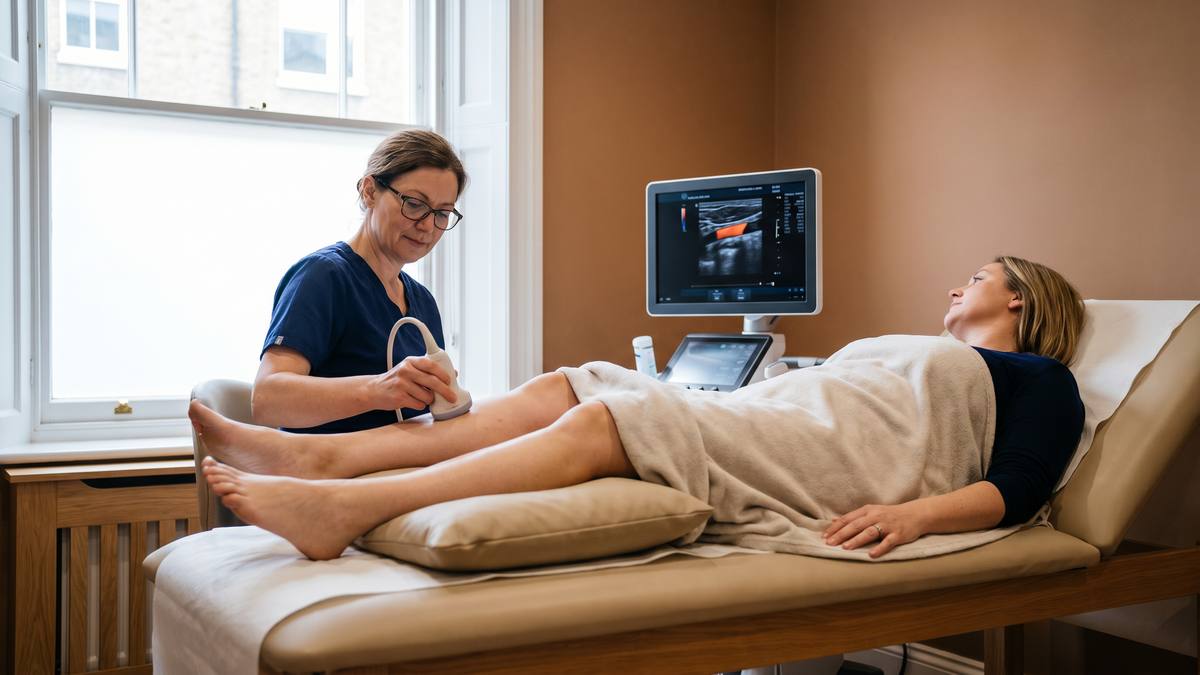
The definitive investigation for varicose veins and chronic venous insufficiency is a venous duplex ultrasound scan (also called a venous reflux study). This scan maps the superficial and deep venous systems of the leg, identifies incompetent valves, and quantifies the degree of reflux (backward blood flow) in each vein segment.
At Sonoworld, our venous reflux studies are performed by a consultant vascular sonographer. The scan is performed standing (to maximise reflux detection) and uses Doppler technology to map blood flow in real time. The results guide the choice of treatment — endovenous laser ablation (EVLA), radiofrequency ablation (RFA), foam sclerotherapy, or conventional surgery.
A venous duplex scan is required before any interventional treatment for varicose veins. NICE recommends duplex ultrasound as the first-line investigation for all patients being considered for varicose vein treatment.
Treatment options
The choice of treatment depends on the pattern of reflux identified on duplex ultrasound:
Endovenous laser ablation (EVLA) or radiofrequency ablation (RFA): Minimally invasive procedures that use heat energy to close the incompetent vein. NICE recommends these as first-line treatments for great saphenous vein (GSV) incompetence.
Foam sclerotherapy: Injection of a sclerosant foam that damages the vein wall and causes it to close. Used for smaller varicosities and recurrent varicose veins.
Conventional surgery (stripping): Surgical removal of the varicose vein under general anaesthetic. Less commonly performed since the advent of endovenous techniques.
Compression hosiery: Does not treat the underlying reflux but can manage symptoms effectively in patients who are not suitable for or do not wish to have interventional treatment.
From Our Practice
Patients often come to us having been told by their GP that their varicose veins are "cosmetic" and therefore not eligible for NHS treatment. While it is true that NICE criteria for NHS treatment require evidence of complications (skin changes, ulceration, or bleeding), a venous duplex scan at Sonoworld provides the objective evidence needed to support a referral — and in many cases identifies significant reflux that meets the NICE threshold for treatment. Without a duplex scan, the GP cannot make an evidence-based referral decision.
Frequently asked questions
Are varicose veins dangerous?
Varicose veins are not immediately dangerous for most people, but untreated chronic venous insufficiency can progress to skin changes and venous leg ulcers, which are difficult to treat and significantly affect quality of life. Varicose veins also increase the risk of superficial thrombophlebitis (clot in a surface vein) and, rarely, DVT.
Can I get varicose vein treatment on the NHS?
NHS treatment is available for varicose veins that cause significant symptoms or complications (skin changes, ulceration, or bleeding). A duplex ultrasound scan is required to support the referral. Cosmetic varicose veins without symptoms are not treated on the NHS.
Is a venous reflux scan painful?
No. The scan is entirely painless. You will be asked to stand during part of the examination to allow accurate reflux mapping.
Sonoworld is registered with the Care Quality Commission (CQC). Our sonographers are registered with HCPC and are members of BMUS. All scans are performed at our Marylebone clinic: 29 Weymouth Street, London W1G 7DB.
Book Your Venous Reflux Studies at Sonoworld
Same-day and next-day appointments available at our Marylebone clinic. Instant verbal results. Written report within 24 hours. No GP referral required.