Book Scan
Hernia Ultrasound Scan London | Sonoworld Harley Street
General Medical Scans · Diagnostic Ultrasound

Hernia Ultrasound Scan in London

A private hernia ultrasound is a dynamic scan that confirms an inguinal, femoral, umbilical, incisional or epigastric hernia by imaging the abdominal wall while you cough, strain or hold a Valsalva manoeuvre. We scan you both standing and lying down to catch hernias that disappear when you relax. Same-day appointments at our Harley Street clinic.

CQC registered Consultant sonographers Same-day appointments No GP referral needed

Bilateral hernia scan £350 · Insurance accepted (AXA, Healix, WPA)

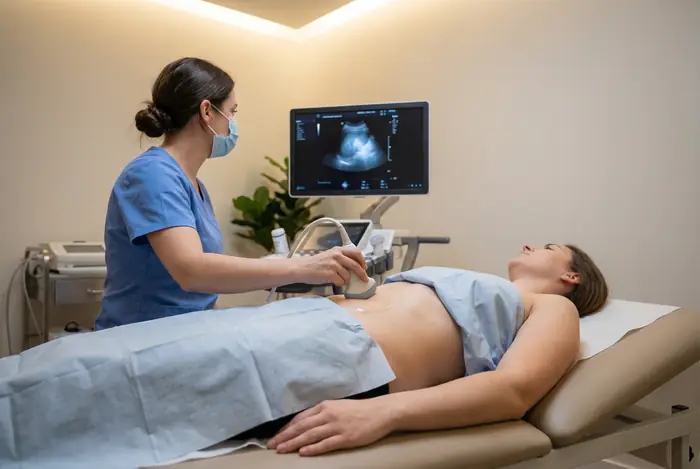
Consultant sonographer performing a dynamic hernia ultrasound at Sonoworld, Harley Street, London

What you get

  • Dynamic scan: standing and supine, with Valsalva
  • Both groins assessed where indicated
  • Inguinal, femoral, umbilical, incisional, epigastric
  • Instant verbal explanation from your sonographer
  • Immediate results
Diagnostic Overview

What is a hernia ultrasound?

A hernia ultrasound uses high-frequency sound waves to image the abdominal wall in real time and identify a defect through which fat, bowel or other tissue is protruding. The scan is dynamic: the sonographer asks you to cough, strain or perform a Valsalva manoeuvre while watching the suspect area, because most hernias only become visible when intra-abdominal pressure rises.1 Ultrasound is the first-line imaging investigation for groin and abdominal-wall hernias when the diagnosis is uncertain on examination, recommended by the British Hernia Society and the Royal College of Radiologists iRefer guidelines.

15 min
Typical scan time. Add 5–10 minutes for both sides.
85.6%
Pooled positive predictive value of ultrasound for clinically occult groin hernia.1
>94%
Accuracy in differentiating inguinal from femoral hernia on ultrasound.1
24 h
Written report turnaround. Verbal explanation given at the scan.

The aim of the scan is twofold: to confirm whether a true hernia is present, and if so, to characterise it (location, contents, size of the defect, reducibility) so that a hernia surgeon can plan repair without further imaging in most cases.2 If you have a visible groin or abdominal-wall lump, the scan also rules out the alternatives that can mimic a hernia on examination: lipoma, lymph node, hydrocele, varicocele, seroma and sebaceous cyst.

Hernia Types We Scan

Which hernias does ultrasound diagnose?

Ultrasound is best suited to abdominal-wall and groin hernias, where the defect is close enough to the skin for high-frequency imaging to resolve it clearly. Each type has its own anatomical landmarks; the sonographer adapts probe position and dynamic manoeuvres accordingly.

Epigastric midline, above navel Umbilical at the navel Spigelian lateral abdominal wall Incisional through previous scar Inguinal groin, above ligament Femoral groin, below ligament
Common hernia locations on the anterior abdominal wall. The dashed midline is the linea alba; the V-shaped lines are the inguinal ligaments. Hernias above the inguinal ligament are inguinal; below it, femoral.
Type Where it appears What ultrasound shows Typical patient
Inguinal Groin crease, above the inguinal ligament. Direct (medial to inferior epigastric vessels) or indirect (lateral, often extending into the scrotum). Bowel, fat or omentum protruding through the inguinal canal during Valsalva. The relationship to the inferior epigastric vessels classifies direct vs indirect. Adult men in particular; lifetime risk around 27% in men, 3% in women.
Femoral Below the inguinal ligament, medial to the femoral vein. Tissue passing through the femoral canal, displacing the femoral vein laterally. More common in women; higher strangulation risk than inguinal.
Umbilical At or just above the navel. Fat or bowel through a midline linea alba defect; defect size is measured for surgical planning. Adults of any age; common after pregnancy or with raised intra-abdominal pressure.
Incisional Through a previous surgical scar (laparoscopy, open abdominal surgery, C-section). Bowel or fat herniating through the fascial defect at the scar; size, contents and reducibility documented. Anyone with prior abdominal surgery; risk peaks 1–5 years post-op.
Epigastric Midline, between the navel and the lower end of the breastbone. Pre-peritoneal fat through a small linea alba defect; often only seen on Valsalva. Often picked up because of localised pain rather than a visible bulge.
Spigelian Lateral abdominal wall, along the semilunar line. An interparietal hernia between muscle layers; can be missed on examination but visible on ultrasound. Less common; presents with localised pain and a sometimes-palpable mass.
Sportsman’s groin Posterior wall of the inguinal canal, no overt protrusion. Posterior-wall deficiency (bulging) on Valsalva. Associated with chronic groin pain in athletes.3 Athletes with persistent groin pain and a normal-feeling examination.
What this scan does not assess

Ultrasound is the right test for hernias of the groin and abdominal wall. It does not assess hiatus hernia (which sits within the chest and needs endoscopy or contrast imaging), and a chronically irreducible or strangulated hernia with bowel obstruction is a surgical emergency in which CT, not ultrasound, is the imaging of choice. If you have severe pain, vomiting or a tender lump that has changed colour, do not wait for an outpatient scan; go to A&E.

When To Get Scanned

Symptoms a hernia ultrasound investigates

Patients self-refer to Sonoworld for hernia imaging in three broad situations: a lump that comes and goes, pain or dragging discomfort with no visible lump, and surgical work-up before a planned repair. The scan is also used after hernia surgery to investigate recurrence, seroma or chronic post-operative pain.

Common reasons to book a hernia scan

  • Groin lump that bulges when you cough, strain or stand up and disappears when you lie flat.
  • Groin pain on lifting, coughing or exercise, even without a visible lump (occult hernia or sports hernia).
  • Umbilical or epigastric bulge at or above the navel.
  • Lump or pain at a previous scar from open or laparoscopic surgery (suspected incisional hernia).
  • Recurrent symptoms after a previous hernia repair.
  • Pre-operative work-up when a surgeon wants confirmation of side, type and contents.
  • Persistent groin pain in athletes with a normal-feeling examination, where dynamic ultrasound has been validated.3
What To Expect

What happens at your hernia scan

From check-in to written report, the entire visit takes about 30 minutes. There is no preparation needed: you can eat, drink and take your usual medications normally before the scan. Wear loose clothing that allows access to the abdomen and groin.

1

Brief history

Your sonographer asks where the symptoms are, what brings them on, and reviews any previous surgery or imaging.

2

Supine scan

You lie flat. The sonographer scans the suspect area first at rest, then while you cough and perform a Valsalva manoeuvre.

3

Standing scan

You stand up and the scan is repeated, because gravity-dependent hernias often only appear in the upright position.

4

Verbal explanation

You receive an instant verbal summary, with the screen turned towards you for the key images. Your written report follows within 24 hours.

No preparation needed. Eat, drink and take medications normally before the scan. Wear loose two-piece clothing for easy access to the abdomen and groin. Bring any previous imaging or letter from your GP or surgeon. A chaperone or partner can be present throughout.

Why we scan you both standing and lying down

A small inguinal or femoral hernia can sit fully reduced inside the canal at rest. Gravity and intra-abdominal pressure are what make it visible, so we always combine a supine examination with a standing one and use cough plus sustained Valsalva to push the contents into the defect. This is the protocol set out in the published groin-ultrasound technique guidance from the American Journal of Roentgenology.2

From Our Practice

Why our hernia scans are dynamic and bilateral by default

Operational rationale

Standing, supine and Valsalva on every scan

The most common reason a hernia is missed on imaging is a static scan performed only with the patient lying down. A small inguinal or femoral hernia can sit completely reduced inside the canal at rest and only become visible when intra-abdominal pressure rises. The published protocol guidance from the American Journal of Roentgenology is explicit: groin hernias must be assessed during Valsalva and documented in two orthogonal planes to avoid diagnostic pitfalls.2

We adopt this as a non-negotiable in our hernia scan protocol. Every patient is scanned at rest, then with a cough, then with a sustained Valsalva, and then a second time standing up. This adds about five minutes to the scan and occasionally turns a negative supine examination into a clearly demonstrated direct inguinal hernia. We would rather take the extra time than send a patient home with a falsely reassuring report.

Clinical pattern

The contralateral groin almost always gets imaged

When patients present with a unilateral groin lump, it is tempting to scan only the symptomatic side. We do not. A cross-sectional study of asymptomatic men aged 45–67 found that 16% had an unsuspected inguinal hernia on ultrasound, with 4% bilateral.4 A meaningful minority of our patients arrive convinced they have a one-sided problem and leave with a clearer picture: an obvious symptomatic hernia on one side, and a small early defect on the other that the surgeon can address at the same operation. Our bilateral scan price (£350) reflects this; it is rarely a wasted second image.

Reasoning

Why we keep the verbal result and the surgical report separate

At the end of every scan, our sonographer turns the screen, walks you through what you can see and what it means, and answers your questions. That conversation is not the diagnosis: it is reassurance and orientation. The diagnosis is the written report, prepared and signed off the same day or next morning, and structured so a hernia surgeon can act on it without re-imaging: type, side, size of defect, contents, reducibility, relationship to the inferior epigastric vessels for inguinal hernias. Most of our patients hand the report directly to the surgeon they have already chosen. A small number ask us for an onward referral; we keep a list of London hernia surgeons we have worked with and will write directly with consent.

Patterns observed across our hernia scan caseload, not individual patient histories. Anonymised composite scenarios; no patient-identifying detail.
How It Compares

Hernia ultrasound compared with other imaging

Ultrasound is the first-line imaging investigation for the majority of suspected groin and abdominal-wall hernias, but it is not the only option. The right test depends on whether the hernia is clinically obvious, whether it is occult, and whether complications are suspected.

Test Best for Limitations Radiation Typical wait (NHS)
Ultrasound Clinically suspected groin or abdominal-wall hernias; dynamic assessment; pre-op planning. Operator-dependent; less reliable for purely occult hernias and for deep abdominal contents.1 None Weeks to months
MRI Sportsman’s groin, occult hernia after a non-diagnostic ultrasound, athletic groin pain. Higher cost; longer scan; not all centres offer Valsalva sequences.5 None Weeks to months
CT Suspected complications (incarceration, strangulation, bowel obstruction); large or complex incisional hernias. Static (unless Valsalva CT is performed); ionising radiation. Yes Hours (in A&E) to weeks
Examination only Classic, easily palpable hernias where imaging adds nothing. Sensitivity is around 75% for clinically apparent hernias and falls sharply for small or occult ones.5 None Days to weeks

At Sonoworld, you can have a hernia ultrasound the same day, with no GP referral, for £235. Most patients leave with a clear answer and a written report ready for a surgical consultation. If the scan is non-diagnostic and an MRI or surgical opinion is the next step, we will say so plainly in the report rather than leave you uncertain.

Transparent Pricing

Hernia ultrasound price & what’s included

One price per scan. No booking fees, no separate report fees, no add-ons.

£235 single hernia scan · £350 bilateral

Includes the dynamic scan (standing, supine and Valsalva), instant verbal results, and a written radiologist-signed report within 24 hours.

£235
Single hernia ultrasound scan, all-inclusive.
£350
Bilateral groin scan or two abdominal-wall sites.

Insurance accepted: AXA Health, AXA Global, Healix and WPA. Please confirm cover and obtain pre-authorisation before booking.

Related scans you might consider

If your symptoms could be coming from another structure in the same area, the relevant alternative is a private testicular ultrasound (£235) for scrotal lumps or pain, a lumps and bumps scan (£235) for soft-tissue lumps elsewhere, or a private abdominal scan (£235) if abdominal organ pathology is part of the differential. Your sonographer will advise on the day if a different scan would be more useful.

Daniela Stan, Consultant Ultrasound Practitioner, HCPC-registered, at Sonoworld

Daniela Stan, MSc Medical Ultrasound

Consultant Ultrasound Practitioner and clinical lead at Sonoworld. HCPC-registered, with over 20 years' experience across abdominal, pelvic, MSK and vascular ultrasound. Member of the Society and College of Radiographers and the British Medical Ultrasound Society.

4.9
★★★★★
Verified Google reviews · read all patient testimonials
Patient Reviews

What our patients say

★★★★★

"Daniela is an amazing, experienced, knowledgeable, thorough, caring, kind medical professional who listens and cares about her patients. She talks you through everything and her lovely smile makes you feel at ease and understood. Thank you so much for your care and attention. I would highly recommend!"

Verified Google review
★★★★★

"I'm very relieved by the good ultrasound results. Thank you to the team for your professionalism and attention. This gives me peace of mind and confidence moving forward."

Verified Google review
★★★★★

"Just wanted to leave a short thank you message for the care I received at Sonoworld. It's my second time going and my experience was amazing on both occasions. I received clear explanations plus advice on what to do next."

Verified Google review
Frequently Asked Questions

Hernia ultrasound: common questions

Can ultrasound miss a hernia?

It can, and the risk is highest when the hernia is small, occult and the scan is performed only with the patient lying down. Pooled data from a 2018 European Radiology meta-analysis show that the positive predictive value of ultrasound for clinically occult groin hernia is 85.6%, but sensitivity varies and depends heavily on the scanner’s skill and on whether dynamic manoeuvres are used.1 In our scans we always include cough, Valsalva and a standing examination to reduce the false-negative rate.

Do I need a GP referral?

No. Sonoworld is a CQC-registered self-referral clinic. You can book directly online or by calling 020 3633 4902. With your consent, we send the written report to your GP and to any hernia surgeon you nominate.

Do I need to fast or have a full bladder?

Neither. A hernia ultrasound has no preparation. Eat, drink and take your medications as you normally would. Wear loose two-piece clothing so the abdomen and groin can be accessed easily.

How long does the scan take?

About 15 minutes for a single side, 20–25 minutes for a bilateral or multi-site examination. With the brief history and the verbal explanation at the end, plan for 30 minutes in clinic in total.

Will I get my results on the day?

Yes. Your sonographer gives you an instant verbal explanation immediately after the scan, with the screen turned towards you so you can see the relevant images. The signed written report follows within 24 hours and is suitable for handing directly to a hernia surgeon.

Can the scan tell me what type of hernia I have?

In most cases, yes. Ultrasound differentiates direct from indirect inguinal hernia by their relationship to the inferior epigastric vessels, distinguishes inguinal from femoral hernias with high accuracy (more than 94% in published series),1 and characterises umbilical, epigastric and incisional hernias by location, defect size and contents.

What if the scan is normal but I still have symptoms?

A normal hernia ultrasound does not exclude every cause of groin pain. We routinely consider hip joint pathology, adductor or rectus injury, ilioinguinal nerve entrapment and, in athletes, sportsman’s groin. The report will state plainly which alternatives need investigating, and an MRI is the usual next step for occult hernias.5

Is the scan painful?

No. The probe is pressed against the skin with warm gel; you may feel mild discomfort if the area is already sore, and the cough and Valsalva manoeuvres can briefly reproduce your symptoms. That is useful, because that is the moment the hernia becomes visible. Tell the sonographer at any point if you need a break.

References & Sources

Evidence and guidelines

  1. Kwee RM, Kwee TC. Ultrasonography in diagnosing clinically occult groin hernia: systematic review and meta-analysis. European Radiology. 2018;28(11):4550–4560.
  2. Jacobson JA, Khoury V, Brandon CJ. Ultrasound of the groin: techniques, pathology, and pitfalls. American Journal of Roentgenology. 2015;205(3):513–523.
  3. Vasileff WK, Nekhline M, Kolowich PA, Talpos GB, Eyler WR, van Holsbeeck M. Inguinal hernia in athletes: role of dynamic ultrasound. Sports Health. 2017;9(5):414–421.
  4. Burgmans I, Voorbrood C, Simmermacher R, et al. Incidental inguinal hernia in men: cross-sectional study. British Journal of Surgery. 2021 (P112 abstract).
  5. Miller J, Cho J, Michael MJ, Saouaf R, Towfigh S. Role of imaging in the diagnosis of occult hernias. JAMA Surgery. 2014;149(10):1077–1080.
  6. Royal College of Radiologists. iRefer Guidelines: Making the Best Use of Clinical Radiology. Abdominal-wall and groin hernia indications.
  7. British Hernia Society. Groin Hernia Guidelines: diagnosis and management of groin hernia in adults.

Book your private hernia ultrasound

Same-day appointments at 29 Weymouth Street, Marylebone, just off Harley Street. £235 single, £350 bilateral.

crossmenu
Not sure which scan you need?
Sono AISonoworld Scan Advisor
Tap to Call