Home ›
Blog ›
MSK ›
Frozen shoulder
Frozen Shoulder: Scan, Steroid or Physiotherapy?
Frozen shoulder is diagnosed by examination, not by a scan: the shoulder becomes
painful and stiff, especially when the arm is turned outwards. A scan helps when the
diagnosis is unclear, mainly to check the rotator cuff. A steroid injection eases
pain in the short term, and physiotherapy after the injection may help.
Written by Sonoworld Clinical Team ·
Reviewed by Daniela Stan, Consultant Ultrasound Practitioner ·
Updated 26 November 2026
When shoulder pain needs urgent help
- Call 999 if shoulder pain comes with chest pain, breathlessness or sweating.
- See a doctor urgently, rather than booking a scan, if your shoulder is hot, swollen and painful and you have a fever, if you cannot move your arm or it looks deformed after an injury, or if you have shoulder pain with unexplained weight loss.
What Is Frozen Shoulder?
Frozen shoulder, also called adhesive capsulitis, is a condition in which the capsule
around the shoulder joint becomes inflamed and tight. It causes pain, often felt near
the top of the outer arm and worse at night, and stiffness. The typical sign is a
marked loss of passive outward rotation: even when someone else moves your arm, it
will not turn outwards normally.
Frozen shoulder gets better on its own, but the NHS says it can take months or years.
It is often described in three stages, painful, freezing and thawing, but the British
Elbow and Shoulder Society (BESS) says the stages are of limited value for choosing
treatment. Treatment aims to ease pain and restore movement as quickly as is acceptable
to you. For shoulder pain more generally, see our guide to
shoulder pain and when to scan.
Who Gets Frozen Shoulder?
BESS says frozen shoulder affects 2 to 5% of people, typically women aged 45 to 60.
Diabetes is the strongest link: in the studies BESS reviewed, about 10.8% of people
with diabetes developed frozen shoulder, compared with 2.3% of people without it. It
is also linked with an underactive thyroid, Dupuytren's disease, Parkinson's disease
and stroke, and it can follow an injury or surgery that stopped you moving your arm
normally.
Do You Need a Scan for Frozen Shoulder?
Often not. BESS says frozen shoulder is a clinical diagnosis, made from your history
and an examination. Imaging is used to rule out other causes of a stiff, painful
shoulder. London's NHS shoulder pathway suggests an X-ray when the shoulder is very
stiff and the diagnosis is uncertain, because shoulder arthritis can look similar. BESS also notes that in people over 40, a tumour can occasionally be mistaken for frozen shoulder.
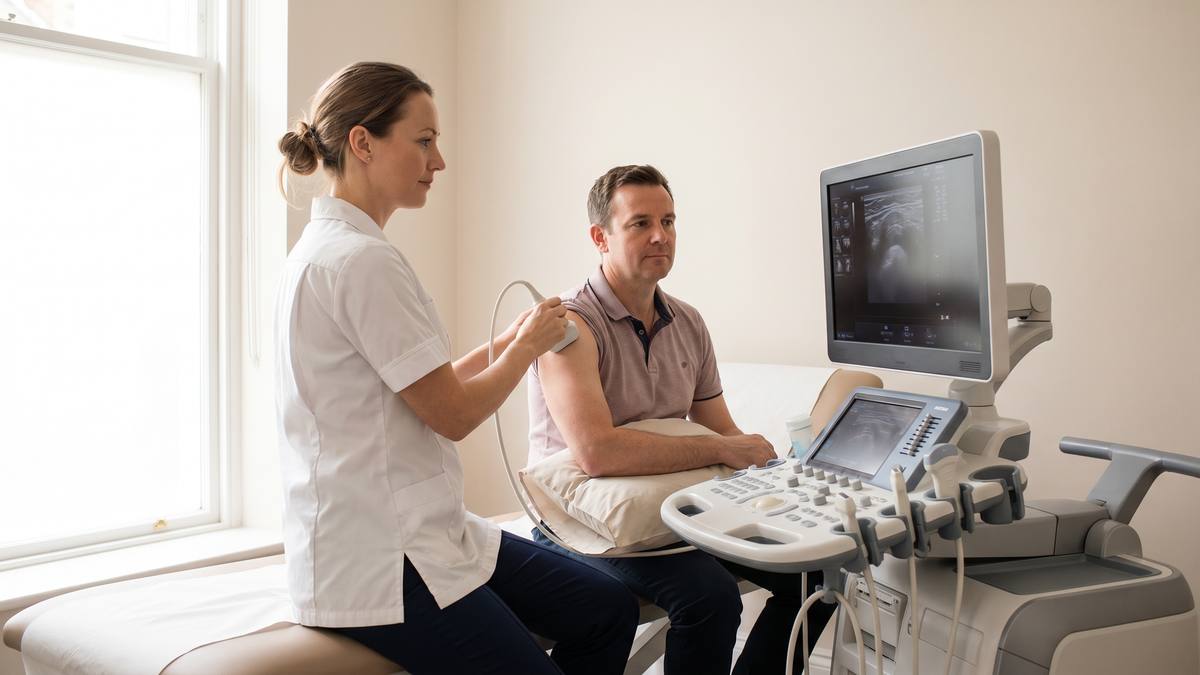
Ultrasound helps when the diagnosis is unclear, particularly to check whether the
rotator cuff, the group of tendons around the shoulder, is torn. A cuff tear can also
cause pain and weakness and is treated differently.
What Does Ultrasound Show in Frozen Shoulder?
Ultrasound shows the rotator cuff and the soft tissues around the joint, and it lets
the sonographer watch the shoulder move. In frozen shoulder, studies have found thickening of the coracohumeral ligament, a band at the front and top of the shoulder. They have also found changes in the rotator interval, the gap between two of the cuff tendons, and restricted movement on a moving scan. Ultrasound can also guide an injection
into the right place.
Which Treatment Works for Frozen Shoulder?
The 2025 BESS pathway reviewed the evidence for each option. Painkillers such as
paracetamol or ibuprofen, heat packs and gentle exercises can help day to day, as the
NHS describes. For more lasting treatment:
| Treatment | What the 2025 BESS pathway says | At Sonoworld |
|---|
| Steroid injection (low volume) | Consider for short-term symptom control. Benefit is not seen beyond 3 months | Yes, ultrasound-guided, from £250 |
| Physiotherapy after an injection | Consider; may give a low-risk short-term benefit | Through your physiotherapist |
| Physiotherapy on its own | Not enough evidence to recommend it over natural recovery | Through your physiotherapist |
| Hydrodilatation (high-volume injection to stretch the capsule) | Evidence supports it over physiotherapy for short- to medium-term pain and movement | Not offered |
| Manipulation under anaesthetic | A viable option, chosen through shared decision-making | Hospital treatment |
| Keyhole capsular release | Shared decision-making first; no better improvement at 12 months than the alternatives | Hospital treatment |
Our guide to ultrasound-guided injections
explains why guidance helps place an injection accurately.
How Do We Scan and Treat Frozen Shoulder?
From our MSK clinic
- What the report covers: whether the rotator cuff is intact, the coracohumeral ligament and rotator interval, and any restriction of movement we see while scanning the shoulder as it moves.
- X-ray first if you have not had one: the report recommends an X-ray to rule out arthritis, if you have not already had one.
- Treatment we offer: an ultrasound-guided steroid (cortisone) injection, from £250. We do not offer hydrodilatation.
This describes how Sonoworld scans and treats the shoulder. Your GP, physiotherapist
or specialist will help you choose the treatment that suits you.
Frequently Asked Questions
Can an ultrasound diagnose frozen shoulder?
Frozen shoulder is diagnosed from your history and an examination, mainly a marked loss of outward rotation. Ultrasound supports the diagnosis and, most usefully, checks whether the rotator cuff is torn, which can cause similar pain. It can also show thickening of the ligament at the front of the shoulder and restricted movement during a moving scan.
Should I have a steroid injection for frozen shoulder?
It can help with pain. The 2025 BESS pathway says a low-volume steroid injection should be considered for short-term symptom control, although the benefit is not seen beyond 3 months, and that physiotherapy afterwards may add a short-term benefit. Discuss the risks and benefits with your doctor, especially if you have diabetes. We offer ultrasound-guided injections from £250.
Do you offer hydrodilatation for frozen shoulder?
No. Hydrodilatation is a high-volume injection that stretches the joint capsule, and the 2025 BESS pathway found evidence for it over physiotherapy in the short to medium term. We do not offer it at Sonoworld. Your GP or a shoulder specialist can tell you where it is available. We offer ultrasound-guided steroid injections from £250.
How long does frozen shoulder last?
Frozen shoulder gets better on its own, but the NHS says it can take months or years. The pain and stiffness usually go eventually. Treatment such as a steroid injection, physiotherapy, or hospital procedures in some cases aims to ease pain and improve movement sooner. See your GP if the pain and stiffness are not going away.
Is frozen shoulder linked to diabetes?
Yes. Diabetes is the strongest known link. In the evidence reviewed by the British Elbow and Shoulder Society, about 10.8% of people with diabetes developed frozen shoulder, compared with 2.3% of people without diabetes. It is also linked with an underactive thyroid and some other conditions. If you have diabetes, mention it before any steroid injection.
Do I need an X-ray for frozen shoulder?
An X-ray helps rule out other causes of a stiff, painful shoulder, such as arthritis, when the diagnosis is uncertain. If you have not had one, our report recommends it. BESS notes that in people over 40, a tumour can occasionally be mistaken for frozen shoulder, which is another reason imaging may be advised.
Book a shoulder ultrasound
£235, no GP referral needed. Instant verbal results; written report within 24 hours. Ultrasound-guided cortisone injections from £250, discussed after the scan.
Book a shoulder scan
29 Weymouth Street, London W1G 7DB · 020 3633 4902 · Ultrasound-guided cortisone injection
Sources
This guide is general information and does not replace individual medical advice.
Sonoworld Diagnostic Services Limited is registered with the Care Quality Commission:
see our CQC registration.