
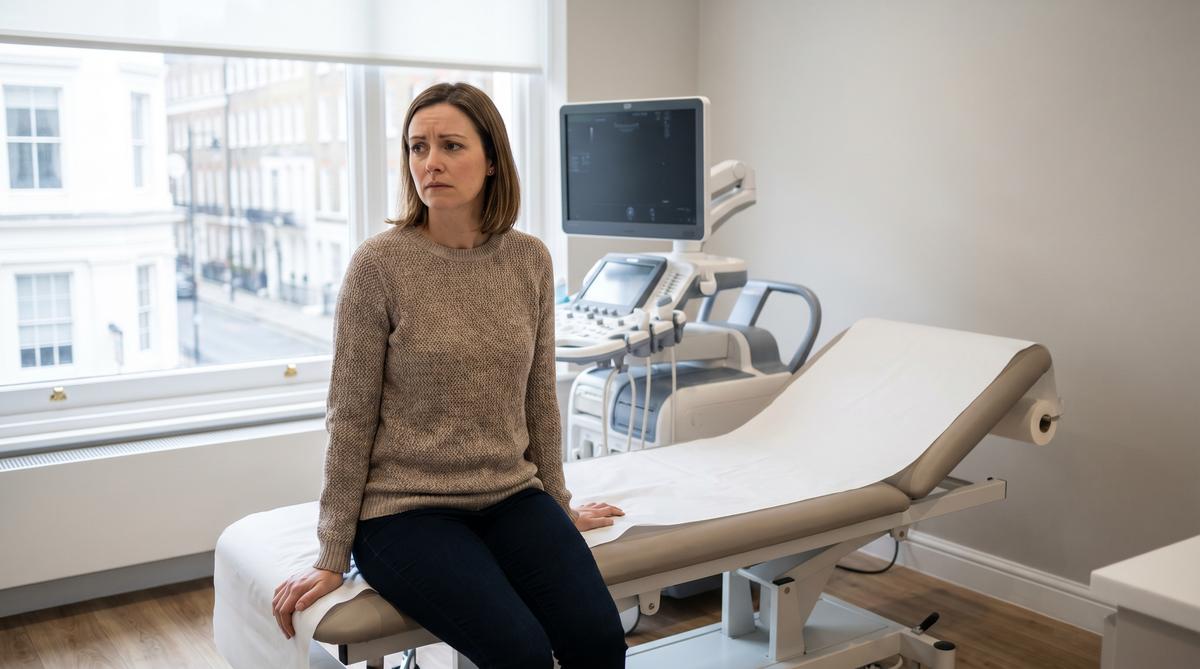
Pelvic Pain: Do I Need an Ultrasound Scan?
A consultant sonographer explains the threshold for investigation, what an ultrasound can and cannot find, and the specific symptoms that should not wait.
- Sudden, severe pelvic pain on one side — especially with nausea, vomiting, or feeling faint — go to A&E or call 999. This can be a twisted ovary (torsion) or a ruptured cyst.
- Pelvic pain or bleeding when you are, or could be, pregnant — an ectopic pregnancy must be excluded urgently. Seek same-day review through your GP, NHS 111, or your nearest early pregnancy unit.
- Women's Health
- Pelvic Ultrasound
- Updated July 2026
The Short Answer
Pelvic pain that keeps returning, is worsening, or is disrupting your work, sleep, or daily life deserves investigation. A pelvic ultrasound scan is the standard first-line test for most gynaecological causes of pelvic pain, and it is available privately at Sonoworld without a GP referral, with same-day appointments and verbal results in the room.
The harder question is not "should I get a scan?" but "when?" This guide sets out the threshold clearly, explains what an ultrasound can and cannot find, and describes the specific symptoms that should not wait for a routine appointment.
When Should You Get a Pelvic Ultrasound?
The threshold for a pelvic ultrasound is not severity alone. Sudden, severe pain is an emergency (see the box above). But the more common scenario is persistent, moderate pain — the kind that comes and goes, is hard to describe, and has been present for weeks or months. This is exactly the type of pain that warrants investigation, and that is often left too long without one.
Consider a pelvic ultrasound if you have any of the following:
- Pelvic or lower abdominal pain that has lasted more than two weeks
- Pain that recurs at the same point in your menstrual cycle
- Pain during or after sexual intercourse (dyspareunia)
- Pelvic pain alongside abnormal or irregular bleeding — see our guide to abnormal and postmenopausal bleeding
- A feeling of pressure, heaviness, or bloating in the lower abdomen — see our guide to bloating and abdominal swelling in women
- Pain alongside urinary symptoms (frequency, urgency, or pain on urination)
- A known history of ovarian cysts, fibroids, or endometriosis that has not been recently reviewed
- Pelvic pain in the context of fertility concerns or difficulty conceiving
You do not need to have all of these. One persistent, unexplained symptom that is affecting your quality of life is sufficient reason to investigate.
What Causes Pelvic Pain? What the Scan Is Looking For
Not all pelvic pain is gynaecological. Alongside the ovaries and uterus, the pelvis contains the bladder, the lower bowel, and the pelvic floor muscles — all of which can generate pain that feels identical on the surface. A pelvic ultrasound helps untangle these possibilities by imaging the gynaecological organs directly.
Gynaecological Causes
| Condition | What the Scan Shows | Notes |
|---|---|---|
| Ovarian cyst | Fluid-filled structure on or within the ovary; size, wall characteristics, internal features | Most are functional and resolve without treatment; complex cysts need follow-up or referral |
| Endometriosis | Endometriomas (chocolate cysts) on the ovaries; may show adhesions indirectly | Ultrasound does not detect all endometriosis — superficial implants are not visible |
| Fibroids (uterine leiomyomata) | Solid masses within or on the uterine wall; size, number, and location mapped | Very common; most are benign; location determines symptoms and treatment options |
| Pelvic inflammatory disease (PID) | Thickened, fluid-filled fallopian tubes; free fluid in the pelvis | PID requires antibiotic treatment; ultrasound confirms severity |
| Ovarian torsion | Enlarged ovary; absent or reduced blood flow on Doppler | Surgical emergency — go to A&E, not a private clinic |
| Adenomyosis | Enlarged, globular uterus; heterogeneous myometrium; asymmetric thickening | Often underdiagnosed; experienced sonographer assessment is important |
| Uterine polyps | Small echogenic lesions within the uterine cavity | Commonly found alongside irregular bleeding |
| Ectopic pregnancy | Empty uterus; adnexal mass; free fluid in pelvis | Emergency — seek same-day review if pregnant or possibly pregnant |
Non-Gynaecological Causes Ultrasound Can Also Assess
A pelvic ultrasound also images the bladder and, to a degree, the lower urinary tract. Bladder stones, a thickened bladder wall, or significant post-void residual urine can all be identified. Bowel pathology is generally not well-visualised on pelvic ultrasound, but the scan can identify free fluid or other indirect signs that prompt further investigation.
What Ultrasound Cannot Find
Ultrasound sees structure. It does not detect microscopic disease, superficial endometriosis implants, or early-stage ovarian cancer with certainty. A completely normal pelvic ultrasound is genuinely reassuring — it rules out the major structural causes — but it does not rule out everything. Persistent symptoms after a normal scan are a reason to go back to your GP with the report, not to go quiet.
What Happens During a Pelvic Ultrasound?
A pelvic ultrasound at Sonoworld normally has two parts. For a full description of the procedure — including what the transvaginal component involves, whether it hurts, and what is normal afterwards — see our detailed guide: Transvaginal Ultrasound: Your Questions Answered.
In brief:
- Transabdominal scan: Performed over the lower abdomen with a full bladder. Gives an overview of the uterus, ovaries, and pelvis.
- Transvaginal scan: Performed with an empty bladder using a slim internal probe. Gives detailed close-up images of the uterus and ovaries. This is the most informative part of the examination for most gynaecological symptoms.
The appointment takes 20–30 minutes. You receive verbal results during the scan, and a written report is sent to you within 24 hours. No GP referral is required.
To book a pelvic scan: Book Pelvic Ultrasound Scan — £235
From Our Practice
The pattern we see most often is a woman who has had pelvic pain for three to six months, has attributed it to her cycle, and has not sought investigation because the pain is not constant. By the time she books, the pain has become predictable enough that she knows exactly which days of the month will be difficult — but she has never had it explained.
In the majority of these cases, the scan finds something straightforward: a functional ovarian cyst that has persisted longer than expected, a small fibroid that was never identified, or a uterus with features consistent with adenomyosis. None of these findings are emergencies. All of them are answers — and an answer, even a non-urgent one, changes how a patient manages her symptoms and what she asks her GP for next.
The second pattern is the patient who has already been told by her GP that her pain is "probably just IBS" or "hormonal." She books because the pain has not improved. In a meaningful proportion of these cases, the scan identifies a gynaecological cause that was not previously investigated. The scan does not replace the GP's assessment — but it adds structural information that the GP did not have.
The third pattern is the patient who arrives convinced the scan will find something serious. In the majority of cases, it does not. A normal scan is not a wasted appointment — it is a clinical answer that allows the patient to stop worrying about the structural causes and focus on what is actually driving the symptoms.
Observations above are drawn from composite patterns across our patient population, not from any individual case. They are intended to illustrate typical clinical scenarios, not to provide advice about any specific patient's situation.
Symptoms That Should Not Wait for a Routine Appointment
The following symptoms warrant same-day medical assessment — through your GP, NHS 111, or A&E — rather than a booked private scan:
- Sudden, severe pelvic pain, especially one-sided, with nausea, vomiting, or faintness
- Pelvic pain or vaginal bleeding when you are, or could be, pregnant
- Fever alongside pelvic pain (possible PID or appendicitis)
- Pelvic pain with heavy, uncontrolled vaginal bleeding
- Pelvic pain with inability to pass urine
For these presentations, a private clinic appointment is not the right first step. Go to A&E or call 999 for sudden severe pain; call NHS 111 or your GP for same-day assessment of the others.
NHS vs Private Pelvic Ultrasound
On the NHS, a pelvic ultrasound requires a GP referral and is subject to waiting times that currently average 8–14 weeks for non-urgent diagnostic imaging in many areas of England. A private pelvic ultrasound at Sonoworld is available with same-day or next-day appointments, no GP referral, and verbal results in the room. The price is £235, all-inclusive.
The practical difference is time. For symptoms that are persistent but not urgent, a private scan means an answer this week rather than in three months. The written report can be shared with your GP to inform any further management.
For a full comparison of costs across scan types, see: How Much Does a Private Ultrasound Scan Cost?
Pelvic Pain FAQs
Can a pelvic ultrasound detect endometriosis?
Pelvic ultrasound can detect endometriomas — the ovarian cysts associated with endometriosis — and can identify some features of deep infiltrating endometriosis in experienced hands. However, it cannot detect superficial peritoneal implants, which are only visible at laparoscopy. A normal ultrasound does not rule out endometriosis. If symptoms are strongly suggestive, a normal scan should be followed up with a gynaecology referral rather than accepted as a final answer.
Can a pelvic ultrasound detect ovarian cancer?
Pelvic ultrasound can identify ovarian masses and characterise their features — size, whether they are solid or cystic, wall characteristics, and vascularity. These features help risk-stratify a mass, but ultrasound cannot confirm or exclude ovarian cancer with certainty. A suspicious ovarian mass on ultrasound will be referred for further assessment, typically including a CA-125 blood test and specialist review. Always seek individual professional advice if you are concerned about ovarian cancer symptoms.
Do I need a GP referral for a private pelvic ultrasound?
No. At Sonoworld you can self-refer — your symptoms are the clinical indication. You do not need a GP letter or referral. The written report is sent directly to you, and you can choose whether to share it with your GP or another clinician.
How should I prepare for a pelvic ultrasound?
Arrive with a comfortably full bladder — drink approximately one litre of water one hour before your appointment and do not empty your bladder before arriving. This is for the first (transabdominal) part of the scan. You will be asked to empty your bladder before the transvaginal part. For full preparation instructions, see our guide: How to Prepare for Your Ultrasound Scan.
How much does a private pelvic ultrasound cost?
A pelvic ultrasound at Sonoworld costs £235, all-inclusive. This covers the consultation, the scan (both transabdominal and transvaginal components), verbal results during the appointment, and a written report within 24 hours. There are no separate charges for the report or images.
Can I have a pelvic ultrasound while on my period?
Yes. A pelvic ultrasound can be performed at any point in your cycle, including during your period. Remove a tampon before the transvaginal part of the scan. If bleeding is heavy, just inform the sonographer — an absorbent pad is placed on the couch and the scan proceeds as normal.
Sources
- National Institute for Health and Care Excellence. Endometriosis: diagnosis and management (NG73). NICE, 2017. nice.org.uk/guidance/ng73
- Royal College of Obstetricians and Gynaecologists. The Initial Management of Chronic Pelvic Pain (Green-top Guideline No. 41). RCOG, 2012. rcog.org.uk
- NHS. Pelvic pain. Accessed July 2026. nhs.uk/conditions/pelvic-pain
- Sonoworld clinical imaging team. Composite practice patterns — Sonoworld Diagnostic Services, Marylebone, London. July 2026.
Book a Pelvic Ultrasound Scan
£235 all-inclusive. Same-day appointments available. No GP referral needed. Verbal results in the room, written report within 24 hours.
29 Weymouth Street, Marylebone, London W1G 7DB | 020 3633 4902