Written by Daniela Stan MSc Medical Ultrasound, Consultant Sonographer & Clinical Director, Sonoworld London. Reviewed July 2025.
How each test works
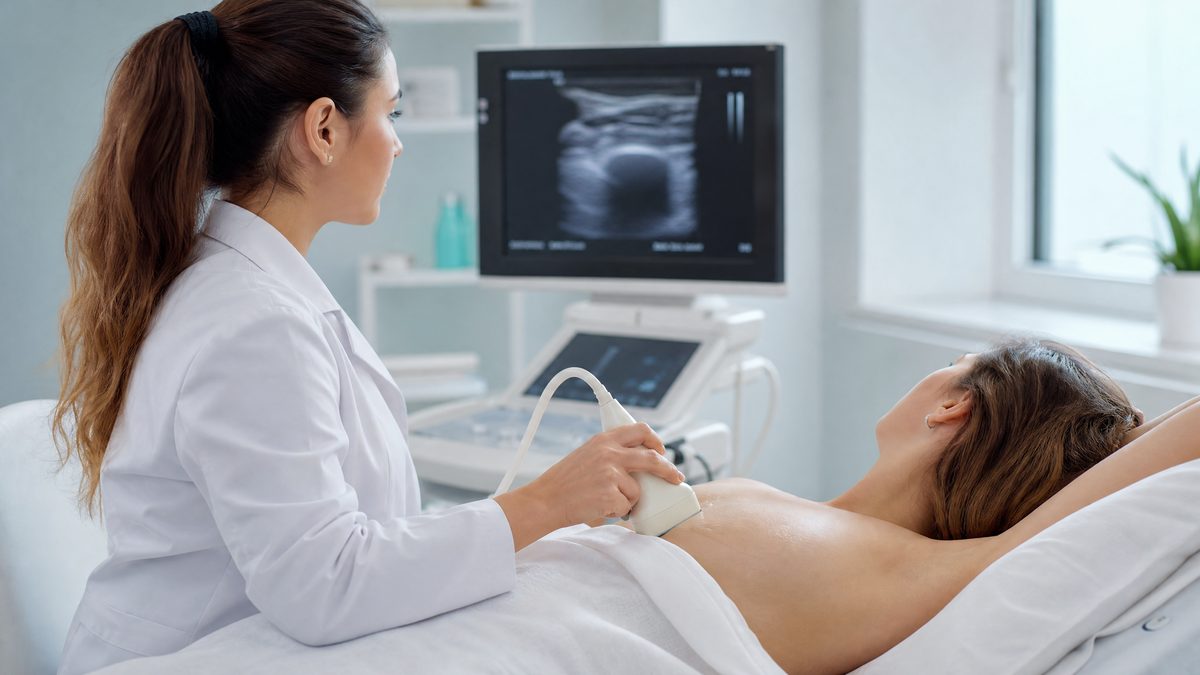
Breast ultrasound uses high-frequency sound waves to produce real-time images of breast tissue. A handheld transducer is moved across the skin surface, and the reflected sound waves are processed into a detailed image. There is no radiation, no compression, and no discomfort for most patients.
Mammography uses low-dose X-rays to produce images of the breast. The breast is compressed between two plates to spread the tissue and reduce the radiation dose required. The compression can be uncomfortable, particularly in women with dense or tender breast tissue.
What each test shows
The two tests have complementary strengths:
Mammography is highly sensitive for microcalcifications — tiny calcium deposits that can be an early sign of ductal carcinoma in situ (DCIS). It is the gold standard for population screening in women over 50.
Breast ultrasound is superior for characterising masses — distinguishing solid from cystic lesions, and providing detailed morphological assessment of solid nodules. It is also more sensitive than mammography in women with dense breast tissue.
Breast ultrasound vs mammogram: key differences
Factor
Breast Ultrasound
Mammogram
Technology
Sound waves
X-ray (low dose)
Radiation
None
Low dose
Compression
Not required
Required — can be uncomfortable
Best for
Masses, cysts, dense breast tissue, targeted assessment
Microcalcifications, population screening, overall breast survey
Dense breast tissue
Highly effective
Reduced sensitivity
Age group
All ages, including under 40
Primarily 40+ (NHS screening from 50)
Pregnancy
Safe
Not recommended
Availability at Sonoworld
Yes — from £235
Not available at Sonoworld
When is breast ultrasound preferred?
Breast ultrasound is the preferred first-line investigation in the following situations:
Women under 40: Dense breast tissue in younger women reduces mammographic sensitivity. Ultrasound is more informative.
A palpable lump: Ultrasound provides targeted assessment of a specific area of concern and can immediately distinguish a cyst from a solid mass.
Dense breast tissue on mammogram: Women with category C or D density on mammogram benefit from supplemental ultrasound.
Pregnancy or breastfeeding: Ultrasound is safe; mammography is avoided.
Breast implants: Ultrasound can assess breast tissue around and adjacent to implants without the compression required for mammography.
Follow-up of a known cyst or nodule: Ultrasound is the appropriate modality for monitoring a previously identified lesion.
Can they be used together?
Yes — and in many clinical scenarios, they should be. The combination of mammography and ultrasound has higher sensitivity for breast cancer than either test alone. Women with dense breast tissue who have a normal mammogram are increasingly offered supplemental ultrasound as part of their screening pathway.
At Sonoworld, we perform targeted breast ultrasound. If you have had a mammogram and been advised to have an ultrasound, or if you have a specific area of concern, we can provide a same-day appointment.
From Our Practice
The most common scenario we see is a woman in her 30s or early 40s who has found a lump and been told by her GP to have an ultrasound rather than a mammogram. This is the correct clinical pathway — ultrasound is more informative than mammography in younger women with dense tissue, and it provides an immediate answer: the lump is a simple cyst, a fibroadenoma, or something that needs further assessment. In the vast majority of cases, the finding is benign, and the patient leaves with genuine reassurance.
Frequently asked questions
Does Sonoworld offer mammography?
No. Sonoworld specialises in diagnostic ultrasound. We do not offer mammography. If you require a mammogram, your GP can refer you to an NHS or private radiology department.
How much does a breast ultrasound cost at Sonoworld?
A breast ultrasound scan at Sonoworld costs £235, all-inclusive. This includes the scan, verbal results at the end of the appointment, and a written report within 24 hours. Book online.
Do I need a GP referral?
No. You can book directly without a GP referral.
Sonoworld is registered with the Care Quality Commission (CQC). Our sonographers are registered with HCPC and are members of BMUS. All scans are performed at our Marylebone clinic: 29 Weymouth Street, London W1G 7DB.
Book Your Breast Ultrasound Scan at Sonoworld
Same-day and next-day appointments available at our Marylebone clinic. Instant verbal results. Written report within 24 hours. No GP referral required.